


A dual initiator approach for oxygen tolerant RAFT polymerization
文献信息
发布日期
2022-08-08
DOI
10.1039/D2PY00603K
影响因子
5.582
作者
Nicholas G. Taylor, Marcus H. Reis, Travis P. Varner, Johann L. Rapp, Alexis Sarabia, Frank A. Leibfarth
查看原文
摘要
Reversible-deactivation radical polymerizations are privileged approaches for the synthesis of functional and hybrid materials. A bottleneck for conducting these processes is the need to maintain oxygen free conditions. Herein we report a broadly applicable approach to “polymerize through” oxygen using the synergistic combination of two radical initiators having different rates of homolysis. The in situ monitoring of the concentrations of oxygen and monomer simultaneously provided insight into the function of the two initiators and enabled the identification of conditions to effectively remove dissolved oxygen and control polymerization under open-to-air conditions. By understanding how the surface area to volume ratio of reaction vessels influence open-to-air polymerizations, well-defined polymers were produced using acrylate, styrenic, and methacrylate monomers, which each represent an expansion of scope for the “polymerizing through” oxygen approach. Demonstration of this method in tubular reactors using continuous flow chemistry provided a more complete structure–reactivity understanding of how reaction headspace influences PTO RAFT polymerizations.
期刊推荐

Chemistry Education Research and Practice
Russian Chemical Bulletin
Organic Process Research & Development

Current Opinion in Solid State & Materials Science
New Journal of Chemistry
Russian Journal of General Chemistry
Russian Journal of Organic Chemistry
Russian Journal of Applied Chemistry

Acta Materialia
Russian Journal of Coordination Chemistry
相关文献
Intermediate length-scale chirality related to the vibrational circular dichroism intensity enhancement upon fibril formation in a gelation process
Hajime Torii, Hisako Sato
2018-05-14
Communication
DOI: 10.1039/C8CP02121J
Tuning nuclear depolarization under MAS by electron T1e
Alicia Lund, Asif Equbal
2018-09-05
Paper
DOI: 10.1039/C8CP04167A
Multiple binding modes of a moderate ice-binding protein from a polar microalga
Maddalena Bayer-Giraldi
2018-09-13
Paper
DOI: 10.1039/C8CP04727H
Zn-Porphyrin propped with hydantoin anchor: synthesis, photophysics and electron injection/recombination dynamics
Poomani Ram Kumar, Ebrahim M. Mothi, Mohan Ramesh, Arunkumar Kathiravan
2018-01-18
Paper
DOI: 10.1039/C7CP07326G
Competitor analysis of functional group H-bond donor and acceptor properties using the Cambridge Structural Database
James McKenzie, Christopher A. Hunter
2018-09-26
Paper
DOI: 10.1039/C8CP05470C
Molecular investigation of evaporation of biodroplets containing single-strand DNA on graphene surface
Fahimeh Akbari, Masumeh Foroutan
2018-01-15
Paper
DOI: 10.1039/C7CP07932J
Photoelectron spectroscopy and thermochemistry of o-, m-, and p-methylenephenoxide anions
Daniel J. Nelson, Wilson K. Gichuhi, Charles M. Nichols, Veronica M. Bierbaum, W. Carl Lineberger
2018-09-20
Paper
DOI: 10.1039/C8CP05403G
Importance of protein flexibility in molecular recognition: a case study on Type-I1/2 inhibitors of ALK
Huiyong Sun, Peichen Pan, Feng Zhu, Shan Chang, Lei Xu, Youyong Li
2018-01-16
Paper
DOI: 10.1039/C7CP08241J
The influence of interactions between isotopoloques on coherent, ultrafast vibrational dynamics of liquid C2Cl4
B. Ratajska-Gadomska, W. Gadomski, J. Konarska, K. Polok
2018-01-15
Paper
DOI: 10.1039/C7CP07928A
Insight into the local near-infrared photothermal dynamics of graphene oxide functionalized polymers through optical microfibers
Yunyun Huang, Chaoyan Chen, Hongtao Li, Aoxiang Xiao, Tuan Guo, Bai-Ou Guan
2018-01-20
Paper
DOI: 10.1039/C7CP07915J
您可能还喜欢
化合物问答
3 - (二氟甲基)-1 -氟苯(CAS号:26029-52-7)适用哪些法规指南?
3 - (二氟甲基)-1 -氟苯需遵循联合国全球化学品统一分类和标签制度(GHS),包括急性毒性、皮肤腐蚀/刺激、严重眼损伤/眼刺激等分类。同时,该化合物还需符...
26029-52-71-(Difluoromethyl)-3...
化合物问答
3,5-二甲基苯胺(CAS号:108-69-0)通常如何合成?
3,5-二甲基苯胺通常通过乙苯的氨解反应合成。反应中使用硫酸作为催化剂,反应温度为120-130°C。乙苯在硫酸存在下与氨反应,生成3,5-二甲基苯胺和苯胺副产...
108-69-03,5-Dimethylaniline
化合物问答
3-甲基异噻唑-5-胺(CAS号:24340-76-9)安全吗?
3-甲基异噻唑-5-胺在适当使用和储存条件下是相对安全的,但在操作时应注意防护措施。应避免吸入粉尘,避免与皮肤和眼睛直接接触。在操作过程中,应穿戴适当的防护装备...
24340-76-93-Methyl-1,2-thiazol...
化合物问答
3-(1,3-Thiazol-2-yl)-1H-indole(CAS号:135531-86-1)通常如何合成?
3-(1,3-噻唑-2-基)-1H-吲哚通常通过多步合成方法制备。首先,由噻唑-2-基溴化物和吲哚进行偶联反应,得到中间体。然后,通过还原反应将中间体转化为所需...
135531-86-13-(1,3-Thiazol-2-yl)...
化合物问答
4-溴-2-氟苯甲基氯(CAS号:85510-82-3)的主要用途是什么?
4-溴-2-氟苯甲基氯主要用于有机合成中间体,特别是在医药、农药和染料等领域。作为一种具有特定结构的化合物,它在合成复杂有机分子时扮演重要角色。
85510-82-34-Bromo-1-(chloromet...
化合物问答
处理Fmoc-β-(3-噻吩基)-D-Ala-OH(CAS号:220497-90-5)时应注意哪些实验室安全事项?
处理Fmoc-β-(3-噻吩基)-D-Ala-OH时,应佩戴防护手套、护目镜和实验服。操作应在通风橱内进行。如发生泄露,应立即用大量水冲洗,并通知实验室管理人员...
220497-90-5N-[(9H-Fluoren-9-ylm...
化合物问答
氮化硅(CAS号:12033-89-5)通常如何合成?
氮化硅通常通过氮化硅的直接反应合成,即在高温下将四氯化硅与氨气反应。具体步骤是将四氯化硅和氨气混合并加热至1300-1700℃,在该条件下,四氯化硅与氨气反应生...
12033-89-5Trisilicon tetranitr...
化合物问答
Cetirizine EP Impurity B DiHCl(CAS号:1000690-91-4)通常如何合成?
Cetirizine EP Impurity B DiHCl通常通过一锅法合成,首先将4-氯苯基-苯甲基氯甲酸酯与1-哌嗪乙酸反应,生成相应的酸,然后与盐酸反应...
1000690-91-4{4-[(4-Chlorophenyl)...
化合物问答
如何储存1-哌啶-4-基丁-1-酮(CAS号:3509-15-7)?
1-哌啶-4-基丁-1-酮应储存在阴凉、干燥的地方,避免阳光直射。存储容器应密封,并确保通风良好。建议储存温度不超过25℃,湿度保持在相对较低的水平。
3509-15-71-Piperidin-4-ylbuta...
化合物问答
如何处理含有VORUCICLIB(CAS号:1000023-04-0)的废料?
含有VORUCICLIB的废料应进行专业的收集和处理,包括使用适当的容器进行隔离,避免与其他化学品接触。处理方法通常包括化学中和、沉淀反应或吸附过程,随后进行焚...
1000023-04-02-[2-Chloro-4-(trifl...
来源期刊
Polymer Chemistry

CiteScore:
8.6
自引率:
7.3%
年发文量:
457
Polymer Chemistry welcomes submissions in all areas of polymer science that have a strong focus on macromolecular chemistry. Manuscripts may cover a broad range of fields, yet no direct application focus is required.
推荐化合物
![tert-Butyl N-[(2-chloropyridin-4-yl)methyl]carbamate structure](https://cnstatic.chemtradehub.com/structs/916/916210-27-0-9f95.webp "tert-Butyl N-[(2-chloropyridin-4-yl)methyl]carbamate structure")
![2,6-Bis({(2R)-2-[hydroxy(diphenyl)methyl]-1-pyrrolidinyl}methyl)-4-methylphenol structure](https://cnstatic.chemtradehub.com/structs/877/877395-58-9-70bf.webp "2,6-Bis({(2R)-2-[hydroxy(diphenyl)methyl]-1-pyrrolidinyl}methyl)-4-methylphenol structure")
![5-Methyl-4,5,6,7-tetrahydropyrazolo[1,5-a]pyrazin-2-amine structure](https://cnstatic.chemtradehub.com/structs/122/1227210-33-4-8d64.webp "5-Methyl-4,5,6,7-tetrahydropyrazolo[1,5-a]pyrazin-2-amine structure")
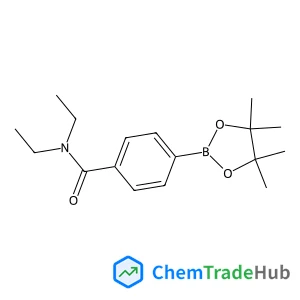
N,N-Diethyl-4-(4,4,5,5-tetramethyl-1,3,2-dioxaborolan-2-yl)benzamide
CAS号:
325142-99-2
分子式:
C17H26BNO3
推荐供应商



免责声明
本页面提供的学术期刊信息仅供参考和研究使用。我们与任何期刊出版商均无关联,也不处理投稿事宜。如有投稿相关咨询,请直接联系相关期刊出版商。
如发现页面信息有误,请发送邮件至 support@chemtradehub.com 联系我们。我们将及时核实并处理您的问题。