





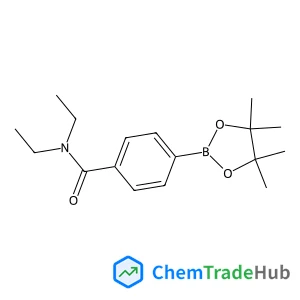
N,N-Diethyl-4-(4,4,5,5-tetramethyl-1,3,2-dioxaborolan-2-yl)benzamide
CAS号:
325142-99-2
分子式:
C17H26BNO3
Nicolas Illy, Emma Mongkhoun
Thiolactones are often described as latent thiols. They can be ring-opened by hydroxy or amine groups releasing thiols, which can further react with a large variety of functional groups. Based on this one-pot cascade reaction, versatile and powerful tools have been developed for macromolecular engineering. This review covers the different uses of γ-thiobutyrolactones in polymer chemistry either as thiolation agents, as linkers, as ring-opening polymerization monomers, as reactant in stepwise polymerization, as components of initiating systems, or as functional handles for double post-modification reactions.
S. Yoshioka, K. Tsuruta, T. Yamamoto, K. Yasuda, S. Matsumura, N. Ishikawa, E. Kobayashi
DOI: 10.1039/C7CP07591J
DOI: 10.1039/C8CP03480J
Yanli Ji, Xiaocha Wang, Wenbo Mi
DOI: 10.1039/C8CP04336A
Efracio Mamani Flores, Rogério Almeida Gouvea, Maurício Jeomar Piotrowski, Mário Lucio Moreira
DOI: 10.1039/C7CP08177D
Xiangkun Wu, Guoqiang Tang, Hanhui Zhang, Xiaoguo Zhou, Shilin Liu, Fuyi Liu, Liusi Sheng, Bing Yan
DOI: 10.1039/C7CP07502B
Panagiotis Krokidas, Salvador Moncho, Edward N. Brothers, Marcelo Castier, Ioannis G. Economou
DOI: 10.1039/C7CP08456K
Fernan Saiz, David Cubero, Nick Quirke
DOI: 10.1039/C8CP01330F
Jin Zhang, Wei-xiao Ji, Chang-wen Zhang, Ping Li, Pei-ji Wang
DOI: 10.1039/C8CP02649A
A. K. A. Lu, D. Chiappe
DOI: 10.1039/C8CP05665J
Timothy A. H. Burd, Xiao Shan, David C. Clary
DOI: 10.1039/C8CP05021J
3 - (二氟甲基)-1 -氟苯需遵循联合国全球化学品统一分类和标签制度(GHS),包括急性毒性、皮肤腐蚀/刺激、严重眼损伤/眼刺激等分类。同时,该化合物还需符...
3,5-二甲基苯胺通常通过乙苯的氨解反应合成。反应中使用硫酸作为催化剂,反应温度为120-130°C。乙苯在硫酸存在下与氨反应,生成3,5-二甲基苯胺和苯胺副产...
3-甲基异噻唑-5-胺在适当使用和储存条件下是相对安全的,但在操作时应注意防护措施。应避免吸入粉尘,避免与皮肤和眼睛直接接触。在操作过程中,应穿戴适当的防护装备...
3-(1,3-噻唑-2-基)-1H-吲哚通常通过多步合成方法制备。首先,由噻唑-2-基溴化物和吲哚进行偶联反应,得到中间体。然后,通过还原反应将中间体转化为所需...
4-溴-2-氟苯甲基氯主要用于有机合成中间体,特别是在医药、农药和染料等领域。作为一种具有特定结构的化合物,它在合成复杂有机分子时扮演重要角色。
处理Fmoc-β-(3-噻吩基)-D-Ala-OH时,应佩戴防护手套、护目镜和实验服。操作应在通风橱内进行。如发生泄露,应立即用大量水冲洗,并通知实验室管理人员...
氮化硅通常通过氮化硅的直接反应合成,即在高温下将四氯化硅与氨气反应。具体步骤是将四氯化硅和氨气混合并加热至1300-1700℃,在该条件下,四氯化硅与氨气反应生...
Cetirizine EP Impurity B DiHCl通常通过一锅法合成,首先将4-氯苯基-苯甲基氯甲酸酯与1-哌嗪乙酸反应,生成相应的酸,然后与盐酸反应...
1-哌啶-4-基丁-1-酮应储存在阴凉、干燥的地方,避免阳光直射。存储容器应密封,并确保通风良好。建议储存温度不超过25℃,湿度保持在相对较低的水平。
含有VORUCICLIB的废料应进行专业的收集和处理,包括使用适当的容器进行隔离,避免与其他化学品接触。处理方法通常包括化学中和、沉淀反应或吸附过程,随后进行焚...

Polymer Chemistry welcomes submissions in all areas of polymer science that have a strong focus on macromolecular chemistry. Manuscripts may cover a broad range of fields, yet no direct application focus is required.
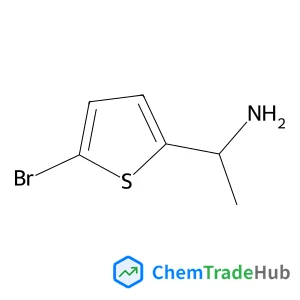
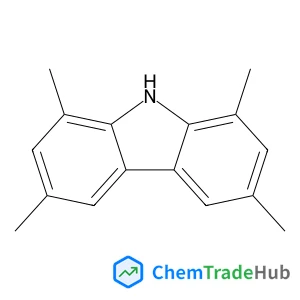
![6-Benzyl-4,5,6,7-tetrahydro-1H-pyrazolo[3,4-c]pyridin-3(2H)-one structure](https://cnstatic.chemtradehub.com/structs/909/909187-64-0-f54f.webp "6-Benzyl-4,5,6,7-tetrahydro-1H-pyrazolo[3,4-c]pyridin-3(2H)-one structure")
![tert-Butyl N-[(2-chloropyridin-4-yl)methyl]carbamate structure](https://cnstatic.chemtradehub.com/structs/916/916210-27-0-9f95.webp "tert-Butyl N-[(2-chloropyridin-4-yl)methyl]carbamate structure")





