








![2,2'-{2,2-Propanediylbis[(2,6-dibromo-4,1-phenylene)oxy]}diethanol structure](https://cnstatic.chemtradehub.com/structs/416/4162-45-2-b3d6.webp "2,2'-{2,2-Propanediylbis[(2,6-dibromo-4,1-phenylene)oxy]}diethanol structure")
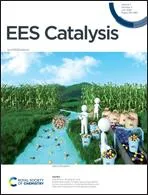
Cobalt-free layered perovskites RBaCuFeO5+δ (R = 4f lanthanide) as electrocatalysts for the oxygen evolution reaction
文献信息
发布日期
2023-10-31
DOI
10.1039/D3EY00142C
影响因子
0
作者
Jike Lyu, Maxime Leménager, N. Sena Yüzbasi, Dino Aegerter, Jinzhen Huang, Niéli D. Daffé, Adam H. Clark, Denis Sheptyakov, Thomas Graule, Maarten Nachtegaal, Ekaterina Pomjakushina, Matthias Krack, Emiliana Fabbri, Marisa Medarde
查看原文
摘要
Co-based perovskite oxides are intensively studied as promising catalysts for electrochemical water splitting in an alkaline environment. However, the increasing Co demand by the battery industry is pushing the search for Co-free alternatives. Here we report a systematic study of the Co-free layered perovskite family RBaCuFeO5+δ (R = 4f lanthanide), where we uncover the existence of clear correlations between electrochemical properties and several physicochemical descriptors. Using a combination of advanced neutron and X-ray synchrotron techniques with ab initio DFT calculations we demonstrate and rationalize the positive impact of a large R ionic radius in their oxygen evolution reaction (OER) activity. We also reveal that, in these materials, Fe3+ is the transition metal cation the most prone to donate electrons. We also show that similar R3+/Ba2+ ionic radii favor the incorporation and mobility of oxygen in the layered perovskite structure and increase the number of available O diffusion paths, which have an additional, positive impact on both, the electric conductivity and the OER process. An unexpected result is the observation of a clear surface reconstruction exclusively in oxygen-rich samples (δ > 0), a fact that could be related to their superior OER activity. The encouraging intrinsic OER values obtained for the most active electrocatalyst (LaBaCuFeO5.49), together with the possibility of industrially producing this material in nanocrystalline form should inspire the design of other Co-free oxide catalysts with optimal properties for electrochemical water splitting.
相关文献
Organocatalytic PET-RAFT polymerization with a low ppm of organic photocatalyst under visible light
Xun Zhang, Yu Jiang, Junqiang Lin, Siping Hu
2021-12-02
Paper
DOI: 10.1039/D1PY01431E
Synthesis of a bead-like multicyclic polymer by UV-induced coupling of an anthracene-telechelic monocyclic precursor and its reversible topological conversion
Hua-long Zhang, Wen Xu, Chao Liu
2021-08-30
Paper
DOI: 10.1039/D1PY00341K
Solvent-induced changes in the reactivity of tricyanate esters undergoing thermal polymerization
Andrey Galukhin, Ilya Nikolaev, Roman Nosov, Daut Islamov
2021-10-11
Paper
DOI: 10.1039/D1PY01088C
Synthesis and characterization of amide-bridged colorless polyimide films with low CTE and high optical performance for flexible OLED displays
Haiquan Guo, Lianxun Gao
2021-08-26
Paper
DOI: 10.1039/D1PY00762A
Structure–property relationships of core-substituted diaryl dihydrophenazine organic photoredox catalysts and their application in O-ATRP
Mariel J. Price, Katherine O. Puffer, Max Kudisch, Declan Knies, Garret M. Miyake
2021-09-28
Paper
DOI: 10.1039/D1PY01060C
Supramolecular dendrimer-containing layer-by-layer nanoassemblies for bioapplications: current status and future prospects
Cristiana F. V. Sousa, Eduardo Fernandez-Megia, João Borges, João F. Mano
2021-10-05
Review Article
DOI: 10.1039/D1PY00988E
Degradability, thermal stability, and high thermal properties in spiro polycycloacetals partially derived from lignin
Minjie Shen, Srikanth Vijjamarri, Hongda Cao, Karla Solis
2021-10-05
Paper
DOI: 10.1039/D1PY01017D
Amphiphilic diblock copolymers of poly(glycidol) with biodegradable polyester/polycarbonate. organocatalytic one-pot ROP and self-assembling property
Tingyu He, Atsushi Narumi, Yanqiu Wang, Liang Xu, Shin-ichiro Sato
2021-09-16
Paper
DOI: 10.1039/D1PY01026C
Visible light-responsive micelles enable co-delivery of nitric oxide and antibiotics for synergistic antibiofilm applications
Kewu He, Zhiqiang Shen, Zhenhua Chen, Bin Zheng, Sheng Cheng, Jinming Hu
2021-10-14
Paper
DOI: 10.1039/D1PY01137E
Design, synthesis and characterization of fused bithiazole- and dithiophene-based low bandgap thienylenevinylene copolymers
Dhananjaya Patra, Marc Comí, Xianhe Zhang, Gururaj P. Kini, Malsha Udayakantha, Alexander J. Kalin, Sarbajit Banerjee, Lei Fang, Xugang Guo, Mohammed Al-Hashimi
2021-09-30
Paper
DOI: 10.1039/D1PY00773D
您可能还喜欢
化合物问答
什么是5-Fluoro-4-iodo-2-methylaniline(CAS号:307306-08-7)?
5-氟-4-碘-2-甲氨基苯属于芳香族化合物,其分子式为C8H7FN2I。该化合物具有一定的反应活性,在有机合成和药物化学领域有一定的应用。
307306-08-75-Fluoro-4-iodo-2-me...
化合物问答
4-氟-3-硝基三氟甲苯(CAS号:367-86-2)通常如何合成?
4-氟-3-硝基三氟甲苯通常通过将三氟甲基苯在酸性条件下催化氧化为三氟甲基硝基苯,然后进行氟化反应得到目标化合物。该过程需要使用催化剂,如三氟乙酸,反应产率较高...
367-86-21-Fluoro-2-nitro-4-(...
化合物问答
6-氯-9-(2,3,5-三苯甲酰氧基-2-C-甲基-beta-D-呋喃核糖基)-9H-嘌呤(CAS号:205171-05-7)的物理化学性质是什么?
该化合物为白色至类白色晶体,分子量约为1046.95。它在水中几乎不溶,在有机溶剂如乙腈和甲醇中具有一定的溶解性。该化合物具有良好的化学稳定性和生物活性。
205171-05-76-Chloro-9-(2-C-meth...
化合物问答
如何储存6-氟喹啉-4-羧酸(CAS号:220844-73-5)?
6-氟喹啉-4-羧酸应储存在阴凉、干燥、通风良好的地方,避免阳光直射。储存在密闭容器中,避免与空气中的水分接触。储存温度应控制在室温以下,避免高温。
220844-73-56-Fluoroquinoline-4-...
化合物问答
(2S,2'S,3S,3'S)-3,3'-di-tert-butyl-4,4'-bis(2,6-dimethoxyphenyl)-2,2',3,3'-tetrahydro-2,2'-bibenzo[d][1,3]oxaphosphole(CAS号:1435940-21-8)通常如何合成?
该化合物通常通过芳香族化合物的亲核取代反应合成,首先将2,6-二甲氧基苯基引入到双环结构中,然后通过特定条件下的还原或氧化反应引入二叔丁基。反应过程中使用了钯作...
1435940-21-8(2S,2'S,3S,3'S)-4,4'...
化合物问答
如何储存KY02111(CAS号:1118807-13-8)?
KY02111应储存于阴凉、干燥、通风良好的地方,避免阳光直射和高温环境。应使用合适的密闭容器储存,并确保容器密封良好,防止水分和潮气进入。在储存期间,应注意检...
1118807-13-8N-(6-chlorobenzo[d]t...
化合物问答
如何储存4-(4-氯苯氧基)丁酸乙酯(CAS号:59227-79-1)?
4-(4-氯苯氧基)丁酸乙酯应储存在阴凉、干燥、通风良好的地方,远离火源和热源。避免阳光直射,防止容器破裂导致泄漏。储存时应保持容器密封,避免与空气中的水蒸气接...
59227-79-1Ethyl 4-(4-chlorophe...
化合物问答
4-庚基苯乙酮(CAS号:37593-03-6)安全吗?
4-庚基苯乙酮相对安全,但在使用和储存时仍需注意。应避免吸入其蒸气,避免皮肤接触,使用时需佩戴防护眼镜和手套。储存时应远离火源和热源,保持容器密封,放置于阴凉、...
37593-03-61-(4-Heptylphenyl)et...
化合物问答
什么是乙基2-氨基-4-(3-溴苯基)噻吩-3-羧酸乙酯(CAS号:438218-48-5)?
乙基2-氨基-4-(3-溴苯基)噻吩-3-羧酸乙酯是一种有机化合物,分子式为C16H12BrN2O2S。它是一种含有噻吩环、氨基、溴苯基和羧酸酯结构的化合物。这...
438218-48-5ethyl 2-amino-4-(3-b...
化合物问答
什么是(9ci)-2-氨基-6-甲基-苯甲酰胺(CAS号:1885-31-0)?
(9ci)-2-氨基-6-甲基-苯甲酰胺是一种化学化合物,其英文名称为2-Amino-6-methylbenzamide,CAS号为1885-31-0。该化合物...
1885-31-02-Amino-6-methylbenz...
来源期刊
推荐化合物
![N-[(E)-Phenylmethylene]benzenesulfonamide structure](https://cnstatic.chemtradehub.com/structs/139/13909-34-7-8167.webp "N-[(E)-Phenylmethylene]benzenesulfonamide structure")
![2-{[4-(2-Methoxyethyl)phenoxy]methyl}oxirane structure](https://cnstatic.chemtradehub.com/structs/567/56718-70-8-f037.webp "2-{[4-(2-Methoxyethyl)phenoxy]methyl}oxirane structure")
推荐供应商




免责声明
本页面提供的学术期刊信息仅供参考和研究使用。我们与任何期刊出版商均无关联,也不处理投稿事宜。如有投稿相关咨询,请直接联系相关期刊出版商。
如发现页面信息有误,请发送邮件至 support@chemtradehub.com 联系我们。我们将及时核实并处理您的问题。