









Highly efficient oil-fouling and foam removal achieved by surfactant mixed systems
文献信息
发布日期
2023-09-28
DOI
10.1039/D3LF00145H
影响因子
0
作者
Jiling Yue
查看原文
摘要
Excessive usage of surfactants in daily life and industry and their undesirable high foamability have caused serious environmental pollution and economic loss. Improving cleaning efficiency and reducing foam stability concurrently is a delicate strategy but a challenging task. Herein, we mixed the most widely used surfactant sodium dodecyl sulfate (SDS) with cyclic amines (CnN, n = 6, 8, 12), by which the self-assembly ability of SDS at the air/water interface and in bulk is significantly enhanced, while spherical micelles, vesicles and wormlike micelles are formed at appropriate total surfactant concentration (CT) and molar fraction of SDS (XSDS). Especially around XSDS = 0.50 and above critical micellar concentration (CMC), the stronger self-assembly ability leads to a higher contact angle of machine oil on stainless-steel plates and lower oil–water interfacial tension in CnN/SDS solution, thus the oil-fouling removal efficiency of CnN/SDS solutions is remarkably improved. Meanwhile, the foamability and foam stability dramatically decline at smaller XSDS and slightly above CMC, attributed to the rapid molecular migration from liquid film of foams to the bulk between the films when the limited surfactant molecules in the films prefer to aggregate in bulk. As a result, C8N/SDS exhibits the best oil cleaning and lowest foaming simultaneously at low XSDS and just above the CMC. This study opens an efficient avenue to eliminate the contradiction between cleaning ability and foamability, thereby obtaining a high-efficiency and low-foam detergent.
相关文献
Flexible enzymatic and chemo-enzymatic approaches to a broad range of uridine-diphospho-sugars
James C. Errey, Balaram Mukhopadhyay, K. P. Ravindranathan Kartha, Robert A. Field
2004-10-13
Communication
DOI: 10.1039/B410184G
Synthesis and characterization of multiferroic BiFeO3 nanotubes
Tae-Jin Park, Yuanbing Mao
2004-10-13
Communication
DOI: 10.1039/B409988E
Development of porous materials for heterogeneous catalysis: kinetic resolution of epoxides
Leilani L. Welbes, Robert C. Scarrow, A. S. Borovik
2004-10-05
Communication
DOI: 10.1039/B408553A
A new type of bromide anion conducting solid
Nobuhito Imanaka, Yasuhiro Kato
2003-05-02
Communication
DOI: 10.1039/B300691C
Chemistry of materials under extreme high pressure-high-temperature conditions
2003-03-27
Focus
DOI: 10.1039/B300963G
Synthesis and characterization of a benzene-centered, phthalocyanine hexamer
Giovanni Bottari, Tomás Torres
2004-10-14
Communication
DOI: 10.1039/B411960F
Synthesis of C-arylglycosides via Ru(ii)-catalyzed [2 + 2 + 2] cycloaddition
Yoshihiko Yamamoto, Tomoaki Saigoku, Takashige Ohgai, Hisao Nishiyama, Kenji Itoh
2004-10-07
Communication
DOI: 10.1039/B411442F
Thermosensitive PNIPAAm cryogel with superfast and stable oscillatory properties
Xian-Zheng Zhang, Chih-Chang Chu
2003-05-19
Communication
DOI: 10.1039/B301423A
Direction control in DNA binding of chiral d-lysine-based peptide nucleic acid (PNA) probed by electrospray mass spectrometry
Stefano Sforza, Tullia Tedeschi, Roberto Corradini, Arnaldo Dossena, Rosangela Marchelli
2003-04-02
Communication
DOI: 10.1039/B212718K
您可能还喜欢
化合物问答
如何处理含有8-氯咪唑并[1,2-A]吡嗪(CAS号:69214-33-1)的废料?
处理含有8-氯咪唑并[1,2-A]吡嗪的废料时,应首先将其收集并进行化学回收或降解。如果无法回收,需采用安全的化学处理方法,如中和、氧化还原或沉淀。处理过程中需...
69214-33-18-chloroimidazo[1,2-...
化合物问答
Calhex 231 hydrochloride(CAS号:2387505-78-2)适用哪些法规指南?
Calhex 231 hydrochloride 需要遵循《全球化学品统一分类和标签制度》(GHS)的分类和标签要求,以及欧盟的《化学品注册、评估、授权和限制条...
2387505-78-24-Chloro-N-[(1S,2S)-...
化合物问答
11-Beta,17-alpha,21-三羟基-5-beta-孕烯-3,20-二酮(CAS号:1482-50-4)的物理化学性质是什么?
11-Beta,17-alpha,21-三羟基-5-beta-孕烯-3,20-二酮是一种无色结晶性粉末,分子量为372.45 g/mol。该化合物在水中的溶解度...
1482-50-45β-Dihydrocortisol
化合物问答
处理5-异丙基-1,3,4-恶二唑-2-羧酸(CAS号:944907-13-5)时应注意哪些实验室安全事项?
处理5-异丙基-1,3,4-恶二唑-2-羧酸时应注意以下安全事项:穿戴适当的个人防护装备,包括实验室外套、手套和护目镜;操作应在通风橱中进行,以减少吸入或接触有...
944907-13-55-Isopropyl-1,3,4-ox...
化合物问答
benzyl 3-bromopropanoate(CAS号:90841-55-7)安全吗?
Benzyl 3-bromopropanoate属于有毒物质,吸入、摄入或皮肤接触均可能对人体造成伤害。操作时应佩戴防护眼镜、口罩和手套,避免吸入蒸汽和直接接触...
90841-55-7Benzyl 3-bromopropan...
化合物问答
什么是(R)-N-苄氧羰基-3,4-二氢-1H-异喹啉羧酸(CAS号:151004-88-5)?
(R)-N-苄氧羰基-3,4-二氢-1H-异喹啉羧酸是一种含有苄氧羰基和异喹啉环结构的化合物,分子式为C17H15NO3。它是一种有机化合物,具有一定的生物活性...
151004-88-5(1R)-2-[(Benzyloxy)c...
化合物问答
在合成中是否有1-苄基吡啶嗡-3-羧酸盐(CAS号:15990-43-9)的替代品?
可以考虑使用1-苄基吡啶-3-羧酸盐作为1-苄基吡啶嗡-3-羧酸盐的替代品。此外,还可以探索其他类似物,如1-苄基吡啶-3-氨基甲酸酯等。具体的替代品选择需根据...
15990-43-91-Benzyl-3-pyridiniu...
化合物问答
(2,6-二甲基吡啶-3-基)甲醇(CAS号:582303-10-4)安全吗?
(2,6-二甲基吡啶-3-基)甲醇在使用时需注意安全,应避免吸入其蒸汽,接触皮肤和眼睛。操作应在通风良好的环境中进行,佩戴适当的个人防护装备。
582303-10-4(2,6-Dimethyl-3-pyri...
化合物问答
5-溴-2-乙烯基吡啶(CAS号:226883-52-9)的物理化学性质是什么?
5-溴-2-乙烯基吡啶是一种有机化合物,外观为白色固体,具有良好的结晶性。分子量约为190.03 g/mol。它的溶解性在水中较差,但在有机溶剂如二氯甲烷、甲醇...
226883-52-95-Bromo-2-vinylpyrid...
化合物问答
2-羟基-3-硝基-5-甲基吡啶(CAS号:7464-14-4)应用于哪些行业?
2-羟基-3-硝基-5-甲基吡啶主要应用于医药、聚合物和半导体行业。在医药领域,它可以用作合成其他药物的中间体。在聚合物领域,它可以作为功能性单体参与聚合反应,...
7464-14-45-Methyl-3-nitro-2(1...
来源期刊
推荐化合物
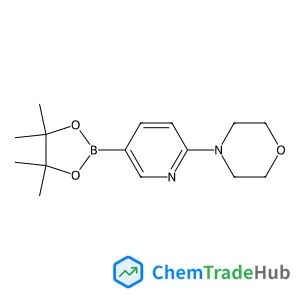
4-(5-(4,4,5,5-tetramethyl-1,3,2-dioxaborolan-2-yl)pyridin-2-yl)morpholine
CAS号:
485799-04-0
分子式:
C15H23BN2O3
推荐供应商





免责声明
本页面提供的学术期刊信息仅供参考和研究使用。我们与任何期刊出版商均无关联,也不处理投稿事宜。如有投稿相关咨询,请直接联系相关期刊出版商。
如发现页面信息有误,请发送邮件至 support@chemtradehub.com 联系我们。我们将及时核实并处理您的问题。