









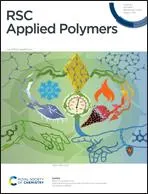
Thermoresponsive polymers with LCST transition: synthesis, characterization, and their impact on biomedical frontiers
文献信息
发布日期
2023-08-29
DOI
10.1039/D3LP00114H
影响因子
0
作者
Yichun Yuan, Konpal Raheja, Nathalie B. Milbrandt, Sophia Beilharz, Steffy Tene, Solomon Oshabaheebwa, Anna Cristina S. Samia, Metin Karayilan
查看原文
摘要
Advances in thermoresponsive materials have significantly impacted many biomedical fields. The unique behavior of reversible phase transition close to the physiological temperatures makes these types of materials a great candidate for a wide variety of biomedical applications including bioimaging, biosensing, injectables, smart surfaces, adhesives, biomanufacturing, and tissue engineering. Thermoresponsive behavior, mainly lower critical solution temperature (LCST) can be easily tuned by shifting the balance between hydrophobicity and hydrophilicity (e.g., by using comonomers or changing end groups) and modifying the molecular weight and architecture of the polymer. Hence, synthetic and characterization tools are critical in tailoring and precisely determining these properties. This review aims to show the full scope of the journey of thermoresponsive polymers from benchtop to potential applications. We especially intend to emphasize the effects of the structural heterogeneity of polymers on thermal transition and highlight the modern characterization techniques used to study thermoresponsive behavior. A better understanding of these structural effects and benchtop tools can help us design and implement more advanced materials for future applications in public health.
相关文献
Ring opening polymerization of β-acetoxy-δ-methylvalerolactone, a triacetic acid lactone derivative
Hussnain Sajjad, Emily A. Prebihalo, William B. Tolman, Theresa M. Reineke
2021-11-14
Paper
DOI: 10.1039/D1PY00561H
Amphiphilic diblock copolymers of poly(glycidol) with biodegradable polyester/polycarbonate. organocatalytic one-pot ROP and self-assembling property
Tingyu He, Atsushi Narumi, Yanqiu Wang, Liang Xu, Shin-ichiro Sato
2021-09-16
Paper
DOI: 10.1039/D1PY01026C
Unlocking the potential of furan-based poly(ester amide)s: an investigation of crystallization, molecular dynamics and degradation kinetics of novel poly(ester amide)s based on renewable poly(propylene furanoate)
Lazaros Papadopoulos, Panagiotis A. Klonos, Marcel Kluge, Alexandra Zamboulis, Zoi Terzopoulou, Dimitra Kourtidou, Andreas Magaziotis, Konstantinos Chrissafis, Apostolos Kyritsis, Dimitrios N. Bikiaris, Tobias Robert
2021-09-08
Paper
DOI: 10.1039/D1PY00713K
Unprecedented coupling of natural rubber and ELP: synthesis, characterization and self-assembly properties
Tingting Zhang, Frédéric Peruch, Anne-Laure Wirotius, Emmanuel Ibarboure, Frédéric Rosu, Christophe Schatz, Bertrand Garbay
2021-10-13
Paper
DOI: 10.1039/D1PY00969A
Achieving molecular weight distribution shape control and broad dispersities using RAFT polymerizations
Stephanie I. Rosenbloom, Renee J. Sifri, Brett P. Fors
2021-04-12
Paper
DOI: 10.1039/D1PY00399B
Synthesis and characterization of amide-bridged colorless polyimide films with low CTE and high optical performance for flexible OLED displays
Haiquan Guo, Lianxun Gao
2021-08-26
Paper
DOI: 10.1039/D1PY00762A
Novel photoinitiators based on difluoroborate complexes of squaraine dyes for radical polymerization of acrylates upon visible light
Alicja Balcerak, Dominika Kwiatkowska, Janina Kabatc
2021-11-30
Paper
DOI: 10.1039/D1PY01294K
Cyclic olefin copolymers containing both linear polyethylene and poly(ethylene-co-norbornene) segments prepared from chain shuttling copolymerization of ethylene and norbornene
Huan Gao, Shangtao Chen, Bin Du, Zhenyu Dai, Xu Lu, Kunyu Zhang, Li Pan, Yang Li
2021-12-03
Paper
DOI: 10.1039/D1PY01251G
Elucidation of network structure in cationic photopolymerization of cyclic ether comonomers
Sara M. Kaalberg, Sage M. Schissel, Michael Soumounthong, Julie L. P. Jessop
2021-10-04
Paper
DOI: 10.1039/D1PY00824B
您可能还喜欢
化合物问答
什么是5-Fluoro-4-iodo-2-methylaniline(CAS号:307306-08-7)?
5-氟-4-碘-2-甲氨基苯属于芳香族化合物,其分子式为C8H7FN2I。该化合物具有一定的反应活性,在有机合成和药物化学领域有一定的应用。
307306-08-75-Fluoro-4-iodo-2-me...
化合物问答
4-氟-3-硝基三氟甲苯(CAS号:367-86-2)通常如何合成?
4-氟-3-硝基三氟甲苯通常通过将三氟甲基苯在酸性条件下催化氧化为三氟甲基硝基苯,然后进行氟化反应得到目标化合物。该过程需要使用催化剂,如三氟乙酸,反应产率较高...
367-86-21-Fluoro-2-nitro-4-(...
化合物问答
6-氯-9-(2,3,5-三苯甲酰氧基-2-C-甲基-beta-D-呋喃核糖基)-9H-嘌呤(CAS号:205171-05-7)的物理化学性质是什么?
该化合物为白色至类白色晶体,分子量约为1046.95。它在水中几乎不溶,在有机溶剂如乙腈和甲醇中具有一定的溶解性。该化合物具有良好的化学稳定性和生物活性。
205171-05-76-Chloro-9-(2-C-meth...
化合物问答
如何储存6-氟喹啉-4-羧酸(CAS号:220844-73-5)?
6-氟喹啉-4-羧酸应储存在阴凉、干燥、通风良好的地方,避免阳光直射。储存在密闭容器中,避免与空气中的水分接触。储存温度应控制在室温以下,避免高温。
220844-73-56-Fluoroquinoline-4-...
化合物问答
(2S,2'S,3S,3'S)-3,3'-di-tert-butyl-4,4'-bis(2,6-dimethoxyphenyl)-2,2',3,3'-tetrahydro-2,2'-bibenzo[d][1,3]oxaphosphole(CAS号:1435940-21-8)通常如何合成?
该化合物通常通过芳香族化合物的亲核取代反应合成,首先将2,6-二甲氧基苯基引入到双环结构中,然后通过特定条件下的还原或氧化反应引入二叔丁基。反应过程中使用了钯作...
1435940-21-8(2S,2'S,3S,3'S)-4,4'...
化合物问答
如何储存KY02111(CAS号:1118807-13-8)?
KY02111应储存于阴凉、干燥、通风良好的地方,避免阳光直射和高温环境。应使用合适的密闭容器储存,并确保容器密封良好,防止水分和潮气进入。在储存期间,应注意检...
1118807-13-8N-(6-chlorobenzo[d]t...
化合物问答
如何储存4-(4-氯苯氧基)丁酸乙酯(CAS号:59227-79-1)?
4-(4-氯苯氧基)丁酸乙酯应储存在阴凉、干燥、通风良好的地方,远离火源和热源。避免阳光直射,防止容器破裂导致泄漏。储存时应保持容器密封,避免与空气中的水蒸气接...
59227-79-1Ethyl 4-(4-chlorophe...
化合物问答
4-庚基苯乙酮(CAS号:37593-03-6)安全吗?
4-庚基苯乙酮相对安全,但在使用和储存时仍需注意。应避免吸入其蒸气,避免皮肤接触,使用时需佩戴防护眼镜和手套。储存时应远离火源和热源,保持容器密封,放置于阴凉、...
37593-03-61-(4-Heptylphenyl)et...
化合物问答
什么是乙基2-氨基-4-(3-溴苯基)噻吩-3-羧酸乙酯(CAS号:438218-48-5)?
乙基2-氨基-4-(3-溴苯基)噻吩-3-羧酸乙酯是一种有机化合物,分子式为C16H12BrN2O2S。它是一种含有噻吩环、氨基、溴苯基和羧酸酯结构的化合物。这...
438218-48-5ethyl 2-amino-4-(3-b...
化合物问答
什么是(9ci)-2-氨基-6-甲基-苯甲酰胺(CAS号:1885-31-0)?
(9ci)-2-氨基-6-甲基-苯甲酰胺是一种化学化合物,其英文名称为2-Amino-6-methylbenzamide,CAS号为1885-31-0。该化合物...
1885-31-02-Amino-6-methylbenz...
来源期刊
推荐化合物
推荐供应商



免责声明
本页面提供的学术期刊信息仅供参考和研究使用。我们与任何期刊出版商均无关联,也不处理投稿事宜。如有投稿相关咨询,请直接联系相关期刊出版商。
如发现页面信息有误,请发送邮件至 support@chemtradehub.com 联系我们。我们将及时核实并处理您的问题。