



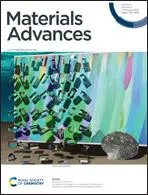
Amorphous N-doped InSnZnO thin films deposited by RF sputtering for thin-film transistor application
文献信息
发布日期
2023-10-31
DOI
10.1039/D3MA00500C
影响因子
0
作者
Shu-Mei Song, Wanxia Wang, Ming-Jiang Dai, Song-Sheng Lin, Ting-Yong Chen, Hui Sun
查看原文
摘要
N-doped InSnZnO (ITZO:N) thin films as the active layer of thin film transistors (TFTs) were prepared using radio frequency (RF) magnetron sputtering at room temperature. The influence of RF power on the microstructure and optical properties of films was investigated. The relationship between the active layer quality and the TFT's electrical properties was also studied. The results show that no evident impacts of RF power are observed on the optical transmittance in the visible range of amorphous ITZO:N thin films. Their optical band gaps increase from 3.44 to 3.54 eV. An appropriate RF power can enhance ITZO:N film's quality, and reduce the interface state density, which is beneficial to improving the carrier concentration of ITZO:N TFTs. Then, the device's performance is optimized. The threshold voltage of TFTs shows a negative shift as the RF power gradually increases. When the RF power is 60 W, the ITZO:N thin film is amorphous with a dense microstructure. The corresponding TFT device exhibits optimal electrical characteristics. Its field-effect mobility, on/off ratio and subthreshold swing are 14.66 cm2 V−1 s−1, >106 and 0.7 V dec−1, respectively.
相关文献
An isoindigo and dithieno[3,2-b:2′,3′-d]silole copolymer for polymer solar cells
Romain Stalder, Caroline Grand, Jegadesan Subbiah, Franky So, John R. Reynolds
2011-10-27
Communication
DOI: 10.1039/C1PY00402F
Programmable digital nonvolatile memory behaviors of donor–acceptor polyimides bearing triphenylamine derivatives: effects of substituents
Taek Joon Lee, Yong-Gi Ko, Hung-Ju Yen, Kyungtae Kim, Dong Min Kim, Wonsang Kwon, Suk Gyu Hahm, Guey-Sheng Liou, Moonhor Ree
2012-03-21
Paper
DOI: 10.1039/C2PY00617K
Enzymatically degradable nanogels by inverse miniemulsion copolymerization of acrylamide with dextran methacrylates as crosslinkers
Daniel Klinger, Eugen M. Aschenbrenner, Clemens K. Weiss, Katharina Landfester
2011-11-18
Paper
DOI: 10.1039/C1PY00415H
Random introduction of degradable linkages into functional vinyl polymers by radical ring-opening polymerization, tailored for soft tissue engineering
Jenny Undin, Teresa Illanes, Anna Finne-Wistrand, Ann-Christine Albertsson
2012-03-19
Paper
DOI: 10.1039/C2PY20034A
Thiol-Michael coupling chemistry: facile access to a library of functional exo-7-oxanorbornenes and their ring-opening metathesis (co)polymerization
Meina Liu, Johannes van Hensbergen, Robert P. Burford, Andrew B. Lowe
2012-04-13
Paper
DOI: 10.1039/C2PY20155K
Synthesis of low-temperature benzocyclobutene cross-linker and utilization
Julia N. Dobish, Sharon K. Hamilton, Eva Harth
2012-01-30
Communication
DOI: 10.1039/C2PY00606E
Two dimensional size controlled confinement of poly(vinyl pyrrolidone) in the interlayer space of swelling clay mineral
Minoru Sohmiya, Shingo Omata
2012-02-10
Paper
DOI: 10.1039/C2PY00465H
High molecular weight acrylonitrile–butadiene architectures via a combination of RAFT polymerization and orthogonal copper mediated azide–alkyne cycloaddition
Christoph J. Dürr, Sebastian G. J. Emmerling, Paul Lederhose, Andreas Kaiser, Sven Brandau, Michael Klimpel, Christopher Barner-Kowollik
2012-02-07
Paper
DOI: 10.1039/C2PY00547F
您可能还喜欢
化合物问答
4-((4-甲基哌嗪-1-基)甲基)苯硼酸(CAS号:763120-62-3)的市场或研究趋势如何?
随着有机硼化学的发展,该化合物在催化、药物合成、材料科学等领域展现出潜在的应用价值。近年来,其在药物前体合成中的应用越来越受到关注。市场趋势显示,随着科研投入的...
763120-62-3{4-[(4-Methyl-1-pipe...
化合物问答
如何储存2,4,5-三甲基-1-硝基苯(CAS号:610-91-3)?
2,4,5-三甲基-1-硝基苯应储存在阴凉、干燥且通风良好的地方,避免阳光直射。储存在密封的金属容器中,远离火源和热源。储存温度应控制在25°C以下,湿度不宜过...
610-91-31,2,4-Trimethyl-5-ni...
化合物问答
处理2,5-二碘噻吩(CAS号:625-88-7)时应注意哪些实验室安全事项?
在处理2,5-二碘噻吩时,应穿戴适当的个人防护装备(PPE),包括实验室外套、手套和防护眼镜。在通风橱中进行操作以避免吸入蒸气。如果发生泄漏,应立即疏散人员并使...
625-88-72,5-Diiodothiophene
化合物问答
在合成中是否有6-bromo-3-chloro-1H-indole(CAS号:57916-08-2)的替代品?
在合成6-溴-3-氯-1H-吲哚(CAS号:57916-08-2)时,可以考虑使用一些类似的化合物作为替代品,如6-氯-3-氯-1H-吲哚或3-氯-1H-吲哚,...
57916-08-26-bromo-3-chloro-1H-...
化合物问答
在合成中是否有(R)-(-)-1-(1-萘基)乙基异氰酸酯(CAS号:42340-98-7)的替代品?
可以考虑使用类似结构的化合物,如1-[(1R)-1-(2-氨基乙基)萘-1-基]乙基异氰酸酯作为替代品。此外,还可以寻找其他类型的异氰酸酯衍生物,如苯基异氰酸酯...
42340-98-71-[(1R)-1-Isocyanato...
化合物问答
3-氨基苯甲酰苯胺(CAS号:14315-16-3)适用哪些法规指南?
3-氨基苯甲酰苯胺适用于多项法规指南,包括但不限于GHS(全球化学品统一分类和标签制度)分类为皮肤腐蚀/刺激类别2,以及潜在的皮肤过敏性类别1。在欧盟地区,它受...
14315-16-33-Amino-N-phenylbenz...
化合物问答
β-环柠檬醛-D5(CAS号:26309-95-5)通常如何合成?
β-环柠檬醛-D5可通过不对称合成方法获得。常见的合成路线包括以环己酮为原料,经过选择性氧化、还原、保护基引入等步骤,最终得到目标化合物。该合成过程中通常使用多...
26309-95-5[(2,2-Dimethylpropan...
34915-68-9Bunitrolol
化合物问答
如何处理含有BIO-1211(CAS号:187735-94-0)的废料?
对于含有BIO-1211(CAS号:187735-94-0)的废料,首先应进行分类收集,确保符合环保要求。然后,可以考虑通过焚烧或其他专业处理方法进行处置。在处...
187735-94-0BIO-1211
化合物问答
如何处理含有4-氯-2-氟-3-甲基苯酚(CAS号:1351668-24-0)的废料?
含有该化合物的废液应收集至专用容器中,避免与其他化学品混合。可采用焚烧或送交专业废弃物处理公司处理。处理过程中需遵守当地环保法规,确保不产生二次污染。处理前应进...
1351668-24-04-Chloro-2-fluoro-3-...
来源期刊
推荐化合物
推荐供应商





免责声明
本页面提供的学术期刊信息仅供参考和研究使用。我们与任何期刊出版商均无关联,也不处理投稿事宜。如有投稿相关咨询,请直接联系相关期刊出版商。
如发现页面信息有误,请发送邮件至 support@chemtradehub.com 联系我们。我们将及时核实并处理您的问题。