










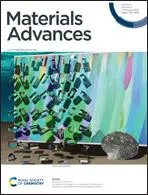
Advances in layer-by-layer processing for efficient and reliable organic solar cells
文献信息
发布日期
2023-10-26
DOI
10.1039/D3MA00754E
影响因子
0
作者
Amaresh Mishra, Nirmala Niharika Bhuyan, Haijun Xu, Ganesh D. Sharma
查看原文
摘要
Layer-by-layer (LBL) deposition using solution processing is a promising technique for fabricating organic solar cells (OSCs) with high efficiency and stability. In comparison with bulk-heterojunction (BHJ) structures, in the LBL method, the donor (D) and acceptor (A) materials are deposited sequentially, presenting many distinct advantages including a p–i–n-like configuration (D/D:A/A) that may create well-defined and controllable nanostructures to facilitate charge generation and extraction. This concept is an advisable option to fabricate pseudo-bilayer configurations in the active layer of OSCs. At present, high power conversion efficiencies (PCEs) of over 19% in ternary LBL processed OSCs and 11.97% in the processed module (11.52 cm2) have been successfully realized, indicating that the selection of an appropriate ternary system is an effective strategy to improve the morphology of the active layer towards efficient and stable OSCs. Moreover, the unique merits of LBL configuration in individual layer processing enable it to be a promising approach for large-scale printing and further commercialization of OSCs. In this article, we summarize the recent advances in LBL OSCs, focusing on the selection of materials, solvents, processing parameters, device architectures, and stability. We also discuss the key strategies used for further improvement of LBL OSCs from the perspectives of structural design, performance, and scalability. Finally, we discuss the current limitations of BHJ devices and the prospect of LBL OSCs as a promising alternative for high-performance and stable OSCs. We also highlight some key research directions that can help enhance the efficiency and stability of LBL OSCs for their potential applications in the future.
期刊推荐
相关文献
Retro-Claisen benzylation: direct use of benzyl alcohols in Pd-catalyzed couplings with nitriles
Tapan Maji, Kinthada Ramakumar, Jon A. Tunge
2014-09-24
Communication
DOI: 10.1039/C4CC07001A
Rational synthesis of Pt-based dandelion-like yolk–shell nanoparticles with enhanced oxygen reduction properties
Chunjie Li, Shuli Yin, Hongjie Yu, Ziqiang Wang, You Xu, Xiaonian Li, Liang Wang, Hongjing Wang
2019-09-09
Paper
DOI: 10.1039/C9SE00618D
Room-temperature synthesis of Ni1−xFex (oxy)hydroxides: structure–activity relationship for the oxygen evolution reaction
Xiaodong Yan, Qing-Tao Hu, Wen-Da Zhang, Tao Li, Haiyan Zhu
2019-12-05
Paper
DOI: 10.1039/C9SE00701F
Switching charge kinetics from type-I to Z-scheme for g-C3N4 and ZnIn2S4 by defective engineering for efficient and durable hydrogen evolution
Mingya Wang, Shushu Huang, Xin Pang, Meiting Song, Chunfang Du, Yiguo Su
2019-09-19
Paper
DOI: 10.1039/C9SE00639G
A nuanced approach for assessing OPV materials for large scale applications
Matthew J. Griffith, Wenqing Liu, Shuixing Li, Kamilla Sivunova, Daniel Elkington, Nathan A. Cooling, Minmin Shi, Warwick Belcher, Hongzheng Chen, Paul Dastoor
2019-12-04
Paper
DOI: 10.1039/C9SE01149H
Formation of highly porous CuCo2O4 nanosheet assemblies for high-rate and long-term lithium storage
Jia Li, Yongxing Zhang, Li Li, Lixun Cheng, Song Dai, Fei Wang, Yanming Wang
2019-10-04
Paper
DOI: 10.1039/C9SE00770A
Unique homo–heterojunction synergistic system consisting of stacked BiOCl nanoplate/Zn–Cr layered double hydroxide nanosheets promoting photocatalytic conversion of CO2 into solar fuels
Ruotian Chen, Xianguang Meng, Bihu Lv, Fengtao Fan, Jinhua Ye, Xiaoyong Wang, Can Li
2018-04-20
Communication
DOI: 10.1039/C8CC01873A
Unlocking the potential of BECCS with indigenous sources of biomass at a national scale
Piera Patrizio, Florian Kraxner
2019-09-23
Paper
DOI: 10.1039/C9SE00609E
Concentrated solar light for rapid crystallization of nanomaterials and extreme enhancement of photoelectrochemical performance
Yina Zhao, Beilei Qiu, Zhonghai Zhang
2018-02-07
Communication
DOI: 10.1039/C8CC00476E
Micropores-in-macroporous gel polymer electrolytes for alkali metal batteries
Hadi Khani, Somayyeh Kalami, John B. Goodenough
2019-10-02
Paper
DOI: 10.1039/C9SE00690G
您可能还喜欢
化合物问答
P11(CAS号:848644-86-0)安全吗?
P11作为一种化学化合物,需要谨慎处理。一般来说,该化合物无毒,但在操作过程中仍需遵循实验室安全规定,避免皮肤接触和吸入。建议在通风良好的环境中操作,并佩戴适当...
848644-86-0L-Histidyl-L-seryl-L...
化合物问答
氨甲环酸杂质C(CAS号:330838-52-3)通常如何合成?
氨甲环酸杂质C通常通过氨甲环酸的衍生物与环己烯进行缩合反应合成。常见的合成方法包括一步合成法和多步合成法,其中多步合成法可以提高产物的选择性和产率。反应通常在无...
330838-52-34-(Aminomethyl)-1-cy...
化合物问答
(±)-茉莉酸(CAS号:221682-41-3)通常如何合成?
(±)-茉莉酸的合成通常采用生物合成或者化学合成的方法。化学合成方法中,可以通过2-戊烯-1-醇与环戊酮的缩合反应,再经过氧化反应得到目标产物。该反应需要温和的...
221682-41-3{3-Oxo-2-[(2E)-2-pen...
化合物问答
(4S,4'S)-2,2'-(1,1-环己烷二基)双(4-异丙基-4,5-二氢-1,3-噁唑)(CAS号:1373357-00-6)安全吗?
(4S,4'S)-2,2'-(1,1-环己烷二基)双(4-异丙基-4,5-二氢-1,3-噁唑)属于有机化合物,应遵循实验室安全规范。在操作时应佩戴适当的个人防护...
1373357-00-6(4S,4'S)-2,2'-(1,1-C...
化合物问答
什么是6-苄氧基-5-甲氧基-2-羧基吲哚(CAS号:2495-92-3)?
6-苄氧基-5-甲氧基-2-羧基吲哚是一种有机化合物,分子式为C16H15NO3。它是一种含有苄氧基、甲氧基和羧基官能团的吲哚衍生物。
2495-92-36-(Benzyloxy)-5-meth...
化合物问答
丙二酸丁酯乙酯(CAS号:17373-84-1)安全吗?
丙二酸丁酯乙酯属于易燃物质,具有一定的毒性。在操作时应佩戴防护眼镜和手套,避免接触皮肤和眼睛。储存时应远离热源和火源,避免阳光直射,以减少火灾和爆炸的风险。
17373-84-1Butyl ethyl malonate
化合物问答
2-碘-3-甲基吡嗪(CAS号:58139-08-5)的市场或研究趋势如何?
2-碘-3-甲基吡嗪作为一种特殊结构的化合物,目前在工业和学术研究中的应用相对有限。然而,随着对特定化学结构及其潜在应用的深入研究,预计未来可能在农药、医药等领...
58139-08-52-Iodo-3-methylpyraz...
化合物问答
千层纸素A-7-0-β-D-葡萄糖醛酸苷甲酯(CAS号:82475-01-2)的物理化学性质是什么?
千层纸素A-7-0-β-D-葡萄糖醛酸苷甲酯是一种白色结晶固体,分子量为616.27 g/mol。该化合物在水中溶解度较低,在有机溶剂中溶解度较高。其反应活性主...
82475-01-25-Hydroxy-8-methoxy-...
化合物问答
什么是7-苄基-4,7-二氮杂螺[2.5]辛烷(CAS号:1222106-45-7)?
7-苄基-4,7-二氮杂螺[2.5]辛烷是一种有机化合物,其结构由一个环状的7-苄基-4,7-二氮杂螺环和一个苯基组成。该化合物的分子式为C14H16N2。它具...
1222106-45-77-Benzyl-4,7-diazasp...
化合物问答
在合成中是否有丁酰胺酸甲酯(CAS号:53171-39-4)的替代品?
丁酰胺酸甲酯的合成中可能的替代品包括其他氨基酸衍生物,如乙酰胺酸甲酯或丙酰胺酸甲酯。这些替代品在某些合成路线中可能更为便利或成本更低。
53171-39-4Methyl 4-amino-4-oxo...
来源期刊
推荐化合物
![2-Methyl-2-propanyl 4-oxo-3,9-diazabicyclo[4.2.1]nonane-9-carboxylate structure](https://cnstatic.chemtradehub.com/structs/131/1312456-05-5-9a15.webp "2-Methyl-2-propanyl 4-oxo-3,9-diazabicyclo[4.2.1]nonane-9-carboxylate structure")
2-Methyl-2-propanyl 4-oxo-3,9-diazabicyclo[4.2.1]nonane-9-carboxylate
CAS号:
1312456-05-5
分子式:
C12H20N2O3
![5-Chloropyrrolo[2,1-f][1,2,4]triazin-4(3H)-one structure](https://cnstatic.chemtradehub.com/structs/888/888720-60-3-4f7c.webp "5-Chloropyrrolo[2,1-f][1,2,4]triazin-4(3H)-one structure")
![2-(5-Bromo-1H-pyrrolo[2,3-B]pyridin-3-YL)acetic acid structure](https://cnstatic.chemtradehub.com/structs/106/1060795-03-0-0589.webp "2-(5-Bromo-1H-pyrrolo[2,3-B]pyridin-3-YL)acetic acid structure")
推荐供应商




免责声明
本页面提供的学术期刊信息仅供参考和研究使用。我们与任何期刊出版商均无关联,也不处理投稿事宜。如有投稿相关咨询,请直接联系相关期刊出版商。
如发现页面信息有误,请发送邮件至 support@chemtradehub.com 联系我们。我们将及时核实并处理您的问题。