




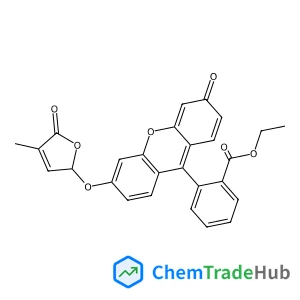
Bi(OTf)3-promoted cascade annulation of hydroxy-pyranones and unsaturated γ-ketoesters for the construction of polycyclic bridged pyrano-furopyranones
文献信息
发布日期
2023-12-20
DOI
10.1039/D3OB01862H
影响因子
3.876
作者
查看原文
摘要
An efficient protocol for constructing complex three dimensional polycyclic bridged chromano-furopyranones and pyrano-furopyranones (closely related to bioactive natural products) via bismuth(III)-catalyzed cascade annulation of hydroxy-pyranones and unsaturated γ-ketoesters is presented. This process involves intermolecular Michael addition, intramolecular hemiketalization, lactonization, formation of one C–C bond and two C–O bonds, rings, and contiguous stereocenters.
相关文献
DIBAL-H-mediated N-deacetylation of tertiary amides: synthesis of synthetically valuable secondary amines
Pushpendra Mani Shukla, Aniruddh Pratap, Biswajit Maji
2023-12-12
Communication
DOI: 10.1039/D3OB01660A
Microbial alcohol dehydrogenases: recent developments and applications in asymmetric synthesis
Anju Chadha, Santosh Kumar Padhi, Selvaraj Stella, Sowmyalakshmi Venkataraman, Thangavelu Saravanan
2023-12-05
Review Article
DOI: 10.1039/D3OB01447A
Direct synthesis of N-functionalized indoles through isomerization of azomethine ylides
2024-01-03
Communication
DOI: 10.1039/D3OB01393F
Catalyst-free assembly of a polyfunctionalized 1,2,4-triazole-fused N-heterocycle, 6-acylated pyrrolo[1,2-a][1,2,4]triazolo[5,1-c]pyrazine
Hyunjin Oh, Ikyon Kim
2023-11-29
Paper
DOI: 10.1039/D3OB01747H
Synthesis of functionalized tetrahydrodibenzo[b,g][1,8]naphthyridin-1(2H)-ones through base-promoted annulation of quinoline-derived dipolarophiles and cyclic enaminones
Wenjun Luo, Xinghua Zheng, Fanglian Zhang, Qiuya Luo, Wen-Ting Deng, Lipeng Long, Daohong Yu, Zhong-Xia Wang, Zhengwang Chen
2023-11-16
Communication
DOI: 10.1039/D3OB01547E
Synthesis of Cs-symmetrical C60 tetra-adducts via reactions of C60Cl6 with CH-acids and enol silyl ester
Olga A. Kraevaya, Alexander S. Peregudov
2023-12-05
Paper
DOI: 10.1039/D3OB01868G
Efficient amidation of weak amines: synthesis, chiral separation by SFC, and antimicrobial activity of N-(9,10-dioxo-9,10-dihydroanthracen-1-yl) carboxamide
A. Zahir Hussain, Andivelu Ilangovan
2023-12-06
Paper
DOI: 10.1039/D3OB01774E
CuI-catalyzed regioselective hydrothiolation of alkynes: a thiol-free route to (Z)-β-alkenyl sulfides
Najmeh Nowrouzi, Mohammad Abbasi, Ensieh Safari, Amin Arman
2023-12-16
Paper
DOI: 10.1039/D3OB01230A
Two-step, high-yielding total synthesis of antibiotic pyrones
Akram Hussain, Sunitha Katta, Dhevalapally B. Ramachary
2023-12-14
Paper
DOI: 10.1039/D3OB01923C
QN-302 demonstrates opposing effects between i-motif and G-quadruplex DNA structures in the promoter of the S100P gene
Effrosyni Alexandrou, Dilek Guneri, Stephen Neidle, Zoë A. E. Waller
2023-11-06
Communication
DOI: 10.1039/D3OB01464A
您可能还喜欢
化合物问答
奥美沙坦酯杂质4(CAS号:95579-71-8)的主要用途是什么?
奥美沙坦酯杂质4在药物工业中并无特定用途,主要作为生产和质量控制中的监控指标,以确保产品质量和符合相关规范。它具有一定的化学活性,因此在生产过程中需要严格控制其...
95579-71-84-Chloro-4-methyl-5-...
化合物问答
如何储存C3bot (154-182)(CAS号:1246280-79-4)?
C3bot (154-182)应储存在干燥、阴凉、通风良好的环境中,避免阳光直射。具体储存条件需要参考其相关安全数据表(SDS)中的储存信息。建议使用密闭容器存...
1246280-79-4C3bot (154-182)
化合物问答
在合成中是否有4-吡唑甲酸乙酯(CAS号:37622-90-5)的替代品?
在合成过程中,可以考虑使用类似结构的化合物作为替代品,例如4-吡唑甲酸甲酯或其他吡唑类化合物。这些替代品在性质上相似,可以用于相似的合成反应中,但需根据具体应用...
37622-90-5Ethyl 1H-pyrazole-4-...
化合物问答
(2-溴乙基)三甲基硅烷(CAS号:18156-67-7)的主要用途是什么?
(2-溴乙基)三甲基硅烷主要用作有机合成中的溴代试剂,特别是在硅化学领域中,用于制备硅烷衍生物和硅基功能材料。它也用于表面改性、催化剂合成、医药中间体合成以及分...
18156-67-7(2-Bromoethyl)(trime...
化合物问答
如何处理含有2-(4-broMophenyl)-1,1,1-trifluoropropan-2-ol(CAS号:122243-28-1)的废料?
含该化合物的废料需按照危险废物管理规定进行分类和处理。首先,应尽量减少废料的产生,通过改进生产工艺实现废物最小化。对于不可避免的废料,建议采用安全的收集方法,避...
122243-28-12-(4-bromophenyl)-1,...
化合物问答
什么是1,1,1-三氟-6-苯基-5-(e)-己烯-2,4-二酮(CAS号:18931-64-1)?
1,1,1-三氟-6-苯基-5-(e)-己烯-2,4-二酮是一种有机化合物,化学式为C14H8F3O2。它是一种具有特定立体结构的芳香族化合物,属于酮类。
18931-64-1(5E)-1,1,1-Trifluoro...
化合物问答
2-(2-甲基哌啶-1-基)-2-氧代-乙酸(CAS号:77654-61-6)的主要用途是什么?
2-(2-甲基哌啶-1-基)-2-氧代-乙酸主要用于药物合成、有机合成及作为化学试剂。它在医药领域有一定的应用,可用于合成某些药物中间体。此外,它还用于实验室研...
77654-61-6(2-Methyl-1-piperidi...
化合物问答
如何储存(R)-1-(3-Chlorophenyl)-2,2,2-trifluoroethanamine(CAS号:1213627-66-7)?
应将(R)-1-(3-氯苯基)-2,2,2-三氟乙胺储存在阴凉、干燥、通风良好的地方,远离火源和热源。应使用密封的容器储存,并避免光照。储存温度应控制在室温范围...
1213627-66-7(1R)-1-(3-Chlorophen...
化合物问答
N-亚硝基-N,N-二壬基胺(CAS号:84424-96-4)的市场或研究趋势如何?
N-亚硝基-N,N-二壬基胺目前主要应用于有机合成和药物化学领域。市场趋势显示,随着有机合成技术的进步,该化合物在新药研发中的应用将更加广泛。新兴研究领域包括其...
84424-96-4N-Nitroso-N-nonyl-1-...
化合物问答
5-Chloro-2-methoxy-3-(2,2,2-trifluoroethoxy)pyridine(CAS号:1280786-68-6)的市场或研究趋势如何?
该化合物在医药、农药等领域有潜在应用价值,但市场需求较小。目前研究趋势主要集中在探索其在特定领域的应用潜力,如作为药物合成中的中间体。随着研究的深入,预计未来市...
1280786-68-65-Chloro-2-methoxy-3...
来源期刊
Organic & Biomolecular Chemistry

CiteScore:
3.4
自引率:
10.3%
年发文量:
1041
Organic & Biomolecular Chemistry (OBC) publishes original and high impact research and reviews in organic chemistry. We welcome research that shows new or significantly improved protocols or methodologies in total synthesis, synthetic methodology or physical and theoretical organic chemistry as well as research that shows a significant advance in the organic chemistry or molecular design aspects of chemical biology, catalysis, supramolecular and macromolecular chemistry, theoretical chemistry, mechanism-oriented physical organic chemistry, medicinal chemistry or natural products. Articles published in the journal should report new work which makes a highly-significant impact in the field. Routine and incremental work is generally not suitable for publication in the journal. More details about key areas of our scope are below. In all cases authors should include in their article clear rationale for why their research has been carried out.
推荐化合物
![2-[1-(4-Chlorobenzyl)-1H-indol-3-yl]-2-oxo-N-(6-quinolinyl)acetamide structure](https://cnstatic.chemtradehub.com/structs/501/501921-61-5-756a.webp "2-[1-(4-Chlorobenzyl)-1H-indol-3-yl]-2-oxo-N-(6-quinolinyl)acetamide structure")
2-[1-(4-Chlorobenzyl)-1H-indol-3-yl]-2-oxo-N-(6-quinolinyl)acetamide
CAS号:
501921-61-5
分子式:
C26H18ClN3O2
推荐供应商






免责声明
本页面提供的学术期刊信息仅供参考和研究使用。我们与任何期刊出版商均无关联,也不处理投稿事宜。如有投稿相关咨询,请直接联系相关期刊出版商。
如发现页面信息有误,请发送邮件至 support@chemtradehub.com 联系我们。我们将及时核实并处理您的问题。