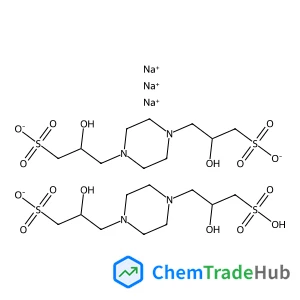
3,3'-(Piperazine-1,4-diyl)bis(2-hydroxypropane-1-sulfonic acid) Sodium Salt
CAS号:
108321-08-0
分子式:
C20H41N4Na3O16S4
Alexander T. Gilligan, Raythe Owens, Ethan G. Miller, Nicholas F. Pompetti
Important applications of photon upconversion through triplet–triplet annihilation require conversion of near-IR photons to visible light. Generally, however, efficiencies in this spectral region lag behind bluer analogues. Herein we consider potential benefits from a conformationally well-defined covalent dimer annihilator TIPS-BTX in studies that systematically compare function to a related monomer model TIPS-tetracene (TIPS-Tc). TIPS-BTX exhibits weak electronic coupling between chromophores juxtaposed about a polycyclic bridge. We report an upconversion yield ϕUC for TIPS-BTX that is more than 20× larger than TIPS-Tc under comparable conditions (0.16%). While the dimer ϕUC is low compared to bluer champion systems, this yield is amongst the largest so-far reported for a tetracenic dimer system and is achieved under unoptimized conditions suggesting a significantly higher ceiling. Further investigation shows the ϕUC enhancement for the dimer is due exclusively to the TTA process with an effective yield more that 30× larger for TIPS-BTX compared to TIPS-Tc. The ϕTTA enhancement for TIPS-BTX relative to TIPS-Tc is indicative of participation by intramolecular multiexciton states with evidence presented in spin statistical arguments that the 5TT is involved in productive channels. For TIPS-BTX we report a spin-statistical factor f = 0.42 that matches or exceeds values found in champion annihilator systems such as DPA. At the same time, the poor relative efficiency of TIPS-Tc suggests involvement of non-productive bimolecular channels and excimeric states are suspected. Broadly these studies indicate that funneling of photogenerated electronic states into productive pathways, and avoiding parasitic ones, remains central to the development of champion upconversion systems.
Crystallography Reports
Russian Journal of Organic Chemistry
Current Opinion in Colloid & Interface Science
Journal of Natural Medicines
Chemistry Education Research and Practice
Russian Chemical Bulletin
Russian Journal of General Chemistry
Organic Process Research & Development
Journal of Peptide Science

Chemical Communications
Porramain Porjai, Malee Sutthiopad, Kritsana Khaothong, Metinee Phantu, Nakorn Kumchaiseemak, Jiraporn Luengviriya, Kenneth Showalter, Chaiya Luengviriya
DOI: 10.1039/C8CP06948D
Thomas J. N. Hooper, Thomas A. Partridge, Gregory J. Rees, Dean S. Keeble, Nigel A. Powell, Mark E. Smith, Iryna P. Mikheenko, Lynne E. Macaskie, Peter T. Bishop, John V. Hanna
DOI: 10.1039/C8CP02594K
Jiehong Lei
DOI: 10.1039/C8CP05350B
Yuji Nakashima, Kenichi Okutsu, Keita Fujimoto, Yuri Ito, Manabu Kanno, Keijiro Ohshimo, Hirohiko Kono, Fuminori Misaizu
DOI: 10.1039/C8CP07068G
Alan Miralrio, Luis E. Sansores, Bruce King, Alvaro Muñoz-Castro
DOI: 10.1039/C8CP04938F
Toshiyuki Takamuku, Hiroyuki Sakurai, Akira Ogawa, Atsuya Tashiro, Masahiro Kawano, Yutaro Kawazu, Koichiro Sadakane, Hiroki Iwase, Kazuhiko Ozutsumi
DOI: 10.1039/C8CP06345A
Trevor C. Brown, David J. Miron, Christopher M. Fellows
DOI: 10.1039/C8CP06163G
Penggang Wang, Yuting Jia, Tao Li, Dongshuai Hou, Qi Zheng
DOI: 10.1039/C8CP02450B
Jing Qing, Anpu Chen, Nanrong Zhao
DOI: 10.1039/C8CP05203D
该化合物适用的法规指南包括GHS(全球化学品统一分类和标签制度)分类为特定目标器官毒性-单次接触类别3;根据欧盟REACH法规,该化合物需要进行注册和评估;在美...
在合成中,可以考虑使用一些类似的化合物作为4-(4-氯苯基)-1H-咪唑的替代品,如4-(4-溴苯基)-1H-咪唑或4-(4-甲氧基苯基)-1H-咪唑。这些化合...
N~2~-甲基丙氨酸酰胺是一种有机化合物,其化学名为2-(Methylamino)propanamide。它是一种酰胺类化合物,分子式为C4H10N2O,相对分...
处理含有N-苄基-3-氨基氧杂环丁烷草酸盐(CAS号:1956341-96-0)的废料时,应首先确保遵循相关法规要求,如GHS和REACH等。通常,废液应先进行...
4-溴-2-氯-6-甲基苯甲酸是一种固体化合物,具有较高的熔点和较低的沸点。它的分子量为261.03 g/mol。该化合物在水中几乎不溶,在有机溶剂中溶解度适中...
该化合物通常通过缩合反应合成,典型的方法是将2,5-二氯嘧啶与N-甲基苯甲酰胺在碱性条件下进行偶联反应。常用的碱包括NaH、LDA等强碱。该合成路线具有较高的选...
3,5-二溴-4-甲基苯胺在某些合成路线中可能没有直接替代品。然而,在某些应用场景下,可以考虑使用其他类似结构的化合物如3,5-二溴-4-硝基苯胺或3,5-二碘...
2-氯喹啉-4-羧酸甲酯主要用于有机合成和药物合成领域,作为中间体或原料。它在合成某些药物和染料时具有重要作用。此外,该化合物还可能用于某些特定的化学研究中。
6-溴-8-氯咪唑[1,2-a]吡啶在操作过程中需要谨慎以确保安全。该化合物具有一定的毒性,吸入其蒸气或粉尘可能导致呼吸道刺激。处理时应佩戴适当的防护装备,如手...
Our journal has a wide-ranging scope which covers the full breadth of the chemical sciences. The research we publish contains the sorts of novel ideas, challenging questions and progressive thinking that bring undiscovered breakthroughs within reach. Your paper could focus on a single area, or cross many. It could be beyond the accepted bounds of the chemical sciences. It might address an immediate challenge, contribute to a future breakthrough or be wholly conceptual. We’re a team from every field of the chemical sciences, and know from experience that breakthroughs that drive the solutions to global challenges can come from anywhere, at any time. You could even start an entirely new area of research. Too bold? Too progressive? No such thing
![(1R,3S,5R)-2-{[(2-Methyl-2-propanyl)oxy]carbonyl}-2-azabicyclo[3.1.0]hexane-3-carboxylic acid structure](https://cnstatic.chemtradehub.com/structs/197/197142-34-0-6a44.webp "(1R,3S,5R)-2-{[(2-Methyl-2-propanyl)oxy]carbonyl}-2-azabicyclo[3.1.0]hexane-3-carboxylic acid structure")