





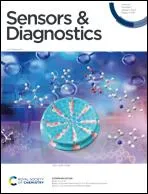

Recent advances in DNA-based electrogenerated chemiluminescence biosensors
文献信息
发布日期
2023-03-14
DOI
10.1039/D3SD00027C
影响因子
0
作者
Jingfeng Zhu
查看原文
摘要
Electrogenerated chemiluminescence (also called electrochemiluminescence and abbreviated as ECL) has witnessed significant development in fields ranging from biological analysis to clinical diagnosis due to its outstanding advantages such as high sensitivity, wide detection range, and low background signal. DNA, a class of biopolymers with programmable self-assembly and molecular recognition functions, is a significant tool in the field of ECL bioanalysis. Benefiting from the unique structures and excellent properties of DNA, DNA-based ECL biosensors have aroused increasing attention. In this review, we summarize and classify the signal output mode of DNA-based ECL biosensors and introduce the different methods for the immobilization of DNA probes on electrodes. In addition, we discuss the recent progress and applications of DNA-based ECL biosensors, including the detection of nucleic acids, proteins, and small biomolecules. Finally, we present a brief summary and prospects in this field.
相关文献
Osteocalcin facilitates calcium phosphate ion complex growth as revealed by free energy calculation
Weilong Zhao, Ziqiu Wang, Zhijun Xu
2018-04-09
Paper
DOI: 10.1039/C8CP01105B
Radiation chemistry of solid acetone in the interstellar medium – a new dimension to an old problem
2017-11-07
Paper
DOI: 10.1039/C7CP06431D
Computational screening of a single transition metal atom supported on the C2N monolayer for electrochemical ammonia synthesis
Zhongxu Wang, Zhigang Yu, Jingxiang Zhao
2018-04-13
Paper
DOI: 10.1039/C8CP01215F
Nonequilibrium self-assembly induced Liesegang rings in a non-isothermal system
Andrés Arango-Restrepo, Daniel Barragán, J. Miguel Rubi
2018-01-25
Paper
DOI: 10.1039/C7CP08469B
Time-dependent changes in the growth of ultrathin ionic liquid films on Ag(111)
Matthias Lexow, Timo Talwar, Bettina S. J. Heller, Benjamin May, Radha G. Bhuin, Florian Maier, Hans-Peter Steinrück
2018-04-27
Paper
DOI: 10.1039/C8CP01411F
The effect of copper on the redox behaviour of iron oxide for chemical-looping hydrogen production probed by in situ X-ray absorption spectroscopy
Nur Sena Yüzbasi, Paula M. Abdala, Qasim Imtiaz, Sung Min Kim, Agnieszka M. Kierzkowska, Andac Armutlulu, Wouter van Beek, Christoph R. Müller
2018-04-17
Paper
DOI: 10.1039/C8CP01309H
Li deposition and desolvation with electron transfer at a silicon/propylene-carbonate interface: transition-state and free-energy profiles by large-scale first-principles molecular dynamics
Tsukuru Ohwaki, Taisuke Ozaki, Yukihiro Okuno, Hideto Imai, Minoru Otani
2018-03-05
Paper
DOI: 10.1039/C7CP08569A
2-Chloromalonaldehyde, a model system of resonance-assisted hydrogen bonding: vibrational investigation
Michèle Chevalier, Justinas Ceponkus, Germán A. Rojas-Lorenzo, Claudine Crépin
2018-04-16
Paper
DOI: 10.1039/C7CP06481K
First-principles study on thermodynamic stability of the hybrid interfacial structure of LiMn2O4 cathode and carbonate electrolyte in Li-ion batteries
Daehyeon Choi, Joonhee Kang, Jinwoo Park, Byungchan Han
2018-03-28
Paper
DOI: 10.1039/C7CP08037A
Collisional excitation of interstellar PO(X2Π) by He: new ab initio potential energy surfaces and scattering calculations
François Lique, Izaskun Jiménez-Serra, Serena Viti, Sarantos Marinakis
2017-09-25
Paper
DOI: 10.1039/C7CP05605B
您可能还喜欢
化合物问答
3 - (二氟甲基)-1 -氟苯(CAS号:26029-52-7)适用哪些法规指南?
3 - (二氟甲基)-1 -氟苯需遵循联合国全球化学品统一分类和标签制度(GHS),包括急性毒性、皮肤腐蚀/刺激、严重眼损伤/眼刺激等分类。同时,该化合物还需符...
26029-52-71-(Difluoromethyl)-3...
化合物问答
3,5-二甲基苯胺(CAS号:108-69-0)通常如何合成?
3,5-二甲基苯胺通常通过乙苯的氨解反应合成。反应中使用硫酸作为催化剂,反应温度为120-130°C。乙苯在硫酸存在下与氨反应,生成3,5-二甲基苯胺和苯胺副产...
108-69-03,5-Dimethylaniline
化合物问答
3-甲基异噻唑-5-胺(CAS号:24340-76-9)安全吗?
3-甲基异噻唑-5-胺在适当使用和储存条件下是相对安全的,但在操作时应注意防护措施。应避免吸入粉尘,避免与皮肤和眼睛直接接触。在操作过程中,应穿戴适当的防护装备...
24340-76-93-Methyl-1,2-thiazol...
化合物问答
3-(1,3-Thiazol-2-yl)-1H-indole(CAS号:135531-86-1)通常如何合成?
3-(1,3-噻唑-2-基)-1H-吲哚通常通过多步合成方法制备。首先,由噻唑-2-基溴化物和吲哚进行偶联反应,得到中间体。然后,通过还原反应将中间体转化为所需...
135531-86-13-(1,3-Thiazol-2-yl)...
化合物问答
4-溴-2-氟苯甲基氯(CAS号:85510-82-3)的主要用途是什么?
4-溴-2-氟苯甲基氯主要用于有机合成中间体,特别是在医药、农药和染料等领域。作为一种具有特定结构的化合物,它在合成复杂有机分子时扮演重要角色。
85510-82-34-Bromo-1-(chloromet...
化合物问答
处理Fmoc-β-(3-噻吩基)-D-Ala-OH(CAS号:220497-90-5)时应注意哪些实验室安全事项?
处理Fmoc-β-(3-噻吩基)-D-Ala-OH时,应佩戴防护手套、护目镜和实验服。操作应在通风橱内进行。如发生泄露,应立即用大量水冲洗,并通知实验室管理人员...
220497-90-5N-[(9H-Fluoren-9-ylm...
化合物问答
氮化硅(CAS号:12033-89-5)通常如何合成?
氮化硅通常通过氮化硅的直接反应合成,即在高温下将四氯化硅与氨气反应。具体步骤是将四氯化硅和氨气混合并加热至1300-1700℃,在该条件下,四氯化硅与氨气反应生...
12033-89-5Trisilicon tetranitr...
化合物问答
Cetirizine EP Impurity B DiHCl(CAS号:1000690-91-4)通常如何合成?
Cetirizine EP Impurity B DiHCl通常通过一锅法合成,首先将4-氯苯基-苯甲基氯甲酸酯与1-哌嗪乙酸反应,生成相应的酸,然后与盐酸反应...
1000690-91-4{4-[(4-Chlorophenyl)...
化合物问答
如何储存1-哌啶-4-基丁-1-酮(CAS号:3509-15-7)?
1-哌啶-4-基丁-1-酮应储存在阴凉、干燥的地方,避免阳光直射。存储容器应密封,并确保通风良好。建议储存温度不超过25℃,湿度保持在相对较低的水平。
3509-15-71-Piperidin-4-ylbuta...
化合物问答
如何处理含有VORUCICLIB(CAS号:1000023-04-0)的废料?
含有VORUCICLIB的废料应进行专业的收集和处理,包括使用适当的容器进行隔离,避免与其他化学品接触。处理方法通常包括化学中和、沉淀反应或吸附过程,随后进行焚...
1000023-04-02-[2-Chloro-4-(trifl...
来源期刊
推荐化合物


![1-[3-(4-Morpholinylsulfonyl)phenyl]methanamine structure](https://cnstatic.chemtradehub.com/structs/933/933989-32-3-51af.webp "1-[3-(4-Morpholinylsulfonyl)phenyl]methanamine structure")
推荐供应商




免责声明
本页面提供的学术期刊信息仅供参考和研究使用。我们与任何期刊出版商均无关联,也不处理投稿事宜。如有投稿相关咨询,请直接联系相关期刊出版商。
如发现页面信息有误,请发送邮件至 support@chemtradehub.com 联系我们。我们将及时核实并处理您的问题。