




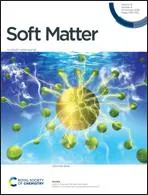
Scaling perspectives of underscreening in concentrated electrolyte solutions
文献信息
发布日期
2023-10-06
DOI
10.1039/D3SM01094E
影响因子
3.679
作者
Philip A. Pincus
查看原文
摘要
We present a scaling view of underscreening observed in salt solutions in the range of concentrations greater than about 1 M, in which the screening length increases with concentration. The system consists of hydrated clusters of positive and negative ions with a single unpaired ion as suggested by recent simulations. The environment of this ion is more hydrated than average which leads to a self-similar situation in which the size of this environment scales with the screening length. The prefactor involves the local dielectric constant and the cluster density. The scaling arguments as well as the cluster model lead to scaling of the screening length with the ion concentration, in agreement with observations.
相关文献
Exploring the complexity of quantum control optimization trajectories
Arun Nanduri, Ofer M. Shir, Ashley Donovan, Tak-San Ho, Herschel Rabitz
2014-11-07
Paper
DOI: 10.1039/C4CP03853C
Strong temperature-dependent crystallization, phase transition, optical and electrical characteristics of p-type CuAlO2 thin films
2014-11-05
Paper
DOI: 10.1039/C4CP04009K
Exploring the phase space of time of flight mass selected PtxY nanoparticles
Federico Masini, Patricia Hernández-Fernández, Davide Deiana, Christian Ejersbo Strebel, David Norman McCarthy, Anders Bodin, Paolo Malacrida, Ifan Stephens, Ib Chorkendorff
2014-07-17
Paper
DOI: 10.1039/C4CP02144D
Revisiting the conundrum of trehalose stabilization
Nidhi Katyal, Shashank Deep
2014-10-28
Paper
DOI: 10.1039/C4CP02914C
Effects of 3d transition-metal doping on electronic and magnetic properties of MoS2 nanoribbons
Xiaoqing Tian, Lin Liu, Yu Du, Juan Gu, Jian-bin Xu, Boris I. Yakobson
2014-11-26
Paper
DOI: 10.1039/C4CP04579C
Reverse hydrotropy by complex formation
Kamil Wojciechowski, Thomas Gutberlet, Vikram Singh Raghuwanshi, Ann Terry
2014-10-16
Paper
DOI: 10.1039/C4CP03835E
Buffers more than buffering agent: introducing a new class of stabilizers for the protein BSA
Bhupender S. Gupta, Mohamed Taha, Ming-Jer Lee
2014-11-06
Paper
DOI: 10.1039/C4CP04663C
Bimodal crystallization at polymer–fullerene interfaces
Dyfrig Môn, Anthony M. Higgins, David James, Mark Hampton, J. Emyr Macdonald, Michael B. Ward, Philipp Gutfreund, Samuele Lilliu, Jonathan Rawle
2014-11-26
Paper
DOI: 10.1039/C4CP04253K
Abnormal incorporation of amino acids into the gas hydrate crystal lattice
Jeong-Hoon Sa, Gye-Hoon Kwak, Bo Ram Lee, Docheon Ahn, Kun-Hong Lee
2014-11-05
Communication
DOI: 10.1039/C4CP05056H
您可能还喜欢
化合物问答
4-[4-三氟甲基苯基]恶唑(CAS号:1126636-40-5)通常如何合成?
4-[4-三氟甲基苯基]恶唑通常通过将4-三氟甲基苯酚与异硫氰酸苯酯在有机溶剂中进行酯化反应合成。该反应可在无水条件下,使用适当的催化剂,如四丁基氢氧化铵,以提...
1126636-40-54-(4-(Trifluoromethy...
59729-32-71-[3-(Dimethylamino)...
化合物问答
RockPhos Pd G3(CAS号:2009020-38-4)通常如何合成?
RockPhos Pd G3 通常通过钯催化偶联反应合成,使用配体 (2'-Amino-2-biphenylyl)(methanesulfonato-kappa...
2009020-38-4(2'-Amino-2-biphenyl...
化合物问答
1-哌啶甲酰胺(CAS号:2158-03-4)的市场或研究趋势如何?
1-哌啶甲酰胺作为有机合成中的重要中间体,其市场需求主要受医药、农药、染料等行业推动。近年来,随着新药开发和绿色化学的发展,该化合物的研究趋势集中在开发更高效、...
2158-03-41-Piperidinecarboxam...
化合物问答
2-(二苯基膦基)乙胺(CAS号:4848-43-5)适用哪些法规指南?
2-(二苯基膦基)乙胺适用于多种法规指南,包括但不限于《全球化学品统一分类和标签制度》(GHS),欧盟《化学品注册、评估、授权和限制》法规(REACH),以及美...
4848-43-52-(Diphenylphosphino...
化合物问答
如何储存间苯二甲酸二烯丙酯(CAS号:1087-21-4)?
间苯二甲酸二烯丙酯应储存在阴凉、干燥、通风良好的地方,远离火源和热源。储存容器应密封,避免光照和高温。储存温度应控制在25℃以下,相对湿度应低于80%。避免与其...
1087-21-4Diallyl isophthalate
化合物问答
什么是间甲苯异硫代异氰酸酯(CAS号:621-30-7)?
间甲苯异硫代异氰酸酯是一种有机化合物,分子式为C7H7NO2S,具有刺激性气味。它是一种重要的有机合成中间体,在合成其他化合物时广泛应用。
621-30-71-Isothiocyanato-3-m...
化合物问答
在合成中是否有N-Boc-D-苯丙氨醇(CAS号:106454-69-7)的替代品?
在合成中,可以考虑使用N-Cbz-D-苯丙氨醇或N-Fmoc-D-苯丙氨醇作为替代品。这些化合物同样具有保护氨基的功能,且在合成过程中表现出良好的反应性能。
106454-69-72-Methyl-2-propanyl ...
化合物问答
3-羟甲基-2-氧异丙基吡啶(CAS号:954240-50-7)的主要用途是什么?
3-羟甲基-2-氧异丙基吡啶主要用于有机合成领域,可以作为合成其他药物、农药或精细化学品的中间体。此外,它还可能在实验室研究中作为特定反应的前体或溶剂。
954240-50-7(2-Isopropoxy-3-pyri...
化合物问答
6-氨基-9-甲基嘌呤(CAS号:700-00-5)应用于哪些行业?
6-氨基-9-甲基嘌呤目前主要应用于医药行业,作为某些药物的中间体。此外,它还可能用于聚合物、传感器和半导体的某些领域,作为功能性单体或掺杂剂。
700-00-59-Methyl-9H-purin-6-...
来源期刊
Soft Matter
CiteScore:
6
自引率:
10.3%
年发文量:
856
Soft Matter provides a unique forum for the communication of significant advances in interdisciplinary soft matter research. There is a particular focus on the interface between chemistry, physics, materials science, biology and chemical engineering. Research may report new soft materials or phenomena, encompass their design, synthesis, and use in new applications; or provide fundamental insight and observations on their behaviour. Experimental, theoretical and computational soft matter approaches are encouraged. The scope of Soft Matter covers the following. Soft matter assemblies, including colloids, granular matter, liquid crystals, gels & networks, polymers, hybrid materials, active matter and further examples Soft nanotechnology, soft robotics and devices Synthesis, self-assembly and directed assembly Biological aspects of soft matter including proteins, biopolymers, cells and tissues Surfaces, interfaces and interactions Phase behaviour, coacervation and rheological behaviour Sustainable soft materials including recycling, circular economy and end of life Mechanistic insights and modelling
推荐化合物
![2-Bromodibenzo[b,d]furan structure](https://cnstatic.chemtradehub.com/structs/86-/86-76-0-1814.webp "2-Bromodibenzo[b,d]furan structure")
![3-[(4-Nitrobenzyl)oxy]-3-oxopropanoic Acid structure](https://cnstatic.chemtradehub.com/structs/773/77359-11-6-0d04.webp "3-[(4-Nitrobenzyl)oxy]-3-oxopropanoic Acid structure")
推荐供应商




免责声明
本页面提供的学术期刊信息仅供参考和研究使用。我们与任何期刊出版商均无关联,也不处理投稿事宜。如有投稿相关咨询,请直接联系相关期刊出版商。
如发现页面信息有误,请发送邮件至 support@chemtradehub.com 联系我们。我们将及时核实并处理您的问题。