








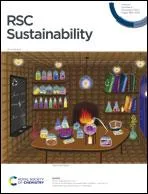
Alkali and alkaline earth metals in liquid salts for supercapatteries
文献信息
发布日期
2023-11-29
DOI
10.1039/D3SU00197K
影响因子
0
作者
Peiying Fan, Yuhan Zhang, Li Guan, Han Wang, George Zheng Chen
查看原文
摘要
The full oxidation of lithium metal (4Li + O2 ⇌ 2Li2O) offers a mass normalised Gibbs energy change greater than that for the combustion of carbon (C + O2 ⇌ CO2) or any hydrocarbon fuel (). This thermodynamic comparison promises a lithium–oxygen (air) battery with a petrol comparable energy density. Similar analyses apply to other abundant alkali and alkaline earth metals (AAEMs) which all feature very high specific charge capacity and the most negative electrode potentials. The success of lithium ion batteries (LIBs) in both research and commercial development confirms these thermodynamic predictions. However, the experimentally demonstrated energy capacities of all AAEM-based batteries are only small fractions of the thermodynamic values. A main cause is that a satisfactory oxygen positive electrode (positrode) is still to be developed, whilst the very few options of AAEM storage positrodes still do not match AAEM negative electrodes (negatrodes) in charge capacity. Another challenge results from the complicated interactions between AAEMs and the currently used organic carbonate electrolytes that not only reduce the negatrode capacity but also exert restrictions on both electron and ion transfers. The flammability of currently used organic electrolytes is another major concern with respect to the safety of AAEM batteries. Herein, we introduce the concept and potential, and review the relevant practices of a promising ionic liquid supercapattery that couples an AAEM negatrode with a supercapacitor positrode to bypass the thermodynamic and kinetic difficulties of an oxygen or AAEM storage positrode. The further discussion aims at the selection of ionic liquid-based electrolytes that can enable the reversible anodic dissolution of AAEMs and a wide potential window for the supercapacitor positrode. The use of molten salt-based electrolytes is also postulated and analysed, not only because of their high ionic conductivity, low cost and unique applications, but also their high temperatures that eliminate dendritic growth on the liquid AAEM negatrode and heat buildup in the cell.
相关文献
Highly efficient bromination of aromatic compounds using 3-methylimidazolium tribromide as reagent/solvent
Cinzia Chiappe, Elsa Leandri, Daniela Pieraccini
2004-09-30
Communication
DOI: 10.1039/B410796A
Fabrication of a stable inorganic–organic hybrid multilayer film with uniform and dense inorganic nanoparticle deposition
Xurong Xu, Joong Tark Han, Kilwon Cho
2003-03-18
Communication
DOI: 10.1039/B300581J
Trimethyltriazacyclohexane as bridging ligand for triangular Cu3 units and C–H hydride abstraction into a Cu6 cluster
Randolf D. Köhn, Zhida Pan, Mary F. Mahon, Gabriele Kociok-Köhn
2003-05-02
Communication
DOI: 10.1039/B302670A
A new route to fullerene substituted phenylalanine derivatives
Jianzhong Yang, Andrew R. Barron
2004-10-25
Communication
DOI: 10.1039/B411118D
The dynamic desorption of krypton from the zeolite chabazite
S. P. Cork, G. Cressey, R. H. Jones, S. J. Teat, V. L. Zholobenko
2004-11-05
Communication
DOI: 10.1039/B410366C
Mo2P4O15 – the most complex oxide structure solved by single crystal methods?
Sarah E. Lister, Ivana Radosavljevic Evans, Judith A. K. Howard, Alan Coelho, John S. O. Evans
2004-10-04
Communication
DOI: 10.1039/B408413F
A novel migrative addition reaction of hydrazines to the diketone derivative of C60
Sho-ichi Iwamatsu, Fumiaki Ono
2003-05-02
Communication
DOI: 10.1039/B302080K
Attachment of glycosaminoglycan oligosaccharides to thiol-derivatised gold surfaces
Susannah J. Patey, Jeremy E. Turnbull
2004-10-11
Communication
DOI: 10.1039/B411726C
Reduction of nitroaromatics to arylnitrenium ions by vinyl halide cations
Hao Chen, Xubin Zheng, Pengxiang Yang, R. Graham Cooks
2004-02-12
Communication
DOI: 10.1039/B314713D
您可能还喜欢
化合物问答
如何处理含有8-氯咪唑并[1,2-A]吡嗪(CAS号:69214-33-1)的废料?
处理含有8-氯咪唑并[1,2-A]吡嗪的废料时,应首先将其收集并进行化学回收或降解。如果无法回收,需采用安全的化学处理方法,如中和、氧化还原或沉淀。处理过程中需...
69214-33-18-chloroimidazo[1,2-...
化合物问答
Calhex 231 hydrochloride(CAS号:2387505-78-2)适用哪些法规指南?
Calhex 231 hydrochloride 需要遵循《全球化学品统一分类和标签制度》(GHS)的分类和标签要求,以及欧盟的《化学品注册、评估、授权和限制条...
2387505-78-24-Chloro-N-[(1S,2S)-...
化合物问答
11-Beta,17-alpha,21-三羟基-5-beta-孕烯-3,20-二酮(CAS号:1482-50-4)的物理化学性质是什么?
11-Beta,17-alpha,21-三羟基-5-beta-孕烯-3,20-二酮是一种无色结晶性粉末,分子量为372.45 g/mol。该化合物在水中的溶解度...
1482-50-45β-Dihydrocortisol
化合物问答
处理5-异丙基-1,3,4-恶二唑-2-羧酸(CAS号:944907-13-5)时应注意哪些实验室安全事项?
处理5-异丙基-1,3,4-恶二唑-2-羧酸时应注意以下安全事项:穿戴适当的个人防护装备,包括实验室外套、手套和护目镜;操作应在通风橱中进行,以减少吸入或接触有...
944907-13-55-Isopropyl-1,3,4-ox...
化合物问答
benzyl 3-bromopropanoate(CAS号:90841-55-7)安全吗?
Benzyl 3-bromopropanoate属于有毒物质,吸入、摄入或皮肤接触均可能对人体造成伤害。操作时应佩戴防护眼镜、口罩和手套,避免吸入蒸汽和直接接触...
90841-55-7Benzyl 3-bromopropan...
化合物问答
什么是(R)-N-苄氧羰基-3,4-二氢-1H-异喹啉羧酸(CAS号:151004-88-5)?
(R)-N-苄氧羰基-3,4-二氢-1H-异喹啉羧酸是一种含有苄氧羰基和异喹啉环结构的化合物,分子式为C17H15NO3。它是一种有机化合物,具有一定的生物活性...
151004-88-5(1R)-2-[(Benzyloxy)c...
化合物问答
在合成中是否有1-苄基吡啶嗡-3-羧酸盐(CAS号:15990-43-9)的替代品?
可以考虑使用1-苄基吡啶-3-羧酸盐作为1-苄基吡啶嗡-3-羧酸盐的替代品。此外,还可以探索其他类似物,如1-苄基吡啶-3-氨基甲酸酯等。具体的替代品选择需根据...
15990-43-91-Benzyl-3-pyridiniu...
化合物问答
(2,6-二甲基吡啶-3-基)甲醇(CAS号:582303-10-4)安全吗?
(2,6-二甲基吡啶-3-基)甲醇在使用时需注意安全,应避免吸入其蒸汽,接触皮肤和眼睛。操作应在通风良好的环境中进行,佩戴适当的个人防护装备。
582303-10-4(2,6-Dimethyl-3-pyri...
化合物问答
5-溴-2-乙烯基吡啶(CAS号:226883-52-9)的物理化学性质是什么?
5-溴-2-乙烯基吡啶是一种有机化合物,外观为白色固体,具有良好的结晶性。分子量约为190.03 g/mol。它的溶解性在水中较差,但在有机溶剂如二氯甲烷、甲醇...
226883-52-95-Bromo-2-vinylpyrid...
化合物问答
2-羟基-3-硝基-5-甲基吡啶(CAS号:7464-14-4)应用于哪些行业?
2-羟基-3-硝基-5-甲基吡啶主要应用于医药、聚合物和半导体行业。在医药领域,它可以用作合成其他药物的中间体。在聚合物领域,它可以作为功能性单体参与聚合反应,...
7464-14-45-Methyl-3-nitro-2(1...
来源期刊
推荐化合物
![N-[(5,6-Dichloro-1H-benzimidazol-2-yl)methyl]-9-(1-methyl-1H-pyrazol-4-yl)-2-(4-morpholinyl)-9H-purin-6-amine structure](https://cnstatic.chemtradehub.com/structs/238/2387704-62-1-25f4.webp "N-[(5,6-Dichloro-1H-benzimidazol-2-yl)methyl]-9-(1-methyl-1H-pyrazol-4-yl)-2-(4-morpholinyl)-9H-purin-6-amine structure")

推荐供应商




免责声明
本页面提供的学术期刊信息仅供参考和研究使用。我们与任何期刊出版商均无关联,也不处理投稿事宜。如有投稿相关咨询,请直接联系相关期刊出版商。
如发现页面信息有误,请发送邮件至 support@chemtradehub.com 联系我们。我们将及时核实并处理您的问题。