


A ZnO&GeSe composite electron transport layer for organic solar cells
文献信息
发布日期
2023-11-29
DOI
10.1039/D3TA05900F
影响因子
12.732
作者
Jingyu Tan, Hongye Li, Yapeng Sun, Guanliang Li, Yujun Zhao, Huangzhong Yu
查看原文
摘要
In organic solar cells (OSCs), ZnO is a widely used electron transport layer (ETL), but various vacancy defects on the surface of ZnO crystals form massive trap-assisted recombination centers, which hinders electron transmission in OSCs. In this paper, a ZnO&GeSe composite is constructed by modifying ZnO with two-dimensional (2D) GeSe, and it is used for the first time as a novel ETL in OSCs, which reduces the defect density on the ZnO surface and improves the electron extraction efficiency in OSCs. The results of first-principles calculations show that GeSe can deposit additional electrons on the surface of ZnO, which stabilizes the ZnO polar surface and reduces the formation of spontaneous defects on the ZnO polar surface. The electric dipole moment formed at the interface also promotes electron transport in OSCs. The power conversion efficiency (PCE) of OSCs based on PBDB-T:ITIC and PM6:Y6 active layers increases from 10.06% and 15.20% to 11.68% and 17.51%, respectively. Meanwhile, the OSC with the ZnO&GeSe composite ETL possesses good stability compared to the device with the pure ZnO ETL. This study shows that 2D GeSe has a good application prospect as a charge transport layer, and provides an idea for the defect modification of ZnO and other semiconductor crystals by 2D materials.
期刊推荐
Bioorganic & Medicinal Chemistry
Journal of Asian Natural Products Research
Acta Metallurgica Sinica-English Letters
Journal of the Indian Institute of Science
Atomization and Sprays

Colloid Journal
Medicinal Chemistry Research
Biocatalysis and Biotransformation

Polycyclic Aromatic Compounds
Journal of Chemical Sciences
相关文献
Engineering disorder in precipitation-based nano-scaled metal oxide thin films
Jennifer L. M. Rupp, Barbara Scherrer, Ludwig J. Gauckler
2010-07-29
Paper
DOI: 10.1039/B920971A
The reduced [2Fe-2S] clusters in adrenodoxin and Arthrospira platensisferredoxin share spin density with proteinnitrogens, probed using 2D ESEEM
Sergei A. Dikanov, Rimma I. Samoilova, Reinhard Kappl, Antony R. Crofts, Jürgen Hüttermann
2009-07-01
Paper
DOI: 10.1039/B904597J
In situ infrared (FTIR) study of the mechanism of the borohydride oxidation reaction
B. Molina Concha, M. Chatenet, F. Maillard, E. A. Ticianelli, F. H. B. Lima, R. B. de Lima
2010-08-02
Paper
DOI: 10.1039/C003652H
Radiofrequency polarization effects in zero-field electron paramagnetic resonance
Christopher T. Rodgers, C. J. Wedge, Stuart A. Norman, Philipp Kukura, Karen Nelson, Neville Baker, Kevin B. Henbest, P. J. Hore
2009-07-03
Communication
DOI: 10.1039/B906102A
Fluorescence of sanguinarine: spectral changes on interaction with amino acids
Marika Janovská, Martin Kubala, Vilím Šimánek, Jitka Ulrichová
2010-08-03
Paper
DOI: 10.1039/B925828K
The OH stretch vibration of liquid water reveals hydrogen-bond clusters
Sean Garrett-Roe, Peter Hamm
2010-07-30
Paper
DOI: 10.1039/C004579A
Solvent-shift Monte Carlo: a cluster algorithm for solvated systems
Christopher Adam Hixson, James P. Benigni, David J. Earl
2009-06-15
Communication
DOI: 10.1039/B905254B
Tandem extraction strategy for separation of metallic and semiconducting SWCNTs using condensed benzenoid molecules: effects of molecular morphology and solvent
Cai-Hong Liu, Yi-Yang Liu, Yong-Hui Zhang, Rui-Rui Wei, Hao-Li Zhang
2009-06-10
Paper
DOI: 10.1039/B901517E
2H and 19F solid-state NMR studies of the ionic liquid [C2Py][BTA]-d10 confined in mesoporous silica materials
Maria Waechtler, Martin Sellin, Annegret Stark, Dilek Akcakayiran, Gerhard Findenegg, Anna Gruenberg, Hergen Breitzke, Gerd Buntkowsky
2010-08-16
Paper
DOI: 10.1039/B926836G
First-principles simulations of hydrogen peroxide formation catalyzed by small neutral gold clusters
Katarzyna A. Kacprzak
2009-05-27
Paper
DOI: 10.1039/B822765A
您可能还喜欢
化合物问答
十二烷基磺酸钠(CAS号:2386-53-0)的主要用途是什么?
十二烷基磺酸钠主要用作表面活性剂,广泛应用于洗涤剂、肥皂、化妆品和工业清洁产品中。它能有效去除油脂和污垢,常用于制造洗发水、沐浴露、洗衣粉和金属清洗剂。此外,它...
2386-53-01-Dodecanesulfonic a...
化合物问答
5-羟基异喹啉(CAS号:2439-04-5)适用哪些法规指南?
5-羟基异喹啉作为化学品,主要适用的法规包括GHS全球化学品统一分类和标签制度,REACH法规等。GHS将5-羟基异喹啉分类为皮肤腐蚀/刺激类别2,严重眼损伤/...
2439-04-55-Isoquinolinol
化合物问答
在合成中是否有FIDAS-5 | Wnt(CAS号:1391934-98-7)的替代品?
合成中可以考虑使用类似结构的化合物,如4-[(E)-2-(2-氯-6-氟苯基)乙烯基]-N-甲基苯胺的类似物或衍生物作为替代品。这类化合物可能具有相似的生物活性...
1391934-98-74-[(E)-2-(2-Chloro-6...
化合物问答
(R)-tert-Butyl 2-(5-bromo-1H-imidazol-2-yl)pyrrolidine-1-carboxylate(CAS号:1370600-56-8)通常如何合成?
该化合物通常通过如下步骤合成:首先,将4-溴-1H-咪唑与对甲苯磺酸在乙酸乙酯中反应,得到中间体5-溴-1H-咪唑-2-甲酸乙酯。然后,该中间体与2-甲基-2-...
1370600-56-82-Methyl-2-propanyl ...
化合物问答
处理4-(吡咯烷-1-基)环己酮(CAS号:10421-18-8)时应注意哪些实验室安全事项?
处理4-(吡咯烷-1-基)环己酮时,应佩戴手套、护目镜和实验室外套,以防止直接接触或吸入。在通风橱中操作,确保良好的通风条件。一旦发生泄漏,应立即清理并使用适当...
10421-18-84-(Pyrrolidin-1-yl)c...
化合物问答
如何处理含有异麦芽糖醇(CAS号:534-73-6)的废料?
含有异麦芽糖醇的废液应首先进行分类收集,避免与其他化学品混合。对于小规模的废液,可以通过焚烧或加入特定的化学试剂进行无害化处理。对于大规模的废液,建议联系专业的...
534-73-66-O-alpha-D-Glucopyr...
化合物问答
7-甲基壬酸(CAS号:41653-89-8)的主要用途是什么?
7-甲基壬酸主要用于有机合成领域,作为合成其他化合物的原料。此外,它还可能作为一种中间体用于药品制造和香料合成,但具体用途需要根据其具体的化学结构和反应特性来确...
41653-89-87-Methylnonanoic aci...
化合物问答
N-甲氧基-N-甲基甲基吡啶羧酰胺(CAS号:148493-07-6)应用于哪些行业?
N-甲氧基-N-甲基甲基吡啶羧酰胺在医药领域有一定的应用,作为一种潜在的药物前体或中间体。此外,该化合物也可能应用于聚合物改性剂、传感器材料等。由于其独特的化学...
148493-07-6N-Methoxy-N-methylpi...
化合物问答
什么是惕各酸香叶酯(CAS号:7785-33-3)?
惕各酸香叶酯是一种化合物,化学名称为(2E)-3,7-二甲基-2,6-辛二烯-1-基(2E)-2-甲基-2-丁烯酸酯。它是一种具有香叶香气的化合物,分子式为C1...
7785-33-3(2E)-3,7-Dimethyl-2,...
化合物问答
1-环丁基哌嗪(CAS号:132800-13-6)安全吗?
1-环丁基哌嗪在适当的操作条件下是相对安全的,但如遇明火或高热会释放有毒气体。操作时应佩戴防护眼镜和手套,避免吸入或接触皮肤、眼睛。
132800-13-61-Cyclobutylpiperazi...
来源期刊
Journal of Materials Chemistry A
CiteScore:
19.5
自引率:
4.7%
年发文量:
2211
Journal of Materials Chemistry A, B & C cover high quality studies across all fields of materials chemistry. The journals focus on those theoretical or experimental studies that report new understanding, applications, properties and synthesis of materials. The journals have a strong history of publishing quality reports of interest to interdisciplinary communities and providing an efficient and rigorous service through peer review and publication. The journals are led by an international team of Editors-in-Chief and Associate Editors who are all active researchers in their fields. Journal of Materials Chemistry A, B & C are separated by the intended application of the material studied. Broadly, applications in energy and sustainability are of interest to Journal of Materials Chemistry A, applications in biology and medicine are of interest to Journal of Materials Chemistry B, and applications in optical, magnetic and electronic devices are of interest to Journal of Materials Chemistry C. More than one Journal of Materials Chemistry journal may be suitable for certain fields and researchers are encouraged to submit their paper to the journal that they feel best fits for their particular article. Example topic areas within the scope of Journal of Materials Chemistry A are listed below. This list is neither exhaustive nor exclusive. Artificial photosynthesis Batteries Carbon dioxide conversion Catalysis Fuel cells Gas capture/separation/storage Green/sustainable materials Hydrogen generation Hydrogen storage Photocatalysis Photovoltaics Self-cleaning materials Self-healing materials Sensors Supercapacitors Thermoelectrics Water splitting Water treatment
推荐化合物
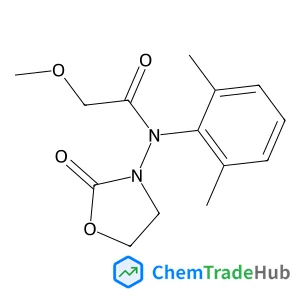
N-(2,6-Dimethylphenyl)-2-methoxy-N-(2-oxo-1,3-oxazolidin-3-yl)acetamide
CAS号:
77732-09-3
分子式:
C14H18N2O4

推荐供应商




免责声明
本页面提供的学术期刊信息仅供参考和研究使用。我们与任何期刊出版商均无关联,也不处理投稿事宜。如有投稿相关咨询,请直接联系相关期刊出版商。
如发现页面信息有误,请发送邮件至 support@chemtradehub.com 联系我们。我们将及时核实并处理您的问题。