


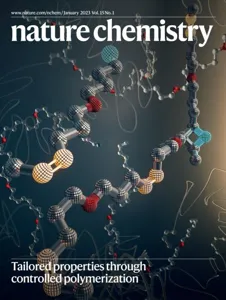
Nature Chemistry
基本信息
期刊简写:
NAT CHEM
影响因子:
19.2
ISSN:
1755-4330
研究领域:
CHEMICAL
h-index:
187
自引率:
1%
年发文量:
183
SCI收录来源:
Science Citation Index Expanded
期刊官网:
https://www.nature.com/nchem
期刊介绍:
Nature Chemistry is a monthly journal dedicated to publishing high-quality papers that describe the most significant and cutting-edge research in all areas of chemistry. As well as reflecting the traditional core subjects of analytical, inorganic, organic and physical chemistry, the journal also features a broad range of chemical research including, but not limited to, catalysis, computational and theoretical chemistry, environmental chemistry, green chemistry, medicinal chemistry, nuclear chemistry, polymer chemistry, supramolecular chemistry and surface chemistry. Other cross-disciplinary topics such as bioinorganic, bioorganic, organometallic and physical–organic chemistry will also be featured. The submission of manuscripts detailing multidisciplinary research performed at the interface of chemistry and other scientific fields of inquiry such as biology, materials science, nanotechnology and physics is also encouraged, where the central theme of the work — and the major advances that are reported — fall within the bounds of chemistry. In addition to primary research, Nature Chemistry also publishes review articles, news and views, research highlights about important work reported in other journals, commentaries, book reviews, correspondence, and analysis of the broader chemical picture beyond the laboratory — including issues such as education, funding, policy, intellectual property, and the impact chemistry has on society. In this way, the journal aims to be the voice of the worldwide chemical community. Nature Chemistry is committed to publishing top-tier original research in all areas of chemistry through a fair and rigorous review process. It offers authors high visibility for their papers, access to a broad readership, high standards of copy editing and production, rapid publication and independence from academic societies and others with vested interests.
CiteScore
CiteScore
29.6
SJR
6.94
SNIP
3.334
| 学科 | 排名 | 百分位 |
|---|---|---|
Chemical EngineeringGeneral Chemical Engineering |
4 / 273 | 98% |
期刊统计
Monthly
期/年
Submission to first editorial decision (median days): 8
Submission to acceptance (median days): 273
审稿周期
€10290 EUR/$12290 USD/£8890 GBP
论文处理费
投稿信息
投稿网址:
https://mts-nchem.nature.com/收录体裁:
Article
Correspondence
Matters Arising
News and Views
Books and Arts
Review
Perspective
Commentary
Correspondence
Matters Arising
News and Views
Books and Arts
Review
Perspective
Commentary
相关文献
Multiphoton dissociation dynamics of BrCl and the BrCl+cation
Olivier P. J. Vieuxmaire, N. Hendrik Nahler, Richard N. Dixon, Michael N. R. Ashfold
2007-08-30
Paper
DOI: 10.1039/B709222A
Kinetic analysis of supported Ni-catalyzed CO2/CH4 reactions using photoacoustic spectroscopy
Ji-Woong Kim, Jae-Au Ha, Hun Jung, Byung-II Ahn, Sung-Han Lee, Joong-Gill Choi
2007-09-25
Paper
DOI: 10.1039/B709102H
Structures and energetics of 98 atom Pd–Pt nanoalloys: potential stability of the Leary tetrahedron for bimetallic nanoparticles
Lauro Oliver Paz-Borbón, Thomas V. Mortimer-Jones, Roy L. Johnston, Alvaro Posada-Amarillas, Giovanni Barcaro, Alessandro Fortunelli
2007-07-17
Paper
DOI: 10.1039/B707136A
Selected ion flow tube cation–molecule reaction studies and threshold photoelectron photoion coincidence spectroscopy of cyclic-C5F8
Michael A. Parkes, Sahangir Ali, Richard P. Tuckett, Victor A. Mikhailov, Chris A. Mayhew
2007-08-02
Paper
DOI: 10.1039/B704862A
Synthesis, characterization, and intracellular uptake of carboxyl-terminated poly(amidoamine) dendrimer-stabilized iron oxide nanoparticles
Xiangyang Shi, Thommey P. Thomas, Lukasz A. Myc, Alina Kotlyar, James R. Baker, Jr
2007-09-07
Paper
DOI: 10.1039/B709147H
Transient behavior of an electrolytic diode
Zdeněk Slouka, Michal Přibyl, Dalimil Šnita, Tomáš Postler
2007-08-03
Paper
DOI: 10.1039/B707197C
您可能还喜欢
化合物问答
4-[4-三氟甲基苯基]恶唑(CAS号:1126636-40-5)通常如何合成?
4-[4-三氟甲基苯基]恶唑通常通过将4-三氟甲基苯酚与异硫氰酸苯酯在有机溶剂中进行酯化反应合成。该反应可在无水条件下,使用适当的催化剂,如四丁基氢氧化铵,以提...
1126636-40-54-(4-(Trifluoromethy...
59729-32-71-[3-(Dimethylamino)...
化合物问答
RockPhos Pd G3(CAS号:2009020-38-4)通常如何合成?
RockPhos Pd G3 通常通过钯催化偶联反应合成,使用配体 (2'-Amino-2-biphenylyl)(methanesulfonato-kappa...
2009020-38-4(2'-Amino-2-biphenyl...
化合物问答
1-哌啶甲酰胺(CAS号:2158-03-4)的市场或研究趋势如何?
1-哌啶甲酰胺作为有机合成中的重要中间体,其市场需求主要受医药、农药、染料等行业推动。近年来,随着新药开发和绿色化学的发展,该化合物的研究趋势集中在开发更高效、...
2158-03-41-Piperidinecarboxam...
化合物问答
2-(二苯基膦基)乙胺(CAS号:4848-43-5)适用哪些法规指南?
2-(二苯基膦基)乙胺适用于多种法规指南,包括但不限于《全球化学品统一分类和标签制度》(GHS),欧盟《化学品注册、评估、授权和限制》法规(REACH),以及美...
4848-43-52-(Diphenylphosphino...
化合物问答
如何储存间苯二甲酸二烯丙酯(CAS号:1087-21-4)?
间苯二甲酸二烯丙酯应储存在阴凉、干燥、通风良好的地方,远离火源和热源。储存容器应密封,避免光照和高温。储存温度应控制在25℃以下,相对湿度应低于80%。避免与其...
1087-21-4Diallyl isophthalate
化合物问答
什么是间甲苯异硫代异氰酸酯(CAS号:621-30-7)?
间甲苯异硫代异氰酸酯是一种有机化合物,分子式为C7H7NO2S,具有刺激性气味。它是一种重要的有机合成中间体,在合成其他化合物时广泛应用。
621-30-71-Isothiocyanato-3-m...
化合物问答
在合成中是否有N-Boc-D-苯丙氨醇(CAS号:106454-69-7)的替代品?
在合成中,可以考虑使用N-Cbz-D-苯丙氨醇或N-Fmoc-D-苯丙氨醇作为替代品。这些化合物同样具有保护氨基的功能,且在合成过程中表现出良好的反应性能。
106454-69-72-Methyl-2-propanyl ...
化合物问答
3-羟甲基-2-氧异丙基吡啶(CAS号:954240-50-7)的主要用途是什么?
3-羟甲基-2-氧异丙基吡啶主要用于有机合成领域,可以作为合成其他药物、农药或精细化学品的中间体。此外,它还可能在实验室研究中作为特定反应的前体或溶剂。
954240-50-7(2-Isopropoxy-3-pyri...
化合物问答
6-氨基-9-甲基嘌呤(CAS号:700-00-5)应用于哪些行业?
6-氨基-9-甲基嘌呤目前主要应用于医药行业,作为某些药物的中间体。此外,它还可能用于聚合物、传感器和半导体的某些领域,作为功能性单体或掺杂剂。
700-00-59-Methyl-9H-purin-6-...
推荐化合物
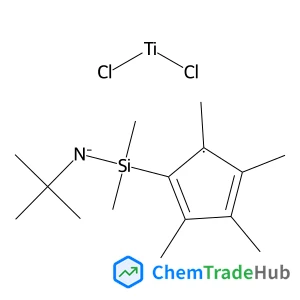
2,3,4,5-TETRAMETHYLCYCLOPENTADIENEDIMETHYLSILYL-TERT-BUTYLAMIDO TITANIUM DICHLORIDE
CAS号:
135072-61-6
分子式:
C15H27Cl2NSiTi-
![4-Chloro-1-[(4-methylphenyl)sulfonyl]-1H-pyrrolo[2,3-b]pyridine structure](https://cnstatic.chemtradehub.com/structs/348/348640-05-1-7db8.webp "4-Chloro-1-[(4-methylphenyl)sulfonyl]-1H-pyrrolo[2,3-b]pyridine structure")
推荐供应商



免责声明
本页面提供的学术期刊信息仅供参考和研究使用。我们与任何期刊出版商均无关联,也不处理投稿事宜。如有投稿相关咨询,请直接联系相关期刊出版商。
如发现页面信息有误,请发送邮件至 support@chemtradehub.com 联系我们。我们将及时核实并处理您的问题。