




Determination of anions in soil solutions by capillary zone electrophoresis
文献信息
发布日期
DOI
10.1039/A707497B
影响因子
4.616
作者
查看原文
摘要
Two simple methods have been developed for the direct quantification of low molecular mass aliphatic carboxylates and inorganic anions in soil solutions by capillary zone electrophoresis (CZE), one for di- and tricarboxylates and inorganic anions and the other for monocarboxylates. In addition to carboxylates and inorganic anions, soil solutions contain cations and unspecified humic substances which can interfere in the CZE analysis. Owing to complex formation, high concentrations of aluminium will invalidate the quantification of di- and tricarboxylates, such as citrate, malate and oxalate. This interference may be eliminated by addition of 10% v/v of 20 mM Na4EDTA at pH 11 to the soil solution samples prior to the analysis, with no further sample preparation. Metal cations did not interfere in the quantification of monocarboxylates and inorganic anions. The detection limits of low molecular mass aliphatic carboxylates and inorganic anions were all below 2 µM. The relative standard deviations for carboxylates and inorganic anions were within the ranges 4.2–5.1% for 100 µM and 9.3–59% for 1 µM standard solutions. The recovery of oxalate added to soil solution was 100 ± 8%. The CZE method requires small sample volumes and is robust to high concentrations of humic substances in the soil solutions and it is easier to maintain the capillary than ion chromatographic columns.
相关文献
The biocompatible polythiophene-g-polycaprolactone copolymer as an efficient dopamine sensor platform
Anca D. Bendrea, Luminita Cianga, Ioan Cianga
2017-09-11
Paper
DOI: 10.1039/C7PY01326D
The effect of conjugated π-bridge and fluorination on the properties of asymmetric-building-block-containing polymers (ABC polymers) based on dithienopyran donor and benzothiadiazole acceptors
Xiaochen Wang, Ailing Tang
2017-07-26
Paper
DOI: 10.1039/C7PY00964J
Synthesis and characterization of anion-exchange membranes based on hydrogenated poly(norbornene)
S. C. Price, X. Ren, A. M. Savage, F. L. Beyer
2017-08-22
Paper
DOI: 10.1039/C7PY01084B
On the high pressure rate constants for the H/Mu + O2 addition reactions
J. M. C. Marques, A. J. C. Varandas
2001-01-23
Communication
DOI: 10.1039/B010024M
Ligand field effect on the chemical shift in XANES spectra of Cu(II) compounds
Ken-ichi Shimizu, Hajime Maeshima, Hisao Yoshida, Atsushi Satsuma, Tadashi Hattori
2001-02-06
Paper
DOI: 10.1039/B007276L
The influence of orbital asymmetry on the kinetics of the gas-phase reactions of ozone with unsaturated compounds
David Johnson, Andrew R. Rickard, Charlotte D. McGill, George Marston
2000-01-25
Paper
DOI: 10.1039/A908701J
Partial molar volumes of linear hydrocarbons in methanol in the very dilute region. Intermolecular interactions. H-bond effects
Ester F. G. Barbosa, Susana M. C. Sousa, M. Soledade C. S. Santos, Isabel M. S. Lampreia
2001-01-19
Paper
DOI: 10.1039/B008685L
Improvement of CO tolerance of proton exchange membrane (PEM) fuel cells by a pulsing technique
2000-11-02
Paper
DOI: 10.1039/B005843M
Retracted Article: A polyurethane–chitosan brush as an injectable hydrogel for controlled drug delivery and tissue engineering
Arun Kumar Mahanta, Sudipta Senapati, Pralay Maiti
2017-09-19
Paper
DOI: 10.1039/C7PY01218G
您可能还喜欢
化合物问答
4-[4-三氟甲基苯基]恶唑(CAS号:1126636-40-5)通常如何合成?
4-[4-三氟甲基苯基]恶唑通常通过将4-三氟甲基苯酚与异硫氰酸苯酯在有机溶剂中进行酯化反应合成。该反应可在无水条件下,使用适当的催化剂,如四丁基氢氧化铵,以提...
1126636-40-54-(4-(Trifluoromethy...
59729-32-71-[3-(Dimethylamino)...
化合物问答
RockPhos Pd G3(CAS号:2009020-38-4)通常如何合成?
RockPhos Pd G3 通常通过钯催化偶联反应合成,使用配体 (2'-Amino-2-biphenylyl)(methanesulfonato-kappa...
2009020-38-4(2'-Amino-2-biphenyl...
化合物问答
1-哌啶甲酰胺(CAS号:2158-03-4)的市场或研究趋势如何?
1-哌啶甲酰胺作为有机合成中的重要中间体,其市场需求主要受医药、农药、染料等行业推动。近年来,随着新药开发和绿色化学的发展,该化合物的研究趋势集中在开发更高效、...
2158-03-41-Piperidinecarboxam...
化合物问答
2-(二苯基膦基)乙胺(CAS号:4848-43-5)适用哪些法规指南?
2-(二苯基膦基)乙胺适用于多种法规指南,包括但不限于《全球化学品统一分类和标签制度》(GHS),欧盟《化学品注册、评估、授权和限制》法规(REACH),以及美...
4848-43-52-(Diphenylphosphino...
化合物问答
如何储存间苯二甲酸二烯丙酯(CAS号:1087-21-4)?
间苯二甲酸二烯丙酯应储存在阴凉、干燥、通风良好的地方,远离火源和热源。储存容器应密封,避免光照和高温。储存温度应控制在25℃以下,相对湿度应低于80%。避免与其...
1087-21-4Diallyl isophthalate
化合物问答
什么是间甲苯异硫代异氰酸酯(CAS号:621-30-7)?
间甲苯异硫代异氰酸酯是一种有机化合物,分子式为C7H7NO2S,具有刺激性气味。它是一种重要的有机合成中间体,在合成其他化合物时广泛应用。
621-30-71-Isothiocyanato-3-m...
化合物问答
在合成中是否有N-Boc-D-苯丙氨醇(CAS号:106454-69-7)的替代品?
在合成中,可以考虑使用N-Cbz-D-苯丙氨醇或N-Fmoc-D-苯丙氨醇作为替代品。这些化合物同样具有保护氨基的功能,且在合成过程中表现出良好的反应性能。
106454-69-72-Methyl-2-propanyl ...
化合物问答
3-羟甲基-2-氧异丙基吡啶(CAS号:954240-50-7)的主要用途是什么?
3-羟甲基-2-氧异丙基吡啶主要用于有机合成领域,可以作为合成其他药物、农药或精细化学品的中间体。此外,它还可能在实验室研究中作为特定反应的前体或溶剂。
954240-50-7(2-Isopropoxy-3-pyri...
化合物问答
6-氨基-9-甲基嘌呤(CAS号:700-00-5)应用于哪些行业?
6-氨基-9-甲基嘌呤目前主要应用于医药行业,作为某些药物的中间体。此外,它还可能用于聚合物、传感器和半导体的某些领域,作为功能性单体或掺杂剂。
700-00-59-Methyl-9H-purin-6-...
来源期刊
Analyst

CiteScore:
7.8
自引率:
5.6%
年发文量:
653
Analyst publishes analytical and bioanalytical research that reports premier fundamental discoveries and inventions, and the applications of those discoveries, unconfined by traditional discipline barriers.
推荐化合物

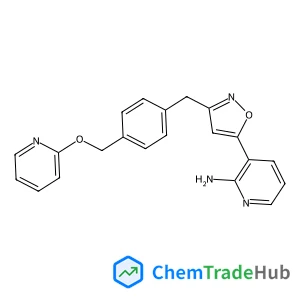
3-(3-(4-((Pyridin-2-yloxy)methyl)benzyl)isoxazol-5-yl)pyridin-2-amine
CAS号:
936339-60-5
分子式:
C21H18N4O2
推荐供应商





免责声明
本页面提供的学术期刊信息仅供参考和研究使用。我们与任何期刊出版商均无关联,也不处理投稿事宜。如有投稿相关咨询,请直接联系相关期刊出版商。
如发现页面信息有误,请发送邮件至 support@chemtradehub.com 联系我们。我们将及时核实并处理您的问题。