






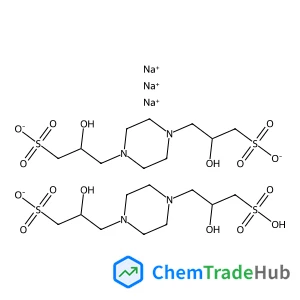
3,3'-(Piperazine-1,4-diyl)bis(2-hydroxypropane-1-sulfonic acid) Sodium Salt
CAS号:
108321-08-0
分子式:
C20H41N4Na3O16S4
The reaction of OH radicals with benzene and consecutive reactions of benzene–OH adducts with O2 were studied in the gas phase in N2–O2 mixtures at atmospheric pressure and room temperature. OH was produced by pulsed 248 nm photolysis of H2O2. Time-resolved detection of both OH and benzene–OH adducts was performed by continuous-wave (cw) UV-laser long-path absorption at around 308 nm. The reaction: OH+benzene→products [reaction (1)] was not affected by the presence of O2. Rate constants k1=(1.10±0.07)×10-12 cm3 s-1 and (1.06±0.07)×10-12 cm3 s-1 were obtained in N2 and O2, respectively. In N2 addition of NO2 did not change k1, from which an upper limit of 5% is derived for formation of H atoms in reaction (1). An absorption cross-section of σ(308 nm)=(5.8±1.5)×10-18 cm2 and a self-reaction rate constant of (3.4±1.7)×10-11 cm3 s-1 were determined for the benzene–OH adduct. Upper limits of 5×10-15 cm3 s-1, 1×10-14 cm3 s-1 and 5×10-14 cm3 s-1 were obtained for reactions of the adduct with benzene, H2O2 and NO, respectively. The adduct kinetics in the presence of O2 is consistent with the reversible formation of a peroxy radical: adduct+O2↔adduct–O2 [reaction (2a/-2a)]. An equilibrium constant of K2a=(2.7±0.4)×10-19 cm3 was determined and a rate constant of k2a=(2±1)×10-15 cm3 s-1 was roughly estimated. The effective adduct loss from the equilibrium can be explained by (i) an additional irreversible reaction of the adduct with O2 with a rate constant of (2.1±0.2)×10-16 cm3 s-1, or (ii) a unimolecular reaction of the peroxy radical, with a rate constant of (7.6±0.8)×102 s-1. For a reaction of the peroxy radical with O2 an upper limit of 1×10-17 cm3 s-1 is estimated. Addition of NO reveals formation of HO2 in the presence of O2 by recovering OH via HO2+NO. Applying numerical methods, reaction models were tested to describe the observed complex kinetics of OH. The data are consistent with rapid HO2 formation following a peroxy radical+NO reaction with a rate constant of (1.1±0.4)×10-11 cm3 s-1. Extrapolation of HO2 formation rates to [NO]=0 points at a second source of HO2 not preceded by any RO2+NO reaction.
Weiwei Zhu, Fuchong Li, Jikun Liu, Xingyu Ma, Xianxing Jiang
DOI: 10.1039/C9RE00227H
Dogancan Karan, Saif A. Khan
DOI: 10.1039/C9RE00150F
Eiji Yamaguchi, Nao Taguchi, Akichika Itoh
DOI: 10.1039/C9RE00061E
Hanxi Bao, Zhiqiang Zhou, Georgios Kotsalis, Guanghui Lan, Zhaohui Tong
DOI: 10.1039/C9RE00176J
Mikhail N. Zharkov, Svetlana S. Arabadzhi, Ilya V. Kuchurov, Sergei G. Zlotin
DOI: 10.1039/C9RE00035F
Wai Kuan Wong, Swee Kun Yap, Yi Chen Lim, Saif A. Khan, Frédéric Pelletier, Elena Cristina Corbos
DOI: 10.1039/C7RE00072C
Lawson K. Spare, Maria Menti
DOI: 10.1039/C8RE00318A
Masatsugu Mizuno, Hiroyuki Tateno, Yoshimasa Matsumura, Mahito Atobe
DOI: 10.1039/C7RE00089H
该化合物适用的法规指南包括GHS(全球化学品统一分类和标签制度)分类为特定目标器官毒性-单次接触类别3;根据欧盟REACH法规,该化合物需要进行注册和评估;在美...
在合成中,可以考虑使用一些类似的化合物作为4-(4-氯苯基)-1H-咪唑的替代品,如4-(4-溴苯基)-1H-咪唑或4-(4-甲氧基苯基)-1H-咪唑。这些化合...
N~2~-甲基丙氨酸酰胺是一种有机化合物,其化学名为2-(Methylamino)propanamide。它是一种酰胺类化合物,分子式为C4H10N2O,相对分...
处理含有N-苄基-3-氨基氧杂环丁烷草酸盐(CAS号:1956341-96-0)的废料时,应首先确保遵循相关法规要求,如GHS和REACH等。通常,废液应先进行...
4-溴-2-氯-6-甲基苯甲酸是一种固体化合物,具有较高的熔点和较低的沸点。它的分子量为261.03 g/mol。该化合物在水中几乎不溶,在有机溶剂中溶解度适中...
该化合物通常通过缩合反应合成,典型的方法是将2,5-二氯嘧啶与N-甲基苯甲酰胺在碱性条件下进行偶联反应。常用的碱包括NaH、LDA等强碱。该合成路线具有较高的选...
3,5-二溴-4-甲基苯胺在某些合成路线中可能没有直接替代品。然而,在某些应用场景下,可以考虑使用其他类似结构的化合物如3,5-二溴-4-硝基苯胺或3,5-二碘...
2-氯喹啉-4-羧酸甲酯主要用于有机合成和药物合成领域,作为中间体或原料。它在合成某些药物和染料时具有重要作用。此外,该化合物还可能用于某些特定的化学研究中。
6-溴-8-氯咪唑[1,2-a]吡啶在操作过程中需要谨慎以确保安全。该化合物具有一定的毒性,吸入其蒸气或粉尘可能导致呼吸道刺激。处理时应佩戴适当的防护装备,如手...

Physical Chemistry Chemical Physics (PCCP) is an international journal co-owned by 19 physical chemistry and physics societies from around the world. This journal publishes original, cutting-edge research in physical chemistry, chemical physics and biophysical chemistry. To be suitable for publication in PCCP, articles must include significant innovation and/or insight into physical chemistry; this is the most important criterion that reviewers and Editors will judge against when evaluating submissions. The journal has a broad scope and welcomes contributions spanning experiment, theory, computation and data science. Topical coverage includes spectroscopy, dynamics, kinetics, statistical mechanics, thermodynamics, electrochemistry, catalysis, surface science, quantum mechanics, quantum computing and machine learning. Interdisciplinary research areas such as polymers and soft matter, materials, nanoscience, energy, surfaces/interfaces, and biophysical chemistry are welcomed if they demonstrate significant innovation and/or insight into physical chemistry. Joined experimental/theoretical studies are particularly appreciated when complementary and based on up-to-date approaches.
![(1S,4aR,5R,7S,7aS)-1-(beta-D-Glucopyranosyloxy)-5-hydroxy-7-methyl-1,4a,5,6,7,7a-hexahydrocyclopenta[c]pyran-7-yl alpha-D-galactopyranoside structure](https://cnstatic.chemtradehub.com/structs/817/81720-07-2-4ffd.webp "(1S,4aR,5R,7S,7aS)-1-(beta-D-Glucopyranosyloxy)-5-hydroxy-7-methyl-1,4a,5,6,7,7a-hexahydrocyclopenta[c]pyran-7-yl alpha-D-galactopyranoside structure")
![5-Methoxy-1H-pyrrolo[3,2-b]pyridine structure](https://cnstatic.chemtradehub.com/structs/172/17288-40-3-a8d1.webp "5-Methoxy-1H-pyrrolo[3,2-b]pyridine structure")