








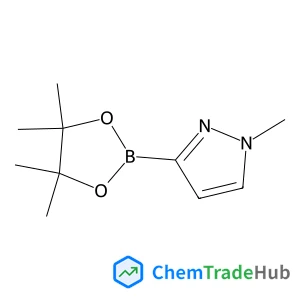
1-Methyl-3-(4,4,5,5-tetramethyl-1,3,2-dioxaborolan-2-yl)-1H-pyrazole
CAS号:
1020174-04-2
分子式:
C10H17BN2O2
Ludovic Tuduri, Valérie Desauziers, Jean Louis Fanlo
Adsorptive solid-phase microextraction (SPME) fibres have proven to be a reliable means of sampling volatile organic compounds (VOCs) in air. In this work, polydimethylsiloxane/carboxen (PDMS/CAR) fibres were used to test a new approach of air sampling strategy with SPME in the lab which could lighten calibration procedure and enhance the use of this already rapid, simple, convenient and cost effective sampling technique. Indeed, only one curve can be used whatever the extraction time chosen by the analyst under constant conditions of air velocity and temperature. Ficks' law of diffusion was used to model SPME grab sampling when the fibre was totally exposed to the air sample. Experimental sampling rates were then determined by GC-FID for different sampling conditions, i.e. in a flowing air stream of known velocity (“dynamic mode”) and in a stagnant air (“static mode”). These sampling rates were found to be 3.50 and 17.80 mL min−1 for acetone, 4.06 and 21.20 mL min−1 for 1,2-dichloroethane, 5.10 and 27.80 mL min−1 for toluene and 5.36 and 30.80 mL min−1 for butyl acetate, for static and dynamic sampling modes respectively. Deviation from linearity of the calibration curves, indicating that a significant fraction of the adsorption sites are occupied, were determined. They were found to be approximately equal to 0.9, 1.57, 3.82 and 4.37 nmol for acetone, dichloroethane, toluene and butyl acetate, respectively. Experimentally determined sampling rates of these isolated compounds were also valid when a complex equimolar gaseous mixture was investigated, but deviation from linearity appears earlier. Then, for a given application, sampling times should be chosen very carefully to avoid competitive adsorption and hence, bad quantitative analysis results.
Xin Zhou, Michel Dupuis, Can Li
DOI: 10.1039/C5CP04299B
Maria-Magdalena Mocanu, Diana Fedunova, Mai Suan Li
DOI: 10.1039/C6CP00901H
Maryana I. Nave, Yu-chen Karen Chen-Wiegart, Jun Wang, Konstantin G. Kornev
DOI: 10.1039/C5CP03431K
Yolanda Díaz-de-Mera, Alfonso Aranda, Alberto Notario, Ana Rodríguez, Diana Rodríguez, Iván Bravo
DOI: 10.1039/C5CP03527A
Aizhu Wang, Mingwen Zhao
DOI: 10.1039/C5CP03060A
Zarah Medina Baiyee, Chi Chen
DOI: 10.1039/C5CP02694F
Yingna Cui, Jingmei Yin, Changping Li, Shenmin Li, Ailing Wang, Guang Yang, Yingping Jia
DOI: 10.1039/C6CP03293A
Marta L. S. Batista, Helena Passos, Bruno J. M. Henriques, Edward J. Maginn, Simão P. Pinho, Mara G. Freire, José R. B. Gomes, João A. P. Coutinho
DOI: 10.1039/C6CP02538B
Shivnetra Saha, Shashank Deep
DOI: 10.1039/C6CP02906J
DOI: 10.1039/C5CP03499J
6-氯-2H-1,4-苯并噁嗪-3(4H)-酮主要应用于医药、农药和聚合物等领域。在医药领域,该化合物可用于合成抗菌药物;在农药领域,可用作杀虫剂的中间体;在聚...
活性氧化铝广泛应用于医药、聚合物、传感器、半导体和催化等领域。在医药行业,活性氧化铝用作吸附剂和干燥剂,有助于去除杂质和水分。在聚合物行业,它用作增白剂和抗结块...
硅胶(Silica gel, pptd.,cryst.-free)是一种无定形、多孔的硅酸盐材料,主要成分为二氧化硅(SiO₂)。其结构由硅氧四面体构成,通过酸...
二乙基甲基一氢硅烷主要用于有机合成、表面处理以及作为溶剂。它还被用作合成其他硅烷化合物的原料,以及在涂料、粘合剂和密封剂中的应用。
在合成过程中,可以考虑使用类似结构的化合物作为替代品,例如N-亚油酰基甘氨酸或N-花生二烯酰基甘氨酸。这些替代品在结构上有类似的双键位置,但可能具有不同的物理化...
在合成过程中,可以考虑使用类似结构的化合物作为替代品,例如1-(3-甲氧基苯基)丙烷-1,2-二酮或1-(4-羟基苯基)丙烷-1,2-二酮。这些替代品具有相似的...
该化合物通常通过一系列复杂的有机合成步骤获得。首先,通过芳香族化合物的羟基化反应获得羟基化产物,然后通过酰化反应形成酰胺中间体,最后通过环化反应得到目标产物。常...
该化合物作为生物活性化合物,尤其是在药物化学领域表现出色。近年来,随着对新型抗炎、抗病毒和抗癌药物的研究增加,其市场和研究趋势持续增长。此外,其在神经科学领域的...
核黄素磷酸钠在常规使用条件下安全,但高剂量可能引起刺激性反应。操作时需佩戴防护手套和护目镜,避免吸入粉尘。若接触皮肤或眼睛,应立即用大量清水冲洗。急救时需根据接...
盐酸丙胺卡因杂质A(EP) 标准品可通过重氮化反应和随后的酰胺化反应合成。首先,利用氯化反应将苯环上的氢原子转化为氯原子,然后通过芳香族重氮化反应引入氨基,最后...

Analyst publishes analytical and bioanalytical research that reports premier fundamental discoveries and inventions, and the applications of those discoveries, unconfined by traditional discipline barriers.
![1,2-Diphenyl-4-[2-(phenylsulfinyl)ethyl]-3,5-pyrazolidinedione structure](https://cnstatic.chemtradehub.com/structs/57-/57-96-5-efcc.webp "1,2-Diphenyl-4-[2-(phenylsulfinyl)ethyl]-3,5-pyrazolidinedione structure")


