







Supersonic jet UV spectrum and nonradiative processes of the thymine analogue 5-methyl-2-hydroxypyrimidine
文献信息
发布日期
2010-03-06
DOI
10.1039/B924395J
影响因子
3.676
作者
Simon Lobsiger, Hans-Martin Frey, Samuel Leutwyler
查看原文
摘要
We investigate the infrared and electronic absorption spectra and the excited-state nonradiative processes of supersonic jet-cooled 5-methyl-2-hydroxypyrimidine (5M2HP), the enol form of deoxythymine, using two-color resonant two-photon ionization (R2PI) and infrared–UV depletion spectroscopies. Unlike uracil and thymine, which exhibit structureless electronic absorption spectra, the vibronic spectrum of 5M2HP is structured with narrow vibronic bands, allowing for the first time to probe the excited state of a thymine analogue. The S0 state infrared depletion spectrum shows an O–H and no N–H stretch band, identifying the spectrum as that of the enol tautomer. The S1 ← S0 electronic transition is 1nπ*, as evidenced by the rotational contour of the 000 band. Vibronic excitations of the in-plane benzene-type vibrations , , and are observed, while none are observed for the out-of plane fundamental excitations, implying that the 1nπ* excited state of 5M2HP has a planar pyrimidine frame. From 1200 to 3600 cm−1 the vibronic bands become steadily broader, signaling a coupling to a lower-lying electronic state that increases with increasing energy. At ∼3600 cm−1 above the origin, the R2PI spectrum broadens completely, indicating that the two states are strongly mixed. Delayed ionization measurements show that the coupled electronic state has a >5 μs lifetime. No fluorescence has been observed from the 1nπ* state, implying relaxation to the lower-lying long-lived state is very efficient. Separate ionization potentials are measured for the 1nπ* state (9.178 eV) and for the long-lived state (∼9.46 eV), hence the latter lies ∼2200 cm−1 below the 1nπ* state. Time-dependent B3LYP calculations of the excited states of 5M2HP indeed predict the S1 state to be 1nπ* with a planar hydroxypyrimidine moiety. The T1 (3ππ*) state is calculated to lie 3000 cm−1 below the S1 state, in excellent agreement with the experiment.
相关文献
Elemental sulfur mediated 2-substituted benzothiazole formation from 2-aminobenzenethiols and arylacetylenes or styrenes under metal-free conditions
Guozheng Li, Jingjing Jiang, Fuhong Xiao, Guo-Jun Deng
2017-11-14
Paper
DOI: 10.1039/C7OB02430D
Strategies for the synthesis of furo-pyranones and their application in the total synthesis of related natural products
2021-01-25
Review Article
DOI: 10.1039/D0QO01421D
Withapubesides A–D: natural inducible nitric oxide synthase (iNOS) inhibitors from Physalis pubescens
Bing-Yang Zhang, Yang Li, Ning Kang, Shi-Jie Cao, Li-Qin Ding, Li-Xia Chen, Feng Qiu
2017-11-13
Paper
DOI: 10.1039/C7OB02551C
Na2S-mediated synthesis of terminal alkynes from gem-dibromoalkenes
Radhey M. Singh, Kishor Chandra Bharadwaj, Tanu Gupta, Raj Pal Singh
2017-11-14
Communication
DOI: 10.1039/C7OB02431B
Controlling miRNA-like off-target effects of an siRNA with nucleobase modifications
Scott R. Suter, Alexi Ball-Jones, Madeline M. Mumbleau, Rachel Valenzuela, Jose Ibarra-Soza, Hassan Owens, Peter A. Beal
2017-11-14
Paper
DOI: 10.1039/C7OB02654D
Nanoprodrug of retinoic acid-modified paclitaxel
Zijun Zhou, Jingzhe Yan, Xin Wang, Zhigang Xie
2017-10-27
Paper
DOI: 10.1039/C7OB02553J
Benzannulation strategies for the synthesis of carbazoles, indolocarbazoles, benzocarbazoles, and carbolines
Ankush Banerjee, Samrat Kundu, Arya Bhattacharyya, Samrat Sahu, Modhu Sudan Maji
2021-03-15
Review Article
DOI: 10.1039/D1QO00092F
Cobalt- and iron-catalyzed regiodivergent alkene hydrosilylations
Sheng Zhang, Jia-Shia Liao, Daniel K. Unruh, Guigen Li, Michael Findlater
2021-02-25
Research Article
DOI: 10.1039/D1QO00018G
您可能还喜欢
化合物问答
十二烷基磺酸钠(CAS号:2386-53-0)的主要用途是什么?
十二烷基磺酸钠主要用作表面活性剂,广泛应用于洗涤剂、肥皂、化妆品和工业清洁产品中。它能有效去除油脂和污垢,常用于制造洗发水、沐浴露、洗衣粉和金属清洗剂。此外,它...
2386-53-01-Dodecanesulfonic a...
化合物问答
5-羟基异喹啉(CAS号:2439-04-5)适用哪些法规指南?
5-羟基异喹啉作为化学品,主要适用的法规包括GHS全球化学品统一分类和标签制度,REACH法规等。GHS将5-羟基异喹啉分类为皮肤腐蚀/刺激类别2,严重眼损伤/...
2439-04-55-Isoquinolinol
化合物问答
在合成中是否有FIDAS-5 | Wnt(CAS号:1391934-98-7)的替代品?
合成中可以考虑使用类似结构的化合物,如4-[(E)-2-(2-氯-6-氟苯基)乙烯基]-N-甲基苯胺的类似物或衍生物作为替代品。这类化合物可能具有相似的生物活性...
1391934-98-74-[(E)-2-(2-Chloro-6...
化合物问答
(R)-tert-Butyl 2-(5-bromo-1H-imidazol-2-yl)pyrrolidine-1-carboxylate(CAS号:1370600-56-8)通常如何合成?
该化合物通常通过如下步骤合成:首先,将4-溴-1H-咪唑与对甲苯磺酸在乙酸乙酯中反应,得到中间体5-溴-1H-咪唑-2-甲酸乙酯。然后,该中间体与2-甲基-2-...
1370600-56-82-Methyl-2-propanyl ...
化合物问答
处理4-(吡咯烷-1-基)环己酮(CAS号:10421-18-8)时应注意哪些实验室安全事项?
处理4-(吡咯烷-1-基)环己酮时,应佩戴手套、护目镜和实验室外套,以防止直接接触或吸入。在通风橱中操作,确保良好的通风条件。一旦发生泄漏,应立即清理并使用适当...
10421-18-84-(Pyrrolidin-1-yl)c...
化合物问答
如何处理含有异麦芽糖醇(CAS号:534-73-6)的废料?
含有异麦芽糖醇的废液应首先进行分类收集,避免与其他化学品混合。对于小规模的废液,可以通过焚烧或加入特定的化学试剂进行无害化处理。对于大规模的废液,建议联系专业的...
534-73-66-O-alpha-D-Glucopyr...
化合物问答
7-甲基壬酸(CAS号:41653-89-8)的主要用途是什么?
7-甲基壬酸主要用于有机合成领域,作为合成其他化合物的原料。此外,它还可能作为一种中间体用于药品制造和香料合成,但具体用途需要根据其具体的化学结构和反应特性来确...
41653-89-87-Methylnonanoic aci...
化合物问答
N-甲氧基-N-甲基甲基吡啶羧酰胺(CAS号:148493-07-6)应用于哪些行业?
N-甲氧基-N-甲基甲基吡啶羧酰胺在医药领域有一定的应用,作为一种潜在的药物前体或中间体。此外,该化合物也可能应用于聚合物改性剂、传感器材料等。由于其独特的化学...
148493-07-6N-Methoxy-N-methylpi...
化合物问答
什么是惕各酸香叶酯(CAS号:7785-33-3)?
惕各酸香叶酯是一种化合物,化学名称为(2E)-3,7-二甲基-2,6-辛二烯-1-基(2E)-2-甲基-2-丁烯酸酯。它是一种具有香叶香气的化合物,分子式为C1...
7785-33-3(2E)-3,7-Dimethyl-2,...
化合物问答
1-环丁基哌嗪(CAS号:132800-13-6)安全吗?
1-环丁基哌嗪在适当的操作条件下是相对安全的,但如遇明火或高热会释放有毒气体。操作时应佩戴防护眼镜和手套,避免吸入或接触皮肤、眼睛。
132800-13-61-Cyclobutylpiperazi...
来源期刊
Physical Chemistry Chemical Physics

CiteScore:
5.5
自引率:
10.3%
年发文量:
3036
Physical Chemistry Chemical Physics (PCCP) is an international journal co-owned by 19 physical chemistry and physics societies from around the world. This journal publishes original, cutting-edge research in physical chemistry, chemical physics and biophysical chemistry. To be suitable for publication in PCCP, articles must include significant innovation and/or insight into physical chemistry; this is the most important criterion that reviewers and Editors will judge against when evaluating submissions. The journal has a broad scope and welcomes contributions spanning experiment, theory, computation and data science. Topical coverage includes spectroscopy, dynamics, kinetics, statistical mechanics, thermodynamics, electrochemistry, catalysis, surface science, quantum mechanics, quantum computing and machine learning. Interdisciplinary research areas such as polymers and soft matter, materials, nanoscience, energy, surfaces/interfaces, and biophysical chemistry are welcomed if they demonstrate significant innovation and/or insight into physical chemistry. Joined experimental/theoretical studies are particularly appreciated when complementary and based on up-to-date approaches.
推荐化合物
![4-[2-(Trichlorosilyl)ethyl]benzenesulfonyl chloride structure](https://cnstatic.chemtradehub.com/structs/797/79793-00-3-de16.webp "4-[2-(Trichlorosilyl)ethyl]benzenesulfonyl chloride structure")
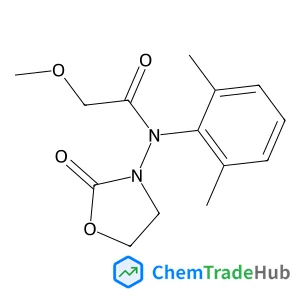
N-(2,6-Dimethylphenyl)-2-methoxy-N-(2-oxo-1,3-oxazolidin-3-yl)acetamide
CAS号:
77732-09-3
分子式:
C14H18N2O4
推荐供应商




免责声明
本页面提供的学术期刊信息仅供参考和研究使用。我们与任何期刊出版商均无关联,也不处理投稿事宜。如有投稿相关咨询,请直接联系相关期刊出版商。
如发现页面信息有误,请发送邮件至 support@chemtradehub.com 联系我们。我们将及时核实并处理您的问题。