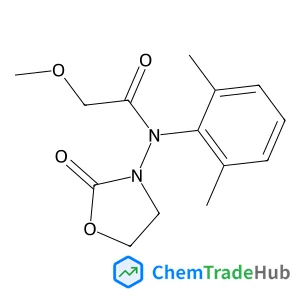
N-(2,6-Dimethylphenyl)-2-methoxy-N-(2-oxo-1,3-oxazolidin-3-yl)acetamide
CAS号:
77732-09-3
分子式:
C14H18N2O4
Jia Deng, Andrew T. B. Gilbert, Peter M. W. Gill
We propose a density functional perturbative scheme to approximate the energy of a high-level DFT calculation at a significantly reduced cost. Our approach involves performing a primary SCF calculation using a crude functional, basis set and quadrature grid, followed by a single step using a more sophisticated secondary functional, basis and grid. Unlike the earlier dual-level DFT approach of Nakajima and Hirao, we use Roothaan diagonalization instead of perturbation theory to incorporate the effects of the secondary basis set. We show that energies at the popular B3LYP/6-311+G(3df,2p)/(75,302) level can be accurately estimated from primary calculations at the relatively economical BLYP/6-31G(d)/SG-0 level.
Heteroatom Chemistry
Acta Metallurgica Sinica-English Letters
Bioorganic & Medicinal Chemistry Letters

Electroanalysis
Colloid Journal
Journal of the Indian Institute of Science
Biocatalysis and Biotransformation
Journal of Asian Natural Products Research
Bioorganic & Medicinal Chemistry
NDT & E International
Renata Costa, Carlos M. Pereira, Fernando Silva
DOI: 10.1039/C003920A
Takuya Shimomura, Kenta Fujii, Toshiyuki Takamuku
DOI: 10.1039/C0CP00614A
Jasper Van Noyen, Bert F. Sels, Pierre A. Jacobs, Thierry Verbiest, Dirk E. De Vos
DOI: 10.1039/C0CP00257G
Sean Garrett-Roe, Peter Hamm
DOI: 10.1039/C004579A
Marika Janovská, Martin Kubala, Vilím Šimánek, Jitka Ulrichová
DOI: 10.1039/B925828K
Giuseppe Brancato, Nadia Rega
DOI: 10.1039/C003005H
Ekaterina Y. Lukianova-Hleb, Lindsey J. E. Anderson, Seunghyun Lee
DOI: 10.1039/C0CP00499E
Andrew P. S. Jurd, Jeremy J. Titman
DOI: 10.1039/B906814G
十二烷基磺酸钠主要用作表面活性剂,广泛应用于洗涤剂、肥皂、化妆品和工业清洁产品中。它能有效去除油脂和污垢,常用于制造洗发水、沐浴露、洗衣粉和金属清洗剂。此外,它...
5-羟基异喹啉作为化学品,主要适用的法规包括GHS全球化学品统一分类和标签制度,REACH法规等。GHS将5-羟基异喹啉分类为皮肤腐蚀/刺激类别2,严重眼损伤/...
合成中可以考虑使用类似结构的化合物,如4-[(E)-2-(2-氯-6-氟苯基)乙烯基]-N-甲基苯胺的类似物或衍生物作为替代品。这类化合物可能具有相似的生物活性...
该化合物通常通过如下步骤合成:首先,将4-溴-1H-咪唑与对甲苯磺酸在乙酸乙酯中反应,得到中间体5-溴-1H-咪唑-2-甲酸乙酯。然后,该中间体与2-甲基-2-...
处理4-(吡咯烷-1-基)环己酮时,应佩戴手套、护目镜和实验室外套,以防止直接接触或吸入。在通风橱中操作,确保良好的通风条件。一旦发生泄漏,应立即清理并使用适当...
含有异麦芽糖醇的废液应首先进行分类收集,避免与其他化学品混合。对于小规模的废液,可以通过焚烧或加入特定的化学试剂进行无害化处理。对于大规模的废液,建议联系专业的...
7-甲基壬酸主要用于有机合成领域,作为合成其他化合物的原料。此外,它还可能作为一种中间体用于药品制造和香料合成,但具体用途需要根据其具体的化学结构和反应特性来确...
N-甲氧基-N-甲基甲基吡啶羧酰胺在医药领域有一定的应用,作为一种潜在的药物前体或中间体。此外,该化合物也可能应用于聚合物改性剂、传感器材料等。由于其独特的化学...
惕各酸香叶酯是一种化合物,化学名称为(2E)-3,7-二甲基-2,6-辛二烯-1-基(2E)-2-甲基-2-丁烯酸酯。它是一种具有香叶香气的化合物,分子式为C1...
1-环丁基哌嗪在适当的操作条件下是相对安全的,但如遇明火或高热会释放有毒气体。操作时应佩戴防护眼镜和手套,避免吸入或接触皮肤、眼睛。

Physical Chemistry Chemical Physics (PCCP) is an international journal co-owned by 19 physical chemistry and physics societies from around the world. This journal publishes original, cutting-edge research in physical chemistry, chemical physics and biophysical chemistry. To be suitable for publication in PCCP, articles must include significant innovation and/or insight into physical chemistry; this is the most important criterion that reviewers and Editors will judge against when evaluating submissions. The journal has a broad scope and welcomes contributions spanning experiment, theory, computation and data science. Topical coverage includes spectroscopy, dynamics, kinetics, statistical mechanics, thermodynamics, electrochemistry, catalysis, surface science, quantum mechanics, quantum computing and machine learning. Interdisciplinary research areas such as polymers and soft matter, materials, nanoscience, energy, surfaces/interfaces, and biophysical chemistry are welcomed if they demonstrate significant innovation and/or insight into physical chemistry. Joined experimental/theoretical studies are particularly appreciated when complementary and based on up-to-date approaches.