



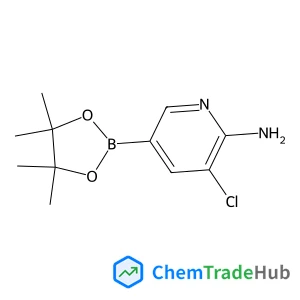
3-Chloro-5-(4,4,5,5-tetramethyl-1,3,2-dioxaborolan-2-yl)-2-pyridinamine
CAS号:
1032758-99-8
分子式:
C11H16BClN2O2
Cunku Dong, Jingyao Qi
The electronic and optical natures of silica-coated semiconductor nanocrystals (Cd2Te2@(SiO2)24) have been investigated by density functional theory (DFT) and time-dependent DFT calculations. The calculated results of Cd2Te2@(SiO2)24 have revealed that the structural synergy effect between the Cd2Te2 quantum dots (QDs) and the silica coating shell plays a dominant role in the photoelectric properties. The binding of embedded Cd2Te2 to the outer silica coating shell leads to the distortion of the silica nanocage, indicating strong coupling between the QDs and silica shell. The optical features of Cd2Te2 clusters and Cd2Te2@(SiO2)24 complexes were evaluated using the time-dependent DFT method. It is determined that the maximal absorption peak of isolated Cd2Te2 in a UV-Vis absorption spectrum appears at 584 nm, which shifts to 534 nm when the Cd2Te2 QDs were encapsulated by silica, in close agreement with the experimental evidence. The excited process has a direct electronic transition character from the occupied Cd2Te2 states to the outer silica nanocage excited states (core → shell electronic transitions). A deep insight into silica-coated QD systems is beneficial for understanding their optical nature and the development of core/shell QDs.
Marcus J. C. Long, Yi Zhao, Yimon Aye
DOI: 10.1039/D0CB00041H
Alexander W. Weig, Samantha L. Barlock, Patrick M. O'Connor, Orry M. Marciano, Richard Smith, Robert K. Ernst, Roberta J. Melander, Christian Melander
DOI: 10.1039/D0MD00238K
Shrestha Tyagi, Manika Chaudhary, Anit K. Ambedkar, Kavita Sharma, Yogendra K. Gautam, Beer Pal Singh
DOI: 10.1039/D1SD00034A
Álvaro Lorente-Macías
DOI: 10.1039/D0MD00292E
Yuichiro Akao, Stacie Canan, Yafeng Cao, Kevin Condroski, Ola Engkvist, Sachiko Itono, Rina Kaki, Chiaki Kimura, Thierry Kogej, Kazuya Nagaoka, Akira Naito, Hiromi Nakai, Garry Pairaudeau, Constantin Radu, Ieuan Roberts, Mitsuyuki Shimada, David Shum, Nao-aki Watanabe, Huanxu Xie, Shuji Yonezawa, Osamu Yoshida, Ryu Yoshida, Charles Mowbray, Benjamin Perry
DOI: 10.1039/D0MD00353K
Xingye Yang, Lupei Du
DOI: 10.1039/D1MD00170A
Tatsuki Koike, Aoi Sugimoto, Shuhei Kosono, Sumika Komaba, Yuko Kanno, Takashi Kitamura, Itsuki Anzai, Tokiko Watanabe, Daisuke Takahashi, Kazunobu Toshima
DOI: 10.1039/D1MD00264C
Alexandria M. Chan
DOI: 10.1039/D0MD00286K
3 - (二氟甲基)-1 -氟苯需遵循联合国全球化学品统一分类和标签制度(GHS),包括急性毒性、皮肤腐蚀/刺激、严重眼损伤/眼刺激等分类。同时,该化合物还需符...
3,5-二甲基苯胺通常通过乙苯的氨解反应合成。反应中使用硫酸作为催化剂,反应温度为120-130°C。乙苯在硫酸存在下与氨反应,生成3,5-二甲基苯胺和苯胺副产...
3-甲基异噻唑-5-胺在适当使用和储存条件下是相对安全的,但在操作时应注意防护措施。应避免吸入粉尘,避免与皮肤和眼睛直接接触。在操作过程中,应穿戴适当的防护装备...
3-(1,3-噻唑-2-基)-1H-吲哚通常通过多步合成方法制备。首先,由噻唑-2-基溴化物和吲哚进行偶联反应,得到中间体。然后,通过还原反应将中间体转化为所需...
4-溴-2-氟苯甲基氯主要用于有机合成中间体,特别是在医药、农药和染料等领域。作为一种具有特定结构的化合物,它在合成复杂有机分子时扮演重要角色。
处理Fmoc-β-(3-噻吩基)-D-Ala-OH时,应佩戴防护手套、护目镜和实验服。操作应在通风橱内进行。如发生泄露,应立即用大量水冲洗,并通知实验室管理人员...
氮化硅通常通过氮化硅的直接反应合成,即在高温下将四氯化硅与氨气反应。具体步骤是将四氯化硅和氨气混合并加热至1300-1700℃,在该条件下,四氯化硅与氨气反应生...
Cetirizine EP Impurity B DiHCl通常通过一锅法合成,首先将4-氯苯基-苯甲基氯甲酸酯与1-哌嗪乙酸反应,生成相应的酸,然后与盐酸反应...
1-哌啶-4-基丁-1-酮应储存在阴凉、干燥的地方,避免阳光直射。存储容器应密封,并确保通风良好。建议储存温度不超过25℃,湿度保持在相对较低的水平。
含有VORUCICLIB的废料应进行专业的收集和处理,包括使用适当的容器进行隔离,避免与其他化学品接触。处理方法通常包括化学中和、沉淀反应或吸附过程,随后进行焚...

Physical Chemistry Chemical Physics (PCCP) is an international journal co-owned by 19 physical chemistry and physics societies from around the world. This journal publishes original, cutting-edge research in physical chemistry, chemical physics and biophysical chemistry. To be suitable for publication in PCCP, articles must include significant innovation and/or insight into physical chemistry; this is the most important criterion that reviewers and Editors will judge against when evaluating submissions. The journal has a broad scope and welcomes contributions spanning experiment, theory, computation and data science. Topical coverage includes spectroscopy, dynamics, kinetics, statistical mechanics, thermodynamics, electrochemistry, catalysis, surface science, quantum mechanics, quantum computing and machine learning. Interdisciplinary research areas such as polymers and soft matter, materials, nanoscience, energy, surfaces/interfaces, and biophysical chemistry are welcomed if they demonstrate significant innovation and/or insight into physical chemistry. Joined experimental/theoretical studies are particularly appreciated when complementary and based on up-to-date approaches.