


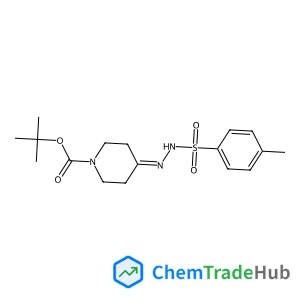
tert-Butyl 4-(2-(p-Tolylsulfonyl)hydrazono)piperidine-1-carboxylate
CAS号:
1046478-89-0
分子式:
C17H25N3O4S
B. P. Vinayan, Rupali Nagar, S. Ramaprabhu
Recent research developments reveal that nanomaterials, especially carbon nanomaterials, can play a significant role in the performance enhancement of energy conversion and storage devices. The synthesis procedure of nanomaterials, however, remains one of the governing factors for their wide scale implementation. In this paper, an in situ synthesis method to prepare palladium nanoparticle decorated nitrogen doped graphene sheets (Pd/N-SG) using focused solar radiation is developed. The present synthesis technique combines three processes simultaneously, namely (a) graphene sheet formation, (b) nitrogen doping of graphene sheets and (c) metal precursor reduction to metal nanoparticles, in one step through a green approach. The hydrogen storage properties of the Pd/N-SG sample are investigated using high pressure Sievert’s apparatus and the sample exhibits an excellent hydrogen storage capacity of 4.3 wt% at room temperature (25 °C and 4 MPa hydrogen pressure). The method developed for the synthesis is environmentally benign, easy to adopt and economical. Also, the proposed one-step synthesis method can be easily scaled up to large quantities and this opens a new pathway for the synthesis of nanomaterials for use in the renewable energy field.

Journal of Organometallic Chemistry
Pharmacological Reviews

Molecular Pharmacology

Pure and Applied Chemistry

Proceedings of the National Academy of Sciences of the United States of America

Fibre Chemistry

Organic Preparations and Procedures International

Journal of Medicinal Chemistry

European Journal of Wood and Wood Products

Kinetics and Catalysis
Chun-Liang Hou, Yuhang Yao, Da Wang, Jing Zhang, Jun-Long Zhang
DOI: 10.1039/C9QO00445A
Jinzhong Yao, Linlin Chen, Linfeng Hu, Xiaofang Li, Hongwei Zhou
DOI: 10.1039/C9QO00028C
Jin-Dou Huang, Jianbin Zhang, Dengyi Chen, Huipeng Ma
DOI: 10.1039/C7QO00367F
Tianjiao Hou, Jian Zhang, Chenjiao Wang, Jun Luo
DOI: 10.1039/C7QO00357A
Ya Ding, Hao Li, Yunge Meng, Te Zhang, Jiawen Li, Qiu-Yun Chen
DOI: 10.1039/C7QO00276A
Wei Guo, Panwang Zhou, Zhe Tang
DOI: 10.1039/C9QO00295B
Qing Zhou, Bo Chen, Xiao-Bing Huang, Ya-Li Zeng, Wen-Dao Chu, Quan-Zhong Liu
DOI: 10.1039/C9QO00325H
Hyungmo Koo, Hun Young Kim, Kyungsoo Oh
DOI: 10.1039/C9QO00217K
Konstantin N. Gavrilov, Igor S. Mikhel, Sergey V. Zheglov, Vladislav K. Gavrilov, Ilya V. Chuchelkin, Ilya D. Firsin, Kirill P. Birin, Ivan S. Pytskii, Ksenia A. Paseshnichenko, Victor A. Tafeenko, Alexei A. Shiryaev
DOI: 10.1039/C9QO00237E
4,5-二甲基-2-硝基苯甲酸主要应用于制药、染料和农药等行业。由于其潜在的毒性,其市场趋势可能受到法规限制和环保考量的影响,推动了替代产品的研发。在研究领域,...
处理直接黑22时应穿戴适当的个人防护装备(PPE),包括实验服、手套、护目镜和口罩。操作应在通风橱内进行,以避免吸入有害气体。如果发生泄漏,应立即清理,并使用大...
处理2,1,3-苯并噻二唑-4-基异氰酸酯时应注意以下安全事项:穿戴个人防护装备,如实验室外套、防护眼镜和手套;在通风橱中操作,确保良好的通风;保持实验室环境干...
含有Δ-8,9-脱氢雌酮的废料需要进行适当的处理以确保环境和人体安全。首先,收集废液并存放于密封容器中,避免泄漏。其次,可以考虑将其转化为无害物质或通过专业处理...
5-溴戊酸应储存在阴凉、干燥、通风良好的环境中,避免阳光直射。建议在室温(约15-25°C)下保存,保持相对湿度低于60%。应使用密封的玻璃或塑料容器,并远离热...
4-(甲基亚磺酰基)苯胺在医药、聚合物和传感器等领域有一定的应用。在医药方面,它可以用作合成药物的中间体;在聚合物领域,可以作为合成特殊性能高分子材料的单体;在...
1-(2-氟苯基)-5-甲基-1H-吡唑-4-亚甲基肼是一种有机化合物,其分子式为C9H9FN3O。该化合物具有特定的物理化学性质,如熔点、沸点等,但具体值需查...
Dauricumine通常通过复杂的合成路线制备,涉及多个步骤,包括环化、氧化、卤化等反应。合成过程中使用了多种催化剂和试剂,例如金属催化剂、氧化剂等。产率通常...
5-氰基苯酞在正常使用条件下相对安全,但其具有一定的毒性,需谨慎操作。在实验或工业应用中,应采取适当的防护措施,如佩戴防护手套、护目镜和实验服,确保通风良好。误...
该化合物在使用时需要谨慎操作。虽然其毒性和健康风险尚未完全明确,但建议在通风良好的环境中操作,并穿戴适当的个人防护装备,如手套和防护眼镜。
Journal of Materials Chemistry A, B & C cover high quality studies across all fields of materials chemistry. The journals focus on those theoretical or experimental studies that report new understanding, applications, properties and synthesis of materials. The journals have a strong history of publishing quality reports of interest to interdisciplinary communities and providing an efficient and rigorous service through peer review and publication. The journals are led by an international team of Editors-in-Chief and Associate Editors who are all active researchers in their fields. Journal of Materials Chemistry A, B & C are separated by the intended application of the material studied. Broadly, applications in energy and sustainability are of interest to Journal of Materials Chemistry A, applications in biology and medicine are of interest to Journal of Materials Chemistry B, and applications in optical, magnetic and electronic devices are of interest to Journal of Materials Chemistry C. More than one Journal of Materials Chemistry journal may be suitable for certain fields and researchers are encouraged to submit their paper to the journal that they feel best fits for their particular article. Example topic areas within the scope of Journal of Materials Chemistry A are listed below. This list is neither exhaustive nor exclusive. Artificial photosynthesis Batteries Carbon dioxide conversion Catalysis Fuel cells Gas capture/separation/storage Green/sustainable materials Hydrogen generation Hydrogen storage Photocatalysis Photovoltaics Self-cleaning materials Self-healing materials Sensors Supercapacitors Thermoelectrics Water splitting Water treatment
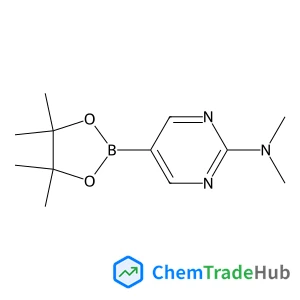
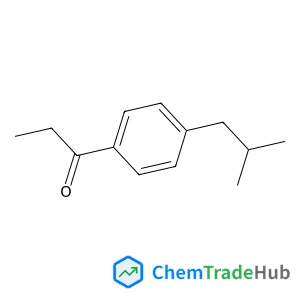
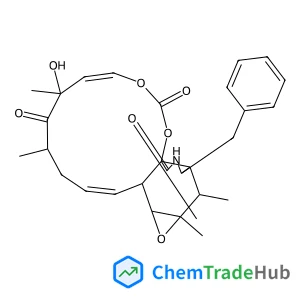
![2-{[(1R,2S)-2-Aminocyclohexyl]amino}-4-{[3-(2H-1,2,3-triazol-2-yl)phenyl]amino}-5-pyrimidinecarboxamide structure](https://cnstatic.chemtradehub.com/structs/137/1370261-96-3-40df.webp "2-{[(1R,2S)-2-Aminocyclohexyl]amino}-4-{[3-(2H-1,2,3-triazol-2-yl)phenyl]amino}-5-pyrimidinecarboxamide structure")




