



Amperometric hydrogen peroxide and glucose biosensor based on NiFe2/ordered mesoporous carbon nanocomposites
文献信息
发布日期
2014-11-27
DOI
10.1039/C4AN01549E
影响因子
4.616
作者
Longwei Yin, Jingyun Ma, Enyan Guo, Qun Li, Zhaoqiang Li, Kegao Liu
查看原文
摘要
Nanocomposites of NiFex embedded in ordered mesoporous carbon (OMC) (x = 0, 1, 2) were prepared by a wet impregnation and hydrogen reduction process and were used to construct electrochemical biosensors for the amperometric detection of hydrogen peroxide (H2O2) or glucose. The NiFe2/OMC nanocomposites were demonstrated to have a large surface area, suitable mesoporous channels, many edge-plane-like defective sites, and a good distribution of alloyed nanoparticles. The NiFe2/OMC and Nafion modified glass carbon electrode (GCE) exhibited excellent electrocatalytic activities toward the reduction of H2O2 as well. By utilizing it as a bioplatform, GOx (glucose oxidase) cross-linked with Nafion was immobilized on the surface of the electrode for the construction of an amperometric glucose biosensor. Our results indicated that the amperometric hydrogen peroxide biosensor (NiFe2/OMC + Nafion + GCE) showed good analytical performances in term of a high sensitivity of 4.29 μA mM−1 cm−2, wide linearity from 6.2 to 42 710 μM and a low detection limit of 0.24 μM at a signal-to-noise ratio of 3 (S/N = 3). This biosensor exhibited excellent selectivity, high stability and negligible interference for the detection of H2O2. In addition, the immobilized enzyme on NiFe2/OMC + Nafion + GCE, retaining its bioactivity, exhibited a reversible two-proton and two-electron transfer reaction, a fast heterogeneous electron transfer rate and an effective Michaelis–Menten constant (K′M) (3.18 mM). The GOx + NiFe2/OMC + Nafion + GCE could be used to detect glucose based on the oxidation of glucose catalyzed by GOx and exhibited a wide detection range of 48.6–12 500 μM with a high sensitivity of 6.9 μA mM−1 cm−2 and a low detection limit of 2.7 μM (S/N = 3). The enzymic biosensor maintained a high selectivity and stability features, and shows great promise for application in the detection of glucose.
期刊推荐

Organic Preparations and Procedures International

Fibre Chemistry

Helvetica Chimica Acta

Russian Chemical Reviews

Science Progress

Proceedings of the National Academy of Sciences of the United States of America

Pharmacological Reviews

European Journal of Wood and Wood Products

Journal of Organometallic Chemistry

Journal of Physics and Chemistry of Solids
相关文献
Hydrogentracer diffusion in LiBH4 measured by spatially resolved Raman spectroscopy
A. Borgschulte, R. Gremaud, Z. Łodziana, A. Züttel
2010-03-29
Paper
DOI: 10.1039/C000229A
Electronic structure of Lewis acid sites on high surface area aluminium fluorides: a combined XPS and ab initio investigation
Christine L. Bailey, Erhard Kemnitz, Sanghamitra Mukhopadhyay, Adrian Wander, Barry G. Searle
2009-05-08
Paper
DOI: 10.1039/B821484K
Supersonic jet UV spectrum and nonradiative processes of the thymine analogue 5-methyl-2-hydroxypyrimidine
Simon Lobsiger, Hans-Martin Frey, Samuel Leutwyler
2010-03-06
Paper
DOI: 10.1039/B924395J
Parallel ultrafast E–C ring closure and E–Z isomerisation in a photochromic furylfulgide studied by femtosecond time-resolved spectroscopy
Ron Siewertsen, Falk Renth, Friedrich Temps, Frank Sönnichsen
2009-05-28
Paper
DOI: 10.1039/B821344E
Motion of single wandering diblock-macromolecules directed by a PTFE nano-fence: real time SFM observations
Marat O. Gallyamov, Shuhui Qin, Krzysztof Matyjaszewski, Martin Möller
2009-04-20
Paper
DOI: 10.1039/B819011A
Defect interactions and ionic transport in scandia stabilized zirconia
R. Devanathan, S. Thevuthasan, J. D. Gale
2009-04-22
Paper
DOI: 10.1039/B902764E
SERS observation of soft C–H vibrational mode of bifunctional alkanethiol molecules adsorbed at Au and Agelectrodes
Inga Razmute-Razmė, Zenonas Kuodis, Olegas Eicher-Lorka, Gediminas Niaura
2010-02-18
Communication
DOI: 10.1039/B921291D
Divalent carbon atom as the proton acceptor in hydrogen bonding
Mirosław Jabłoński, Marcin Palusiak
2009-05-07
Paper
DOI: 10.1039/B901968E
A vibrational circular dichroism approach to the determination of the absolute configuration of flexible and transparent molecules: fluorenoneketals of 1,n-diols
Patrizia Scafato, Carlo Rosini
2010-03-17
Paper
DOI: 10.1039/B913213A
Crystal structure prediction for cyclotrimethylene trinitramine (RDX) from first principles
Betsy M. Rice, Krzysztof Szalewicz
2009-04-28
Paper
DOI: 10.1039/B902015B
您可能还喜欢
化合物问答
十二烷基磺酸钠(CAS号:2386-53-0)的主要用途是什么?
十二烷基磺酸钠主要用作表面活性剂,广泛应用于洗涤剂、肥皂、化妆品和工业清洁产品中。它能有效去除油脂和污垢,常用于制造洗发水、沐浴露、洗衣粉和金属清洗剂。此外,它...
2386-53-01-Dodecanesulfonic a...
化合物问答
5-羟基异喹啉(CAS号:2439-04-5)适用哪些法规指南?
5-羟基异喹啉作为化学品,主要适用的法规包括GHS全球化学品统一分类和标签制度,REACH法规等。GHS将5-羟基异喹啉分类为皮肤腐蚀/刺激类别2,严重眼损伤/...
2439-04-55-Isoquinolinol
化合物问答
在合成中是否有FIDAS-5 | Wnt(CAS号:1391934-98-7)的替代品?
合成中可以考虑使用类似结构的化合物,如4-[(E)-2-(2-氯-6-氟苯基)乙烯基]-N-甲基苯胺的类似物或衍生物作为替代品。这类化合物可能具有相似的生物活性...
1391934-98-74-[(E)-2-(2-Chloro-6...
化合物问答
(R)-tert-Butyl 2-(5-bromo-1H-imidazol-2-yl)pyrrolidine-1-carboxylate(CAS号:1370600-56-8)通常如何合成?
该化合物通常通过如下步骤合成:首先,将4-溴-1H-咪唑与对甲苯磺酸在乙酸乙酯中反应,得到中间体5-溴-1H-咪唑-2-甲酸乙酯。然后,该中间体与2-甲基-2-...
1370600-56-82-Methyl-2-propanyl ...
化合物问答
处理4-(吡咯烷-1-基)环己酮(CAS号:10421-18-8)时应注意哪些实验室安全事项?
处理4-(吡咯烷-1-基)环己酮时,应佩戴手套、护目镜和实验室外套,以防止直接接触或吸入。在通风橱中操作,确保良好的通风条件。一旦发生泄漏,应立即清理并使用适当...
10421-18-84-(Pyrrolidin-1-yl)c...
化合物问答
如何处理含有异麦芽糖醇(CAS号:534-73-6)的废料?
含有异麦芽糖醇的废液应首先进行分类收集,避免与其他化学品混合。对于小规模的废液,可以通过焚烧或加入特定的化学试剂进行无害化处理。对于大规模的废液,建议联系专业的...
534-73-66-O-alpha-D-Glucopyr...
化合物问答
7-甲基壬酸(CAS号:41653-89-8)的主要用途是什么?
7-甲基壬酸主要用于有机合成领域,作为合成其他化合物的原料。此外,它还可能作为一种中间体用于药品制造和香料合成,但具体用途需要根据其具体的化学结构和反应特性来确...
41653-89-87-Methylnonanoic aci...
化合物问答
N-甲氧基-N-甲基甲基吡啶羧酰胺(CAS号:148493-07-6)应用于哪些行业?
N-甲氧基-N-甲基甲基吡啶羧酰胺在医药领域有一定的应用,作为一种潜在的药物前体或中间体。此外,该化合物也可能应用于聚合物改性剂、传感器材料等。由于其独特的化学...
148493-07-6N-Methoxy-N-methylpi...
化合物问答
什么是惕各酸香叶酯(CAS号:7785-33-3)?
惕各酸香叶酯是一种化合物,化学名称为(2E)-3,7-二甲基-2,6-辛二烯-1-基(2E)-2-甲基-2-丁烯酸酯。它是一种具有香叶香气的化合物,分子式为C1...
7785-33-3(2E)-3,7-Dimethyl-2,...
化合物问答
1-环丁基哌嗪(CAS号:132800-13-6)安全吗?
1-环丁基哌嗪在适当的操作条件下是相对安全的,但如遇明火或高热会释放有毒气体。操作时应佩戴防护眼镜和手套,避免吸入或接触皮肤、眼睛。
132800-13-61-Cyclobutylpiperazi...
来源期刊
Analyst

CiteScore:
7.8
自引率:
5.6%
年发文量:
653
Analyst publishes analytical and bioanalytical research that reports premier fundamental discoveries and inventions, and the applications of those discoveries, unconfined by traditional discipline barriers.
推荐化合物


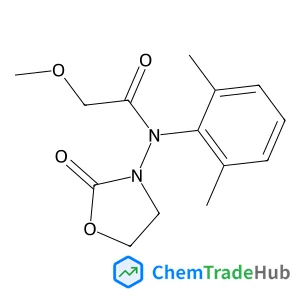
N-(2,6-Dimethylphenyl)-2-methoxy-N-(2-oxo-1,3-oxazolidin-3-yl)acetamide
CAS号:
77732-09-3
分子式:
C14H18N2O4
推荐供应商





免责声明
本页面提供的学术期刊信息仅供参考和研究使用。我们与任何期刊出版商均无关联,也不处理投稿事宜。如有投稿相关咨询,请直接联系相关期刊出版商。
如发现页面信息有误,请发送邮件至 support@chemtradehub.com 联系我们。我们将及时核实并处理您的问题。