










Dual-cure photochemical/thermal polymerization of acrylates: a photoassisted process at low light intensity
文献信息
发布日期
2014-07-25
DOI
10.1039/C4PY00548A
影响因子
5.582
作者
M. Retailleau, A. Ibrahim, X. Allonas
查看原文
摘要
The dual-cure polymerization of an acrylate resin was investigated by combining a conventional technique (temperature measurement at the surface and in the deep zone) with confocal Raman microscopy. Polymerization was first characterized using a thermal initiator alone. Results showed that the thermal system polymerizes slowly and gradually, generating a thermal front that propagates from the bottom of the sample to the surface. Then, a photoinitiator was added to this thermal system. Unexpectedly, at the beginning of the reaction, the addition slows down the thermal polymerization reaction. But quickly, the reaction is accelerated and an almost fully cured material is obtained in a shorter time than the net thermal system. This behaviour highlights a surprising synergistic effect between the photoinitiator and the thermal initiator in the dual-cure polymerization of thick materials.
相关文献
Quasiclassical trajectory calculations of hydrogen absorption in the (NaAlH4)2Ti system on a model analytical potential energy surface
David C. Clary
2012-01-16
Paper
DOI: 10.1039/C2CP23689C
A density functional theory study of hydrogen dissociation and diffusion at the perimeter sites of Au/TiO2
Bo Yang, Xue-Qing Gong
2012-01-16
Communication
DOI: 10.1039/C2CP23755E
4D solid-state NMR for protein structure determination
Matthias Huber, Anja Böckmann, Sebastian Hiller, Beat H. Meier
2012-02-17
Perspective
DOI: 10.1039/C2CP23872A
A peroxide-bridged imidazole dimer formed from a photochromic naphthalene-bridged imidazole dimer
Sayaka Hatano
2012-03-01
Paper
DOI: 10.1039/C2CP40239D
Dielectric relaxation and ultrafast transient absorption spectroscopy of [C6mim]+[Tf2N]−/acetonitrile mixtures
Nils Bartels, Alexander Stoppa, Richard Buchner, Thomas Lenzer, Kawon Oum
2012-02-07
Paper
DOI: 10.1039/C2CP23704K
Computational study of the adsorption and dissociation of phenol on Pt and Rh surfaces
2012-02-28
Paper
DOI: 10.1039/C2CP24064E
Temperature and pressure dependence of the rate coefficient for the reaction between ClO and CH3O2 in the gas-phase
Kimberley E. Leather, Asan Bacak, Ruth Wamsley, Alexander Husk, Dudley E. Shallcross, Carl J. Percival
2012-02-03
Paper
DOI: 10.1039/C2CP22834C
Zwitterionic clusters with dianion core produced by electrospray ionisation of Brønsted acidic ionic liquids
Jing Li, Wei Wei, Leanne C. Nye, Peter S. Schulz, Peter Wasserscheid, Ivana Ivanović-Burmazović, Thomas Drewello
2012-03-14
Paper
DOI: 10.1039/C2CP24071H
The irreversible formation of palladium carbide during hydrogenation of 1-pentyne over silica-supported palladium nanoparticles: in situ Pd K and L3 edge XAS
Min Wei Tew, Maarten Nachtegaal, Markus Janousch, Thomas Huthwelker
2012-02-28
Paper
DOI: 10.1039/C2CP24068H
您可能还喜欢
化合物问答
2-(甲基磺酰基)嘧啶-5-胺(CAS号:56621-92-2)适用哪些法规指南?
该化合物适用的法规指南包括GHS(全球化学品统一分类和标签制度)分类为特定目标器官毒性-单次接触类别3;根据欧盟REACH法规,该化合物需要进行注册和评估;在美...
56621-92-22-(Methylsulfonyl)py...
化合物问答
在合成中是否有4-(4-氯苯基)-1H-咪唑(CAS号:35512-29-9)的替代品?
在合成中,可以考虑使用一些类似的化合物作为4-(4-氯苯基)-1H-咪唑的替代品,如4-(4-溴苯基)-1H-咪唑或4-(4-甲氧基苯基)-1H-咪唑。这些化合...
35512-29-94-(4-Chlorophenyl)-1...
化合物问答
什么是N~2~-甲基丙氨酸酰胺(CAS号:32012-16-1)?
N~2~-甲基丙氨酸酰胺是一种有机化合物,其化学名为2-(Methylamino)propanamide。它是一种酰胺类化合物,分子式为C4H10N2O,相对分...
32012-16-12-(Methylamino)propa...
化合物问答
如何处理含有N-苄基-3-氨基氧杂环丁烷草酸盐(CAS号:1956341-96-0)的废料?
处理含有N-苄基-3-氨基氧杂环丁烷草酸盐(CAS号:1956341-96-0)的废料时,应首先确保遵循相关法规要求,如GHS和REACH等。通常,废液应先进行...
1956341-96-0N-Benzyloxetan-3-ami...
化合物问答
4-bromo-2-chloro-6-methylbenzoic acid(CAS号:877149-07-0)的物理化学性质是什么?
4-溴-2-氯-6-甲基苯甲酸是一种固体化合物,具有较高的熔点和较低的沸点。它的分子量为261.03 g/mol。该化合物在水中几乎不溶,在有机溶剂中溶解度适中...
877149-07-04-Bromo-2-chloro-6-m...
化合物问答
2-[(2,5-二氯-4-嘧啶)氨基]-N-甲基苯甲酰胺(CAS号:761440-08-8)通常如何合成?
该化合物通常通过缩合反应合成,典型的方法是将2,5-二氯嘧啶与N-甲基苯甲酰胺在碱性条件下进行偶联反应。常用的碱包括NaH、LDA等强碱。该合成路线具有较高的选...
761440-08-82-[(2,5-dichloropyri...
4752-10-71,4-Dichlorophthalaz...
化合物问答
在合成中是否有3,5-二溴-4-甲基苯胺(CAS号:13194-73-5)的替代品?
3,5-二溴-4-甲基苯胺在某些合成路线中可能没有直接替代品。然而,在某些应用场景下,可以考虑使用其他类似结构的化合物如3,5-二溴-4-硝基苯胺或3,5-二碘...
13194-73-53,5-Dibromo-4-methyl...
化合物问答
2-氯喹啉-4-羧酸甲酯(CAS号:62482-26-2)的主要用途是什么?
2-氯喹啉-4-羧酸甲酯主要用于有机合成和药物合成领域,作为中间体或原料。它在合成某些药物和染料时具有重要作用。此外,该化合物还可能用于某些特定的化学研究中。
62482-26-2Methyl 2-chloro-4-qu...
化合物问答
i>]吡啶(CAS号:474708-88-8)安全吗?
6-溴-8-氯咪唑[1,2-a]吡啶在操作过程中需要谨慎以确保安全。该化合物具有一定的毒性,吸入其蒸气或粉尘可能导致呼吸道刺激。处理时应佩戴适当的防护装备,如手...
474708-88-86-Bromo-8-chloroimid...
来源期刊
Polymer Chemistry

CiteScore:
8.6
自引率:
7.3%
年发文量:
457
Polymer Chemistry welcomes submissions in all areas of polymer science that have a strong focus on macromolecular chemistry. Manuscripts may cover a broad range of fields, yet no direct application focus is required.
推荐化合物
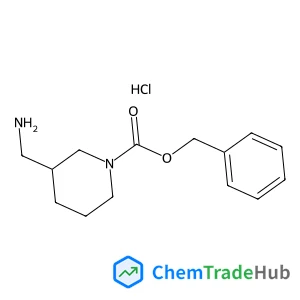
![Benzyl spiro[indole-3,4'-piperidine]-1(2H)-carboxylate hydrochloride (1:1) structure](https://cnstatic.chemtradehub.com/structs/159/159635-46-8-8de0.webp "Benzyl spiro[indole-3,4'-piperidine]-1(2H)-carboxylate hydrochloride (1:1) structure")
Benzyl spiro[indole-3,4'-piperidine]-1(2H)-carboxylate hydrochloride (1:1)
CAS号:
159635-46-8
分子式:
C20H23ClN2O2
推荐供应商





免责声明
本页面提供的学术期刊信息仅供参考和研究使用。我们与任何期刊出版商均无关联,也不处理投稿事宜。如有投稿相关咨询,请直接联系相关期刊出版商。
如发现页面信息有误,请发送邮件至 support@chemtradehub.com 联系我们。我们将及时核实并处理您的问题。