










An instrument-free, screen-printed paper microfluidic device that enables bio and chemical sensing
文献信息
发布日期
2015-07-14
DOI
10.1039/C5AN00909J
影响因子
4.616
作者
Saeed Mohammadi, Masatoshi Maeki, Reza M. Mohamadi, Akihiko Ishida, Hirofumi Tani
查看原文
摘要
This paper describes a simple and instrument-free screen-printing method to fabricate hydrophilic channels by patterning polydimethylsiloxane (PDMS) onto chromatography paper. Clearly recognizable border lines were formed between hydrophilic and hydrophobic areas. The minimum width of the printed channel to deliver an aqueous sample was 600 μm, as obtained by this method. Fabricated microfluidic paper-based analytical devices (μPADs) were tested for several colorimetric assays of pH, glucose, and protein in both buffer and artificial urine samples and results were obtained in less than 30 min. The limits of detection (LODs) for glucose and bovine serum albumin (BSA) were 5 mM and 8 μM, respectively. Furthermore, the pH values of different solutions were visually recognised with the naked eye by using a sensitive ink. Ultimately, it is expected that this PDMS-screen-printing (PSP) methodology for μPADs can be readily translated to other colorimetric detection and hydrophilic channels surrounded by a hydrophobic polymer can be formed to transport fluids toward target zones.
相关文献
The first molecular characterisation of blue- and red-light photoreceptors from Methylobacterium radiotolerans
Eleonora Consiglieri, Kai-Hong Zhao, Wolfgang Gärtner, Aba Losi
2020-05-12
Paper
DOI: 10.1039/D0CP02014A
Effect of zeolite morphology on charge separated states: ZSM-5-type nanocrystals, nanosheets and nanosponges
Lucie Duplouy, Alain Moissette, Matthieu Hureau, Vincent De Waele, Isabelle Batonneau-Gener
2020-05-07
Paper
DOI: 10.1039/D0CP01701A
Photon-mediated charge exchange reactions between 39K atoms and 40Ca+ ions in a hybrid trap
Hui Li, S. Jyothi, Ming Li, Kenneth R Brown, Svetlana Kotochigova
2020-04-22
Paper
DOI: 10.1039/D0CP01131B
Thermodynamics of mixing methanol with supercritical CO2 as seen from computer simulations and thermodynamic integration
Réka A. Horváth, George Horvai, Abdenacer Idrissi, Pál Jedlovszky
2020-04-28
Paper
DOI: 10.1039/D0CP01241F
Mixed uranyl and neptunyl cation–cation interaction-driven clusters: structures, energetic stability, and nuclear quadrupole interactions
Paweł Tecmer, Frank Schindler, Aleksandra Leszczyk, Katharina Boguslawski
2020-05-02
Paper
DOI: 10.1039/D0CP01068E
Microstructural dependent oxygen reduction reaction in a Ruddlesden–Popper perovskite (SmSr)NiO4−δ
Manisha Chauhan, Pardeep K. Jha, Ajay S. Bangwal, Priyanka A. Jha, Prabhakar Singh
2020-05-06
Paper
DOI: 10.1039/D0CP00433B
Quantifying anisotropic dielectric response properties of nanoconfined water within graphene slit pores
Sergi Ruiz-Barragan, Saskia Körning, Dominik Marx
2020-04-27
Communication
DOI: 10.1039/D0CP00916D
A computational exploration of the 1D TiS2(en) nanostructure for lithium ion batteries
Chun-Hao Huang, Elise Y. Li
2020-03-31
Paper
DOI: 10.1039/C9CP04675E
您可能还喜欢
化合物问答
如何储存1,2-环己二酮环乙缩醛(CAS号:4746-96-7)?
1,2-环己二酮环乙缩醛应储存在阴凉、干燥、通风良好的地方,避免阳光直射。建议使用密封容器保存,并保持环境温度在室温范围内,远离火源和热源。
4746-96-71,4-Dioxaspiro[4.5]d...
化合物问答
Ecopladib(CAS号:381683-92-7)的市场或研究趋势如何?
Ecopladib作为一种新型的药物,主要应用于治疗高胆固醇等疾病。目前,市场和研究趋势显示,Ecopladib因其独特的药理作用而受到关注。随着对心血管疾病治...
381683-92-7Ecopladib
化合物问答
2,3-Dimethyl-3H-imidazo[4,5-c]pyridine(CAS号:52538-09-7)通常如何合成?
2,3-二甲基-3H-咪唑[4,5-c]吡啶通常通过咪唑和2,3-二甲基吡啶的缩合反应合成。具体来说,将咪唑和2,3-二甲基吡啶在适当的溶剂中进行加热或加压反应...
52538-09-72,3-Dimethyl-3H-imid...
化合物问答
2,3,4,5-tetrahydro-1H-3-苯并氮杂环;盐酸盐(CAS号:17379-01-0)的市场或研究趋势如何?
该化合物在药物化学和有机合成中有一定的应用。近年来,随着对新型药物化合物的需求增加,该化合物的研究趋势主要集中在探索其生物活性,尤其是其在神经系统疾病治疗中的潜...
17379-01-02,3,4,5-Tetrahydro-1...
68-90-6(2-Ethyl-1-benzofura...
化合物问答
如何储存盐酸甘氨酸丁酯(CAS号:13048-99-2)?
盐酸甘氨酸丁酯应储存在阴凉、干燥、通风良好的地方,避免阳光直射和高温环境,温度应控制在25℃以下。储存容器应密封,避免与空气中的水分和酸性物质接触,以防发生水解...
13048-99-2Butyl glycinate hydr...
化合物问答
什么是2-Iodo-N,N-dimethylbenzamide(CAS号:54616-46-5)?
2-碘-N,N-二甲基苯胺是一种有机化合物,化学名为2-Iodo-N,N-dimethylbenzamide。其分子式为C<sub>9</sub>H<sub>1...
54616-46-52-Iodo-N,N-dimethylb...
16817-90-6N-Cyclohexylglycinam...
化合物问答
5-溴-2-(4H-1,2,4-三唑-4-基)吡啶(CAS号:959240-99-4)的市场或研究趋势如何?
随着医药、农药和新材料领域的发展,该化合物作为关键中间体的应用日益增多。特别是在药物合成中,由于其独特的化学性质,可以用于合成多种药物分子。未来的研究趋势可能集...
959240-99-45-Bromo-2-(4H-1,2,4-...
化合物问答
2,4-二溴-6-三氟甲基嘧啶(CAS号:785778-00-9)通常如何合成?
2,4-二溴-6-三氟甲基嘧啶通常通过溴化反应合成。首先,将6-三氟甲基嘧啶与溴化剂(如液溴)在适当的溶剂(如二氯甲烷、四氢呋喃)中反应,加入适当的催化剂(如四...
785778-00-92,4-Dibromo-6-(trifl...
来源期刊
Analyst

CiteScore:
7.8
自引率:
5.6%
年发文量:
653
Analyst publishes analytical and bioanalytical research that reports premier fundamental discoveries and inventions, and the applications of those discoveries, unconfined by traditional discipline barriers.
推荐化合物
phosphoryl}methyl 4-methylbenzenesulfonate structure](https://cnstatic.chemtradehub.com/structs/864/864068-45-1-ba7c.webp "{[3-(Hexadecyloxy)propoxy](hydroxy)phosphoryl}methyl 4-methylbenzenesulfonate structure")
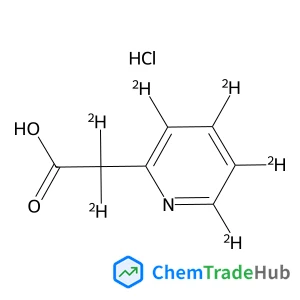
2,2-dideuterio-2-(3,4,5,6-tetradeuterio-2-pyridyl)acetic acid;hydrochloride
CAS号:
1329799-67-8
分子式:
C7H2ClD6NO2

![[(1S,2S,3R,4S,7R,9S,10S,12R,15S)-4,12-Diacetyloxy-15-[(2R,3S)-3-benzamido-3-phenyl-2-(2,2,2-trichloroethoxycarbonyloxy)propanoyl]oxy-1,9-dihydroxy-10,14,17,17-tetramethyl-11-oxo-6-oxatetracyclo[11.3.1.03,10.04,7]heptadec-13-en-2-yl] benzoate structure](https://cnstatic.chemtradehub.com/structs/100/100431-55-8-7104.webp "[(1S,2S,3R,4S,7R,9S,10S,12R,15S)-4,12-Diacetyloxy-15-[(2R,3S)-3-benzamido-3-phenyl-2-(2,2,2-trichloroethoxycarbonyloxy)propanoyl]oxy-1,9-dihydroxy-10,14,17,17-tetramethyl-11-oxo-6-oxatetracyclo[11.3.1.03,10.04,7]heptadec-13-en-2-yl] benzoate structure")
推荐供应商




免责声明
本页面提供的学术期刊信息仅供参考和研究使用。我们与任何期刊出版商均无关联,也不处理投稿事宜。如有投稿相关咨询,请直接联系相关期刊出版商。
如发现页面信息有误,请发送邮件至 support@chemtradehub.com 联系我们。我们将及时核实并处理您的问题。