



Understanding the anomalous behavior of Vegard's law in Ce1−xMxO2 (M = Sn and Ti; 0 < x ≤ 0.5) solid solutions
文献信息
发布日期
2016-04-15
DOI
10.1039/C6CP01525E
影响因子
3.676
作者
Parthasarathi Bera, Olga Safonova, Paula M. Abdala, Birgit Gerke, Rainer Pöttgen, Kaustubh R. Priolkar, Tapas Kumar Mandal
查看原文
摘要
The dependence of the lattice parameter on dopant concentration in Ce1−xMxO2 (M = Sn and Ti) solid solutions is not linear. A change towards a steeper slope is observed around x ∼ 0.35, though the fluorite structure (space group Fm3m) is preserved up to x = 0.5. This phenomenon has not been observed for Ce1−xZrxO2 solid solutions showing a perfectly linear decrease of the lattice parameter up to x = 0.5. In order to understand this behavior, the oxidation state of the metal ions, the disorder in the oxygen substructure and the nature of metal–oxygen bonds have been analyzed by XPS, 119Sn Mössbauer spectroscopy and X-ray absorption spectroscopy. It is observed that the first Sn–O coordination shell in Ce1−xSnxO2 is more compact and less flexible than that of Ce–O. The Sn coordination remains symmetric with eight equivalent, shorter Sn–O bonds, while Ce–O coordination gradually splits into a range of eight non-equivalent bonds compensating for the difference in the ionic radii of Ce4+ and Sn4+. Thus, a long-range effect of Sn doping is hardly extended throughout the lattice in Ce1−xSnxO2. In contrast, for Ce1−xZrxO2 solid solutions, both Ce and Zr have similar local coordination creating similar rearrangement of the oxygen substructure and showing a linear lattice parameter decrease up to 50% Zr substitution. We suggest that the localized effect of Sn substitution due to its higher electronegativity may be responsible for the deviation from Vegard's law in Ce1−xSnxO2 solid solutions.
相关文献
Novel cyclodextrin-based pH-sensitive supramolecular host–guest assembly for staining acidic cellular organelles
Gabriela Pricope, Elena Laura Ursu, Monica Sardaru, Corneliu Cojocaru, Lilia Clima, Narcisa Marangoci, Ramona Danac, Ionel I. Mangalagiu, Mariana Pinteala, Alexandru Rotaru
2017-11-14
Paper
DOI: 10.1039/C7PY01668A
Construction of flexible and stable near-infrared absorbing polymer films containing nickel-bis(dithiolene) moieties via ligand-exchange post-polymerization modification
Jianhua Han, Zhihuan Weng, Zuoqiang Wu, Jingwen Cai, Jinyan Wang, Xigao Jian
2017-06-14
Paper
DOI: 10.1039/C7PY00802C
One-pot and gram-scale synthesis of biodegradable polyglycerols under ambient conditions: nanocarriers for intradermal drug delivery
Zhaoxu Tu, Sarah Hedtrich, Ali Nemati Kharat, Rainer Haag
2017-11-21
Paper
DOI: 10.1039/C7PY01470H
Compartmentalization of an ABC triblock copolymer single-chain nanoparticle via coordination-driven orthogonal self-assembly
Zhigang Cui, Hui Cao, Yi Ding, Pan Gao, Xinhua Lu, Yuanli Cai
2017-05-26
Paper
DOI: 10.1039/C7PY00582B
Electron beam lithography of poly(glycidol) nanogels for immobilization of a three-enzyme cascade
Jacob N. Lockhart, Anthony B. Hmelo, Eva Harth
2018-01-17
Paper
DOI: 10.1039/C7PY01904A
A supramolecular peptide polymer from hydrogen-bond and coordination-driven self-assembly
Xiaomin Zhu, Rongfeng Zou, Peng Sun, Qi Wang, Junchen Wu
2017-12-05
Paper
DOI: 10.1039/C7PY01901G
Looped flow RAFT polymerization for multiblock copolymer synthesis
Agnès Kuroki, Ivan Martinez-Botella, Christian H. Hornung, Liam Martin, Elizabeth G. L. Williams, Katherine E. S. Locock, Matthias Hartlieb
2017-05-12
Communication
DOI: 10.1039/C7PY00630F
您可能还喜欢
化合物问答
6-氯-2H-1,4-苯并噁嗪-3(4H)-酮(CAS号:7652-29-1)应用于哪些行业?
6-氯-2H-1,4-苯并噁嗪-3(4H)-酮主要应用于医药、农药和聚合物等领域。在医药领域,该化合物可用于合成抗菌药物;在农药领域,可用作杀虫剂的中间体;在聚...
7652-29-16-Chloro-2H-1,4-benz...
化合物问答
活性氧化铝(CAS号:1302-74-5)应用于哪些行业?
活性氧化铝广泛应用于医药、聚合物、传感器、半导体和催化等领域。在医药行业,活性氧化铝用作吸附剂和干燥剂,有助于去除杂质和水分。在聚合物行业,它用作增白剂和抗结块...
1302-74-5aluminum;trihydrate
化合物问答
什么是硅胶(CAS号:112926-00-8)?
硅胶(Silica gel, pptd.,cryst.-free)是一种无定形、多孔的硅酸盐材料,主要成分为二氧化硅(SiO₂)。其结构由硅氧四面体构成,通过酸...
112926-00-8Silica gel, pptd.,cr...
化合物问答
二乙基甲基一氢硅烷(CAS号:760-32-7)的主要用途是什么?
二乙基甲基一氢硅烷主要用于有机合成、表面处理以及作为溶剂。它还被用作合成其他硅烷化合物的原料,以及在涂料、粘合剂和密封剂中的应用。
760-32-7Diethyl(methyl)silan...
化合物问答
在合成中是否有N-花生四烯酰基甘氨酸(CAS号:179113-91-8)的替代品?
在合成过程中,可以考虑使用类似结构的化合物作为替代品,例如N-亚油酰基甘氨酸或N-花生二烯酰基甘氨酸。这些替代品在结构上有类似的双键位置,但可能具有不同的物理化...
179113-91-8Glycine, N-[(5Z,8Z,1...
化合物问答
在合成中是否有1-(4-甲氧基苯基)丙烷-1,2-二酮(CAS号:10557-27-4)的替代品?
在合成过程中,可以考虑使用类似结构的化合物作为替代品,例如1-(3-甲氧基苯基)丙烷-1,2-二酮或1-(4-羟基苯基)丙烷-1,2-二酮。这些替代品具有相似的...
10557-27-41-(4-Methoxyphenyl)p...
化合物问答
N-(4-氨基-1-苄基-3-羟基-5-苯基戊基)-3-甲基-2-(2-氧代四氢嘧啶-1-基)-丁酰胺 5-氧代吡咯烷-2-甲酸(CAS号:192726-06-0)通常如何合成?
该化合物通常通过一系列复杂的有机合成步骤获得。首先,通过芳香族化合物的羟基化反应获得羟基化产物,然后通过酰化反应形成酰胺中间体,最后通过环化反应得到目标产物。常...
192726-06-05-Oxo-L-proline - (2...
化合物问答
(S)-2-氨基-3-喹啉-2-丙酸(CAS号:161513-46-8)的市场或研究趋势如何?
该化合物作为生物活性化合物,尤其是在药物化学领域表现出色。近年来,随着对新型抗炎、抗病毒和抗癌药物的研究增加,其市场和研究趋势持续增长。此外,其在神经科学领域的...
161513-46-8(S)-2-Amino-3-quinol...
化合物问答
核黄素磷酸钠(CAS号:130-40-5)安全吗?
核黄素磷酸钠在常规使用条件下安全,但高剂量可能引起刺激性反应。操作时需佩戴防护手套和护目镜,避免吸入粉尘。若接触皮肤或眼睛,应立即用大量清水冲洗。急救时需根据接...
130-40-5Sodium 1-deoxy-1-(7,...
化合物问答
盐酸丙胺卡因杂质A(EP) 标准品(CAS号:19281-31-3)通常如何合成?
盐酸丙胺卡因杂质A(EP) 标准品可通过重氮化反应和随后的酰胺化反应合成。首先,利用氯化反应将苯环上的氢原子转化为氯原子,然后通过芳香族重氮化反应引入氨基,最后...
19281-31-32-Chloro-N-(2-methyl...
来源期刊
Physical Chemistry Chemical Physics

CiteScore:
5.5
自引率:
10.3%
年发文量:
3036
Physical Chemistry Chemical Physics (PCCP) is an international journal co-owned by 19 physical chemistry and physics societies from around the world. This journal publishes original, cutting-edge research in physical chemistry, chemical physics and biophysical chemistry. To be suitable for publication in PCCP, articles must include significant innovation and/or insight into physical chemistry; this is the most important criterion that reviewers and Editors will judge against when evaluating submissions. The journal has a broad scope and welcomes contributions spanning experiment, theory, computation and data science. Topical coverage includes spectroscopy, dynamics, kinetics, statistical mechanics, thermodynamics, electrochemistry, catalysis, surface science, quantum mechanics, quantum computing and machine learning. Interdisciplinary research areas such as polymers and soft matter, materials, nanoscience, energy, surfaces/interfaces, and biophysical chemistry are welcomed if they demonstrate significant innovation and/or insight into physical chemistry. Joined experimental/theoretical studies are particularly appreciated when complementary and based on up-to-date approaches.
推荐化合物
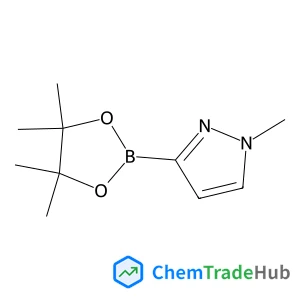
1-Methyl-3-(4,4,5,5-tetramethyl-1,3,2-dioxaborolan-2-yl)-1H-pyrazole
CAS号:
1020174-04-2
分子式:
C10H17BN2O2
推荐供应商







免责声明
本页面提供的学术期刊信息仅供参考和研究使用。我们与任何期刊出版商均无关联,也不处理投稿事宜。如有投稿相关咨询,请直接联系相关期刊出版商。
如发现页面信息有误,请发送邮件至 support@chemtradehub.com 联系我们。我们将及时核实并处理您的问题。