








![Ethyl thieno[3,2-f]quinoline-2-carboxylate structure](https://cnstatic.chemtradehub.com/structs/299/29948-26-3-f62b.webp "Ethyl thieno[3,2-f]quinoline-2-carboxylate structure")
Electrochemical polypyrrole formation from pyrrole ‘adlayer’
文献信息
发布日期
2016-11-22
DOI
10.1039/C6CP06545G
影响因子
3.676
作者
Deivis Plausinaitis, Linas Sinkevicius, Lina Mikoliunaite, Valentina Plausinaitiene, Almira Ramanaviciene
查看原文
摘要
In this research study, we investigated the morphology of polypyrrole nanostructures, which were formed during the electrochemical deposition of conducting polymer. An electrochemical quartz crystal microbalance (EQCM) cell equipped with a flow-through system was employed to exchange solutions of different compositions within the EQCM cell. When bare PBS buffer in the EQCM cell was exchanged with PBS buffer with pyrrole we observed a distinct increase in the resonance frequency Δf. This change in the resonance frequency and electrical capacitance, which was calculated from electrochemical impedance spectroscopy (EIS) data, illustrate that pyrrole on the surface of the gold electrode formed an adsorbed layer (adlayer). The formation of a pyrrole adlayer before the potential pulse that induced polymerization was investigated by QCM-based measurements. The electrochemical polymerization of this adlayer was induced by a single potential pulse and a nanostructured layer, which consisted of adsorbed polypyrrole (Ppy) nanoparticles with a diameter of 50 nm, was formed. QCM and EIS data revealed that by the next cycle of the electrochemical formation of Ppy, which was investigated after flow-through-based exchange of solutions, the initially formed Ppy surface was covered by the adlayer of pyrrole. This adlayer was desorbed when pyrrole was removed from the solution. When electrochemical polymerization was performed using 50 potential pulses, a Ppy layer, which had more complex morphology, was formed on the EQCM crystal. Scanning electron microscopy showed that the conductivity of this layer was unequally distributed. We observed that the polypyrrole layer formed by electrochemical deposition, which was performed using potential pulses, was formed out of aggregated spherical Ppy particles with a diameter of 50 nm.
相关文献
Initial dissolution of D2O at the gas–liquid interface of the ionic liquid [C4min][NTf2] associated with hydrogen-bond network formation
H. Ohoyama, T. Teramoto
2016-09-26
Paper
DOI: 10.1039/C6CP03448A
Interfacial charge separation and photovoltaic efficiency in Fe(ii)–carbene sensitized solar cells
Mariachiara Pastore, Thibaut Duchanois, Li Liu, Antonio Monari, Xavier Assfeld, Stefan Haacke, Philippe C. Gros
2016-09-16
Paper
DOI: 10.1039/C6CP05535D
Excited-state dynamics of the medicinal pigment curcumin in a hydrogel
Takaaki Harada, Stephen F. Lincoln, Tak W. Kee
2016-09-23
Paper
DOI: 10.1039/C6CP05648B
Prediction of proton affinities of organic molecules using the any-particle molecular-orbital second-order proton propagator approach
Laura Pedraza-González, Jonathan Romero, Jorge Alí-Torres, Andrés Reyes
2016-09-08
Communication
DOI: 10.1039/C6CP05128F
Water desalination by electrical resonance inside carbon nanotubes
Jia-wei Feng, Hong-ming Ding
2016-09-16
Paper
DOI: 10.1039/C6CP04201E
Electronic and optical properties of MAPbX3 perovskites (X = I, Br, Cl): a unified DFT and GW theoretical analysis
Paolo Umari
2016-09-08
Paper
DOI: 10.1039/C6CP03969C
Reaction mechanisms of carbon dioxide, ethylene oxide and amines catalyzed by ionic liquids BmimBr and BmimOAc: a DFT study
Zhoujie Luo, Binsen Wang, Yuan Liu, Guohua Gao
2016-09-13
Paper
DOI: 10.1039/C6CP05291F
Efficient light harvesting over a CdS/In2O3 photonic crystal photocatalyst for hydrogenation of 4-nitroaniline to p-phenylenediamine
Xiaofang Li, Changqian Wang, Bo Li, Yu Shao, Danzhen Li
2016-09-09
Paper
DOI: 10.1039/C6CP04929J
Direct photoisomerization of CH2I2vs. CHBr3 in the gas phase: a joint 50 fs experimental and multireference resonance-theoretical study
Veniamin A. Borin, Sergey M. Matveev, Darya S. Budkina, Patrick Z. El-Khoury, Alexander N. Tarnovsky
2016-09-20
Paper
DOI: 10.1039/C6CP05129D
您可能还喜欢
化合物问答
什么是3-表南美楝属二醇(CAS号:19942-04-2)?
3-表南美楝属二醇是一种具有特定立体化学结构的化合物,其分子式为C31H52O2,属于甾醇类化合物。它具有光学活性,是一种复杂的有机分子,主要存在于一些植物中。
19942-04-2(3S,5R,8R,9R,10R,13R...
化合物问答
3-羧基-5-碘苯甲酸甲酯(CAS号:50765-22-5)应用于哪些行业?
3-羧基-5-碘苯甲酸甲酯主要应用于医药行业,作为合成某些药物中间体的重要原料。此外,它还可能用于聚合物的改性、传感器的制备以及半导体材料的制备等领域。
50765-22-5Methyl 3-hydroxy-5-i...
化合物问答
什么是3-Bromoindolin-2-one(CAS号:22942-87-6)?
3-Bromoindolin-2-one是一种含有溴代基团的吲哚酮衍生物,分子式为C9H7BrNO。它是一种无色固体,具有一定的挥发性,熔点为158-159°C...
22942-87-63-Bromoindolin-2-one
化合物问答
如何处理含有L-Lysyl-L-phenylalanyl-L-isoleucylglycyl-L-leucyl-L-methioninamide(CAS号:2990-43-4)的废料?
对于含有该化合物的废液,应先进行中和处理,然后根据其毒性和活性选择合适的处置方法。可以考虑焚烧处理或由专业的化学品废物处理公司进行无害化处理。处理过程中需注意环...
2990-43-4L-Lysyl-L-phenylalan...
化合物问答
ANGIOTENSIN 1/2 + A (2 - 8)(CAS号:51833-76-2)的物理化学性质是什么?
ANGIOTENSIN 1/2 + A (2 - 8)是一种蛋白质类化合物,具有典型的蛋白质性质。它的分子量约为5900 Da。该化合物在水中具有一定的溶解性,...
51833-76-2ANGIOTENSIN 1/2 + A ...
化合物问答
如何储存2-甲基硫代嘧啶-5-硼酸频那酯(CAS号:940284-18-4)?
应将该化合物存放在阴凉干燥、通风良好的地方,避免阳光直射。建议将化合物密封保存在避光的、干燥的容器中,远离火源和高温环境。
940284-18-42-(Methylthio)-5-(4,...
化合物问答
什么是苏丹红IV氘代物 标准品(CAS号:1014689-18-9)?
苏丹红IV氘代物 标准品是一种含有氘代标记的苏丹红IV化合物,是一种用于化合物分析、结构确证以及代谢研究的标准物质。
1014689-18-91-[(E)-{2-Methyl-4-[...
化合物问答
(+)-2-Amino-6-propionamido-d3-tetrahydrobenzothiazole(CAS号:1217680-69-7)适用哪些法规指南?
该化合物需要遵循《全球化学品统一分类和标签制度》(GHS)中的分类和标签要求,具体分类需依据其毒性和物理化学性质。此外,还需要符合《欧盟化学品注册、评估、授权和...
1217680-69-7(+)-2-Amino-6-propio...
化合物问答
如何储存2-氨基-2-(2-吡啶)乙酸乙酯(CAS号:55243-15-7)?
2-氨基-2-(2-吡啶)乙酸乙酯应储存于阴凉、干燥、通风良好的环境中,避免高温和光照。应使用密封容器储存,并远离易燃物、氧化剂和其他危险化学品。
55243-15-7Ethyl 2-amino-2-(pyr...
化合物问答
3-羟基-4-甲氧基吡啶-2-羧酸(CAS号:210300-09-7)的主要用途是什么?
3-羟基-4-甲氧基吡啶-2-羧酸主要用于合成其他有机化合物,如药物合成、农药合成和染料合成等。此外,它还可用作中间体和试剂,在化学研究领域也有一定的应用。
210300-09-73-Hydroxy-4-methoxy-...
来源期刊
Physical Chemistry Chemical Physics

CiteScore:
5.5
自引率:
10.3%
年发文量:
3036
Physical Chemistry Chemical Physics (PCCP) is an international journal co-owned by 19 physical chemistry and physics societies from around the world. This journal publishes original, cutting-edge research in physical chemistry, chemical physics and biophysical chemistry. To be suitable for publication in PCCP, articles must include significant innovation and/or insight into physical chemistry; this is the most important criterion that reviewers and Editors will judge against when evaluating submissions. The journal has a broad scope and welcomes contributions spanning experiment, theory, computation and data science. Topical coverage includes spectroscopy, dynamics, kinetics, statistical mechanics, thermodynamics, electrochemistry, catalysis, surface science, quantum mechanics, quantum computing and machine learning. Interdisciplinary research areas such as polymers and soft matter, materials, nanoscience, energy, surfaces/interfaces, and biophysical chemistry are welcomed if they demonstrate significant innovation and/or insight into physical chemistry. Joined experimental/theoretical studies are particularly appreciated when complementary and based on up-to-date approaches.
推荐化合物

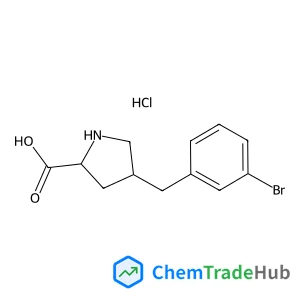
(2S,4R)-4-(3-Bromobenzyl)pyrrolidine-2-carboxylic acid hydrochloride
CAS号:
1049734-10-2
分子式:
C12H15BrClNO2
推荐供应商



免责声明
本页面提供的学术期刊信息仅供参考和研究使用。我们与任何期刊出版商均无关联,也不处理投稿事宜。如有投稿相关咨询,请直接联系相关期刊出版商。
如发现页面信息有误,请发送邮件至 support@chemtradehub.com 联系我们。我们将及时核实并处理您的问题。