

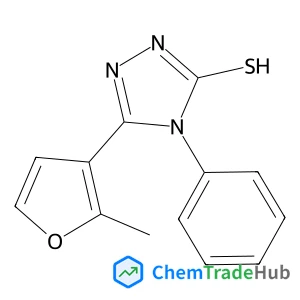
5-(2-Methyl-3-furyl)-4-phenyl-2,4-dihydro-3H-1,2,4-triazole-3-thione
CAS号:
346464-59-3
分子式:
C13H11N3OS
Jiaxun Wan, Luyan Sun, Pan Wu, Fang Wang, Jia Guo, Jianjun Cheng, Changchun Wang
Undesired gene expression can lead to severe diseases such as cancers. Oncogenic proteins or survival factors encoded by oncogenes can sustain cancer cell survival and proliferation. Considering that proteins are manufactured and transported by the endoplasmic reticulum (ER), the destroying of oncogenic proteins within the ER could cut-off the process of undesired gene expression. In this study, a new type of ER targeting strategy was developed based on the coordination interaction of the Ca(II) ion rich ER lumen with the carboxyl group of poly(aspartic acid) (PAsp). A comblike polymer PAsp-g-(PEG-ICG) was rationally designed and successfully prepared by grafting azido-modified polyethylene glycol (PEG) and the azido-modified photosensitizer indocyanine green (ICG) onto alkynyl-modified PAsp through the copper(I)-catalyzed alkyne–azide cycloaddition (CuAAC). Here, ICG not only shows its importance as an imaging agent that reveals the distribution of PAsp-g-(PEG-ICG) micelles both at tissue and subcellular levels, but also acts as a protein destructive agent to generate reactive oxygen species (ROS) resulting in protein denaturation. Moreover, chemotherapeutic drugs, such as paclitaxel, can be easily encapsulated into PAsp-g-(PEG-ICG) (PTX@PAsp-g-(PEG-ICG)) in up to 28% drug loading capacity with excellent stability. The experimental results proved that the as-prepared PTX@PAsp-g-(PEG-ICG) micelles exhibited selective accumulation in the ER lumen of cancer cells. Thus, a 10-fold enhancement of ROS was obtained by incubating cancer cells with PAsp-g-(PEG-ICG) micelles at a PTX concentration of 1.0 μg ml−1 under laser irradiation (0.2 W cm−2, 785 nm, 30 s) for 24 h, leading to disruption of proteins in the ER that caused ER stress-induced cancer cell apoptosis up to 76%. In a cytotoxicity test, U-87 MG glioma cells incubated with PTX@PAsp-g-(PEG-ICG) at the PTX concentration of 2.5 μg ml−1 were reduced to nearly 0% of cell viability upon 24 h laser irradiation (2 W cm−2, 785 nm, 30 s), in comparison with free PTX that showed 60% cell viability under the same conditions, indicating that photodynamic therapy (PDT) remarkably enhanced chemotherapeutic effects. With the good combination of PDT and chemotherapy, the PTX@PAsp-g-(PEG-ICG) micelles offer unprecedented advantages by effectively targeting the ER and displayed a prolonged retention time in the tumors of U-87 MG bearing nude mice, providing great promise for manipulating biomaterial design to achieve the intended ER targeted delivery for non-invasive cancer therapy.
Natasha Djedovic, Riccardo Ferdani, Egan Harder, Jolanta Pajewska, Robert Pajewski, Paul H. Schlesinger, George W. Gokel
DOI: 10.1039/B312209N
Greta Varchi, Christiane Kofink, David M. Lindsay, Alfredo Ricci, Paul Knochel
DOI: 10.1039/B211115B
Young-Kyu Hong, Jae Ho Bahng, Geunseop Lee, Hanchul Kim, Wondong Kim, Sekyung Lee, Ja-Yong Koo, Jong-Il Park, Woo-ram Lee, Jinwoo Cheon
DOI: 10.1039/B310098G
Robin B. Bedford, Michael E. Blake, Craig P. Butts, Debbie Holder
DOI: 10.1039/B211329E
Toshiyuki Kida, Akira Kikuzawa, Yohji Nakatsuji, Mitsuru Akashi
DOI: 10.1039/B309261E
Nadège Pantoustier, Sébastien Moins, Michaël Wautier, Philippe Degée, Philippe Dubois
DOI: 10.1039/B208703K
Bernhard Breit, Peter Demel, Antje Gebert
DOI: 10.1039/B311378G
Haitao Yu, Yu Gao, Jiben Meng, Teruo Matsuura
DOI: 10.1039/B211833E
Steven van Zutphen, Marc S. Robillard, Gijs A. van der Marel, Herman S. Overkleeft, Hans den Dulk, Jaap Brouwer, Jan Reedijk
DOI: 10.1039/B212388F
2,6-二溴-4,8-双[(2-乙基己基)氧基]苯并[1,2-b:4,5-b']二噻吩是一种有机化合物,分子式为C23H32Br2O2S2。该化合物具有芳香性和...
木聚硫钠通常为无色或白色结晶性粉末,具有吸湿性。其分子量约为121.11 g/mol。木聚硫钠易溶于水,不溶于醇类和其他非极性溶剂。在酸性或碱性溶液中,木聚硫钠...
该化合物在合成、储存和运输过程中需遵循《全球化学品统一分类和标签制度》(GHS)的健康、环境和物理危险分类。在欧洲还需符合《化学品注册、评估、授权和限制》(RE...
1,4-二氮杂双环[2.2.2]辛烷-1,4-二硫酸二酯主要用于有机合成中的保护基团,特别是在保护胺基和硫醇基方面具有广泛应用。此外,它还用于一些特殊化学反应的...
含有4-(Bromomethyl)-2-fluorobenzenesulphonamide的废液应首先进行中和处理,以降低pH值,避免对环境造成腐蚀性影响。随后...
Loureiriol是一种天然化合物,其分子式为C15H22O4。Loureiriol为无色结晶性粉末,具有较高的熔点和良好的热稳定性。其相对分子质量为262....
在合成过程中,可以考虑使用类似结构的化合物作为3-氨基苯甲酰苯胺的替代品,例如N-苯基-3-氰基苯胺或N-苯基-3-硝基苯胺等,这些化合物具有相似的化学性质,可...
4-异氰酰苯基硼酸频哪醇酯主要应用于有机合成、药物化学和材料科学领域。随着绿色化学的发展,该化合物因其高效的官能团转化能力和环境友好性而受到越来越多的关注。近年...
3β-乙酰氧基-7,25-甘遂二烯-24(R)-醇应储存在阴凉、干燥、通风良好的地方,避免直接光照。储存容器应密封,防止空气中的水分和氧气影响化合物的稳定性。建...
应将4-氟-2-甲基-1H-吲哚存放在阴凉、干燥、通风良好的地方,避免直接暴露在光照下。容器应密封,避免与空气中的水蒸气接触。建议在避光、温度不超过25℃的环境...

Polymer Chemistry welcomes submissions in all areas of polymer science that have a strong focus on macromolecular chemistry. Manuscripts may cover a broad range of fields, yet no direct application focus is required.
![N-[2-(2-Pyridinyl)ethyl]-1-propanamine structure](https://cnstatic.chemtradehub.com/structs/554/55496-57-6-22b4.webp "N-[2-(2-Pyridinyl)ethyl]-1-propanamine structure")