










![5-Acetyl-2,3-dihydrobenzo[b]furan structure](https://cnstatic.chemtradehub.com/structs/908/90843-31-5-eea4.webp "5-Acetyl-2,3-dihydrobenzo[b]furan structure")
Comparison of quenching mechanisms in Gd3Al5−xGaxO12:Ce3+ (x = 3 and 5) garnet phosphors by photocurrent excitation spectroscopy
文献信息
发布日期
2018-06-11
DOI
10.1039/C8CP03176B
影响因子
3.676
作者
Tadeusz Lesniewski, Sebastian Mahlik, Kazuki Asami, Jumpei Ueda, Marek Grinberg, Setsuhisa Tanabe
查看原文
摘要
In this work we present the results of photocurrent excitation spectroscopy (PCE) of Gd3Al2Ga3O12:Ce3+ (GAGG:Ce3+) and Gd3Ga5O12:Ce3+ (GGG:Ce3+) performed at temperatures ranging from 100 to 500 K supplemented by spectroscopic measurements (steady state and time resolved photoluminescence spectroscopy) performed at temperatures ranging from 10 to 500 K and at high pressure up to 300 kbar. The PCE spectra contain bands related to transitions from the ground state 2F5/2 of the 4f1 electronic configuration to the crystal field split states related to the 5d1 electronic configuration of Ce3+. This implicates the presence of the autoionization process – transfer of electrons from the localized, excited states of Ce3+ to the conduction band (CB), directly linked to luminescence quenching of Ce3+. The mechanism of autoionization of GAGG:Ce3+ and GGG:Ce3+ was determined to be different on the grounds of differences in temperature dependence of photocurrent intensity. The latter system exhibits autoionization, which occurs when all of the 5d excited states are degenerated with the CB, whereas in the former system, the autoionization process is thermally assisted with an activation energy barrier (distance to the edge of the CB) of approximately 1600 cm−1. In GGG:Ce3+ the degeneracy of 5d1 states of Ce3+ was lifted by application of high pressure, shifting the edge of the CB up and exposing Ce3+ luminescence at 20 kbar. Further spectroscopic analyses of the pressure–temperature dependence of the luminescence decay time as well as the temperature dependence of photocurrent intensity of GGG:Ce3+ have independently shown existence of a luminescence quenching state located approximately 600 cm−1 below the CB, attributed to the impurity trapped exciton.
相关文献
A flowing atmospheric pressure afterglow as an ion source coupled to a differential mobility analyzer for volatile organic compound detection
Marcos Bouza, Jaime Orejas, Silvia López-Vidal, Jorge Pisonero, Nerea Bordel, Rosario Pereiro, Alfredo Sanz-Medel
2016-04-13
Paper
DOI: 10.1039/C5AN01938A
A novel logic gate based on liquid-crystals responding to the DNA conformational transition
Fubing Xiao, Hui Tan, Yan Wu, Shuzhen Liao, Zhaoyang Wu, Guoli Shen, Ruqin Yu
2016-04-13
Communication
DOI: 10.1039/C6AN00504G
A two-photon fluorescent probe for bio-imaging of formaldehyde in living cells and tissues
Jun-Bin Li, Qian-Qian Wang, Lin Yuan, Yong-Xiang Wu, Xiao-Xiao Hu, Xiao-Bing Zhang, Weihong Tan
2016-04-14
Paper
DOI: 10.1039/C6AN00473C
Approaches towards molecular amplification for sensing
Sean Goggins, Christopher G. Frost
2016-04-14
Critical Review
DOI: 10.1039/C6AN00348F
Enzymatic reaction-based nanopore detection of zinc ions
Golbarg Mohammadi Roozbahani, Youwen Zhang, Xiaohan Chen, Mona Hoseini Soflaee, Xiyun Guan
2019-10-18
Paper
DOI: 10.1039/C9AN01784D
Soft-trilinear constraints for improved quantitation in multivariate curve resolution
Hamid Abdollahi, Paul J. Gemperline
2019-11-11
Paper
DOI: 10.1039/C8AN00615F
An in vivo quantitative Raman-pH sensor of arterial blood based on laser trapping of erythrocytes
Manman Lin, Bin Xu, Huilu Yao, Aiguo Shen, Jiming Hu
2016-03-23
Paper
DOI: 10.1039/C5AN02315G
Nano-analytical characterization of endogenous minerals in healthy placental tissue: mineral distribution, composition and ultrastructure
Elena Tsolaki, Louis Didierlaurent, Samuel Staubli, Robert Zboray, Antonia Neels, Dörthe Dietrich, Pius Manser, Lotus May Desbiolles, Sebastian Leschka, Simon Wildermuth, Sandro Lehner, Pascale Chavatte-Palmer, Wolfram Jochum, Peter Wick, Tina Bürki-Turnherr, Tina Fischer, René Hornung, Sergio Bertazzo
2019-10-02
Communication
DOI: 10.1039/C9AN01312A
您可能还喜欢
化合物问答
6-氯-2H-1,4-苯并噁嗪-3(4H)-酮(CAS号:7652-29-1)应用于哪些行业?
6-氯-2H-1,4-苯并噁嗪-3(4H)-酮主要应用于医药、农药和聚合物等领域。在医药领域,该化合物可用于合成抗菌药物;在农药领域,可用作杀虫剂的中间体;在聚...
7652-29-16-Chloro-2H-1,4-benz...
化合物问答
活性氧化铝(CAS号:1302-74-5)应用于哪些行业?
活性氧化铝广泛应用于医药、聚合物、传感器、半导体和催化等领域。在医药行业,活性氧化铝用作吸附剂和干燥剂,有助于去除杂质和水分。在聚合物行业,它用作增白剂和抗结块...
1302-74-5aluminum;trihydrate
化合物问答
什么是硅胶(CAS号:112926-00-8)?
硅胶(Silica gel, pptd.,cryst.-free)是一种无定形、多孔的硅酸盐材料,主要成分为二氧化硅(SiO₂)。其结构由硅氧四面体构成,通过酸...
112926-00-8Silica gel, pptd.,cr...
化合物问答
二乙基甲基一氢硅烷(CAS号:760-32-7)的主要用途是什么?
二乙基甲基一氢硅烷主要用于有机合成、表面处理以及作为溶剂。它还被用作合成其他硅烷化合物的原料,以及在涂料、粘合剂和密封剂中的应用。
760-32-7Diethyl(methyl)silan...
化合物问答
在合成中是否有N-花生四烯酰基甘氨酸(CAS号:179113-91-8)的替代品?
在合成过程中,可以考虑使用类似结构的化合物作为替代品,例如N-亚油酰基甘氨酸或N-花生二烯酰基甘氨酸。这些替代品在结构上有类似的双键位置,但可能具有不同的物理化...
179113-91-8Glycine, N-[(5Z,8Z,1...
化合物问答
在合成中是否有1-(4-甲氧基苯基)丙烷-1,2-二酮(CAS号:10557-27-4)的替代品?
在合成过程中,可以考虑使用类似结构的化合物作为替代品,例如1-(3-甲氧基苯基)丙烷-1,2-二酮或1-(4-羟基苯基)丙烷-1,2-二酮。这些替代品具有相似的...
10557-27-41-(4-Methoxyphenyl)p...
化合物问答
N-(4-氨基-1-苄基-3-羟基-5-苯基戊基)-3-甲基-2-(2-氧代四氢嘧啶-1-基)-丁酰胺 5-氧代吡咯烷-2-甲酸(CAS号:192726-06-0)通常如何合成?
该化合物通常通过一系列复杂的有机合成步骤获得。首先,通过芳香族化合物的羟基化反应获得羟基化产物,然后通过酰化反应形成酰胺中间体,最后通过环化反应得到目标产物。常...
192726-06-05-Oxo-L-proline - (2...
化合物问答
(S)-2-氨基-3-喹啉-2-丙酸(CAS号:161513-46-8)的市场或研究趋势如何?
该化合物作为生物活性化合物,尤其是在药物化学领域表现出色。近年来,随着对新型抗炎、抗病毒和抗癌药物的研究增加,其市场和研究趋势持续增长。此外,其在神经科学领域的...
161513-46-8(S)-2-Amino-3-quinol...
化合物问答
核黄素磷酸钠(CAS号:130-40-5)安全吗?
核黄素磷酸钠在常规使用条件下安全,但高剂量可能引起刺激性反应。操作时需佩戴防护手套和护目镜,避免吸入粉尘。若接触皮肤或眼睛,应立即用大量清水冲洗。急救时需根据接...
130-40-5Sodium 1-deoxy-1-(7,...
化合物问答
盐酸丙胺卡因杂质A(EP) 标准品(CAS号:19281-31-3)通常如何合成?
盐酸丙胺卡因杂质A(EP) 标准品可通过重氮化反应和随后的酰胺化反应合成。首先,利用氯化反应将苯环上的氢原子转化为氯原子,然后通过芳香族重氮化反应引入氨基,最后...
19281-31-32-Chloro-N-(2-methyl...
来源期刊
Physical Chemistry Chemical Physics

CiteScore:
5.5
自引率:
10.3%
年发文量:
3036
Physical Chemistry Chemical Physics (PCCP) is an international journal co-owned by 19 physical chemistry and physics societies from around the world. This journal publishes original, cutting-edge research in physical chemistry, chemical physics and biophysical chemistry. To be suitable for publication in PCCP, articles must include significant innovation and/or insight into physical chemistry; this is the most important criterion that reviewers and Editors will judge against when evaluating submissions. The journal has a broad scope and welcomes contributions spanning experiment, theory, computation and data science. Topical coverage includes spectroscopy, dynamics, kinetics, statistical mechanics, thermodynamics, electrochemistry, catalysis, surface science, quantum mechanics, quantum computing and machine learning. Interdisciplinary research areas such as polymers and soft matter, materials, nanoscience, energy, surfaces/interfaces, and biophysical chemistry are welcomed if they demonstrate significant innovation and/or insight into physical chemistry. Joined experimental/theoretical studies are particularly appreciated when complementary and based on up-to-date approaches.
推荐化合物
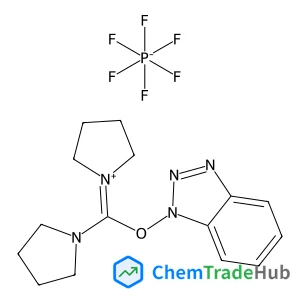
(1H-Benzotriazol-1-yloxy)(di-1-pyrrolidinyl)methylium hexafluorophosphate
CAS号:
105379-24-6
分子式:
C15H21F6N5OP
推荐供应商




免责声明
本页面提供的学术期刊信息仅供参考和研究使用。我们与任何期刊出版商均无关联,也不处理投稿事宜。如有投稿相关咨询,请直接联系相关期刊出版商。
如发现页面信息有误,请发送邮件至 support@chemtradehub.com 联系我们。我们将及时核实并处理您的问题。