

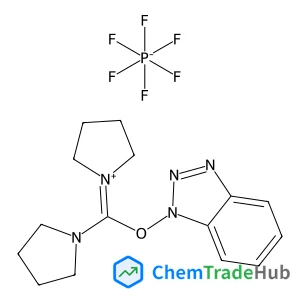
(1H-Benzotriazol-1-yloxy)(di-1-pyrrolidinyl)methylium hexafluorophosphate
CAS号:
105379-24-6
分子式:
C15H21F6N5OP
Yu-Hsuan Weng, Yu-Jane Sheng
The self-healing and dewetting dynamics of a polymer nanofilm on a smooth, partial wetting surface are explored by many-body dissipative particle dynamics. Three types of dewetting phenomena are identified, (i) spinodal decomposition, (ii) nucleation and growth, and (iii) metastable self-healing. The outcome depends on the surface wettability (θY), the polymer film thickness (h0), and the radius of the dry hole (R0). The phase diagram of the dewetting mechanism as a function of θY and h0 is obtained for a specified R0. As the surface wettability decreases (increasing θY), the critical film thickness associated with the nucleation/self-healing crossover (hc) grows so that the metastability of the film can be retained by the self-healing process. In addition to θY and R0, hc depends on the polymer length (N) as well. It is found that a longer polymer requires a thicker nanofilm to avoid dewetting by nucleation. Two strategies for dewetting suppression are proposed. The metastability of a film of polymers with a large molecular weight can be promoted either by the addition of short polymers or by employing compact polymers such as star polymers. In the latter approach, the increment of the arm number enhances the nanofilm stability.
Lidija Malic, Jamal Daoud, Matthias Geissler, Alex Boutin, Ljuboje Lukic, Mojra Janta, Abdelrahman Elmanzalawy, Teodor Veres
DOI: 10.1039/C9AN01316D
Claire V. Crowther, Viola Sanderlin, Mark A. Hayes, Gillian H. Gile
DOI: 10.1039/C9AN01186B
Luca Guerrini
DOI: 10.1039/C9AN02040C
Minghao Ren, Linfang Wang, Xin Lv, Yuanqiang Sun, Hu Chen, Keyuan Zhang, Qi Wu, Yurong Bai, Wei Guo
DOI: 10.1039/C9AN01852B
Tatsuro Nakao, Yutaka Kazoe, Emi Mori, Hisashi Shimizu
DOI: 10.1039/C9AN01491H
Angela Shore
DOI: 10.1039/C9AN01163C
Golbarg Mohammadi Roozbahani, Youwen Zhang, Xiaohan Chen, Mona Hoseini Soflaee, Xiyun Guan
DOI: 10.1039/C9AN01784D
Mónica B. Mamián-López, Paola Corio, Marcia L. A. Temperini
DOI: 10.1039/C6AN00222F
6-氯-2H-1,4-苯并噁嗪-3(4H)-酮主要应用于医药、农药和聚合物等领域。在医药领域,该化合物可用于合成抗菌药物;在农药领域,可用作杀虫剂的中间体;在聚...
活性氧化铝广泛应用于医药、聚合物、传感器、半导体和催化等领域。在医药行业,活性氧化铝用作吸附剂和干燥剂,有助于去除杂质和水分。在聚合物行业,它用作增白剂和抗结块...
硅胶(Silica gel, pptd.,cryst.-free)是一种无定形、多孔的硅酸盐材料,主要成分为二氧化硅(SiO₂)。其结构由硅氧四面体构成,通过酸...
二乙基甲基一氢硅烷主要用于有机合成、表面处理以及作为溶剂。它还被用作合成其他硅烷化合物的原料,以及在涂料、粘合剂和密封剂中的应用。
在合成过程中,可以考虑使用类似结构的化合物作为替代品,例如N-亚油酰基甘氨酸或N-花生二烯酰基甘氨酸。这些替代品在结构上有类似的双键位置,但可能具有不同的物理化...
在合成过程中,可以考虑使用类似结构的化合物作为替代品,例如1-(3-甲氧基苯基)丙烷-1,2-二酮或1-(4-羟基苯基)丙烷-1,2-二酮。这些替代品具有相似的...
该化合物通常通过一系列复杂的有机合成步骤获得。首先,通过芳香族化合物的羟基化反应获得羟基化产物,然后通过酰化反应形成酰胺中间体,最后通过环化反应得到目标产物。常...
该化合物作为生物活性化合物,尤其是在药物化学领域表现出色。近年来,随着对新型抗炎、抗病毒和抗癌药物的研究增加,其市场和研究趋势持续增长。此外,其在神经科学领域的...
核黄素磷酸钠在常规使用条件下安全,但高剂量可能引起刺激性反应。操作时需佩戴防护手套和护目镜,避免吸入粉尘。若接触皮肤或眼睛,应立即用大量清水冲洗。急救时需根据接...
盐酸丙胺卡因杂质A(EP) 标准品可通过重氮化反应和随后的酰胺化反应合成。首先,利用氯化反应将苯环上的氢原子转化为氯原子,然后通过芳香族重氮化反应引入氨基,最后...

Physical Chemistry Chemical Physics (PCCP) is an international journal co-owned by 19 physical chemistry and physics societies from around the world. This journal publishes original, cutting-edge research in physical chemistry, chemical physics and biophysical chemistry. To be suitable for publication in PCCP, articles must include significant innovation and/or insight into physical chemistry; this is the most important criterion that reviewers and Editors will judge against when evaluating submissions. The journal has a broad scope and welcomes contributions spanning experiment, theory, computation and data science. Topical coverage includes spectroscopy, dynamics, kinetics, statistical mechanics, thermodynamics, electrochemistry, catalysis, surface science, quantum mechanics, quantum computing and machine learning. Interdisciplinary research areas such as polymers and soft matter, materials, nanoscience, energy, surfaces/interfaces, and biophysical chemistry are welcomed if they demonstrate significant innovation and/or insight into physical chemistry. Joined experimental/theoretical studies are particularly appreciated when complementary and based on up-to-date approaches.