






Aqueous cationic homo- and co-polymerizations of β-myrcene and styrene: a green route toward terpene-based rubbery polymers
文献信息
发布日期
2018-11-07
DOI
10.1039/C8PY01378K
影响因子
5.582
作者
Maksim I. Hulnik, Irina V. Vasilenko, Alexei V. Radchenko, Frédéric Peruch, Francois Ganachaud
查看原文
摘要
Aqueous cationic polymerization of β-myrcene, a naturally occurring monomer, was performed for the first time using a water-dispersible Lewis acid surfactant combined catalyst (LASC) prepared from ytterbium chloride and a branched sodium dodecylbenzenesulfonate surfactant. At 40 °C, poly(β-myrcene)s of high molecular weight (Mn up to 150 kg mol−1) and low glass transition temperature (Tg < −63 °C) were obtained. They possess predominantly 1,4-units (∼43% cis and ∼50% trans) and few 3,4-units (∼7%) together with both regular head-to-tail (62–72%) and inverse (5–10% head-to-head and 23–28% tail-to-tail) sequences. The LASC showed also high efficiency in catalyzing the emulsion cationic copolymerization of β-myrcene and styrene, affording the synthesis of random copolymers with high molecular weights (Mn from 60 to 120 kg mol−1) and single glass transition temperatures (Tg's from −43 to 15 °C). Finally, a simple procedure was developed to recover the catalyst from the reaction mixture, which showed high activity in the β-myrcene emulsion cationic polymerization even after five successive cycles of extraction.
相关文献
Reducing optical losses in organic solar cells using microlens arrays: theoretical and experimental investigation of microlens dimensions
Yuqing Chen, Stephen Bergeson, Max Noack, Joong-Mok Park, Andrew C. Hillier
2014-12-18
Paper
DOI: 10.1039/C4CP05221H
Carbon nanoscroll from C4H/C4F-type graphene superlattice: MD and MM simulation insights
Yehan Tao, Xiaofang Li, Tiantian Wu, Yakang Jin, Zhongyang Zhang
2014-12-04
Paper
DOI: 10.1039/C4CP04102J
Galvanic deposition of Rh and Ru on randomly structured Ti felts for the electrochemical NH3 synthesis
Kurt Kugler, Mareike Luhn, Jean André Schramm, Khosrow Rahimi
2014-12-16
Paper
DOI: 10.1039/C4CP05501B
The origin of the absorption spectra of porphyrin N- and dithiaporphyrin S-oxides in their neutral and protonated states
Torsten Bruhn, Christian Brückner
2014-12-11
Paper
DOI: 10.1039/C4CP04675G
Reporter-encapsulated liposomes on graphene field effect transistors for signal enhanced detection of physiological enzymes
Mark Platt
2014-12-11
Paper
DOI: 10.1039/C4CP04644G
Rectification inversion in oxygen substituted graphyne–graphene-based heterojunctions
Wen-kai Zhao, Bin Cui, Chang-feng Fang, Guo-min Ji, Jing-fen Zhao, Xiang-ru Kong, Dong-qing Zou, Dong-mei Li
2014-12-03
Paper
DOI: 10.1039/C4CP04859H
Quantification of protein–materials interaction by soft colloidal probe spectroscopy
Steve Martin, Hanqing Wang, Laura Hartmann, Tilo Pompe, Stephan Schmidt
2014-12-23
Communication
DOI: 10.1039/C4CP05484A
Alternative alcohol-soluble conjugated small molecule electrolytes for high-efficiency inverted polymer solar cells
Yueqin Shi
2014-12-09
Paper
DOI: 10.1039/C4CP04295F
Microsecond pulsed hydrogen/deuterium exchange of electrosprayed ubiquitin ions stored in a linear ion trap
2014-12-16
Paper
DOI: 10.1039/C4CP04716H
您可能还喜欢
化合物问答
6-氯-2H-1,4-苯并噁嗪-3(4H)-酮(CAS号:7652-29-1)应用于哪些行业?
6-氯-2H-1,4-苯并噁嗪-3(4H)-酮主要应用于医药、农药和聚合物等领域。在医药领域,该化合物可用于合成抗菌药物;在农药领域,可用作杀虫剂的中间体;在聚...
7652-29-16-Chloro-2H-1,4-benz...
化合物问答
活性氧化铝(CAS号:1302-74-5)应用于哪些行业?
活性氧化铝广泛应用于医药、聚合物、传感器、半导体和催化等领域。在医药行业,活性氧化铝用作吸附剂和干燥剂,有助于去除杂质和水分。在聚合物行业,它用作增白剂和抗结块...
1302-74-5aluminum;trihydrate
化合物问答
什么是硅胶(CAS号:112926-00-8)?
硅胶(Silica gel, pptd.,cryst.-free)是一种无定形、多孔的硅酸盐材料,主要成分为二氧化硅(SiO₂)。其结构由硅氧四面体构成,通过酸...
112926-00-8Silica gel, pptd.,cr...
化合物问答
二乙基甲基一氢硅烷(CAS号:760-32-7)的主要用途是什么?
二乙基甲基一氢硅烷主要用于有机合成、表面处理以及作为溶剂。它还被用作合成其他硅烷化合物的原料,以及在涂料、粘合剂和密封剂中的应用。
760-32-7Diethyl(methyl)silan...
化合物问答
在合成中是否有N-花生四烯酰基甘氨酸(CAS号:179113-91-8)的替代品?
在合成过程中,可以考虑使用类似结构的化合物作为替代品,例如N-亚油酰基甘氨酸或N-花生二烯酰基甘氨酸。这些替代品在结构上有类似的双键位置,但可能具有不同的物理化...
179113-91-8Glycine, N-[(5Z,8Z,1...
化合物问答
在合成中是否有1-(4-甲氧基苯基)丙烷-1,2-二酮(CAS号:10557-27-4)的替代品?
在合成过程中,可以考虑使用类似结构的化合物作为替代品,例如1-(3-甲氧基苯基)丙烷-1,2-二酮或1-(4-羟基苯基)丙烷-1,2-二酮。这些替代品具有相似的...
10557-27-41-(4-Methoxyphenyl)p...
化合物问答
N-(4-氨基-1-苄基-3-羟基-5-苯基戊基)-3-甲基-2-(2-氧代四氢嘧啶-1-基)-丁酰胺 5-氧代吡咯烷-2-甲酸(CAS号:192726-06-0)通常如何合成?
该化合物通常通过一系列复杂的有机合成步骤获得。首先,通过芳香族化合物的羟基化反应获得羟基化产物,然后通过酰化反应形成酰胺中间体,最后通过环化反应得到目标产物。常...
192726-06-05-Oxo-L-proline - (2...
化合物问答
(S)-2-氨基-3-喹啉-2-丙酸(CAS号:161513-46-8)的市场或研究趋势如何?
该化合物作为生物活性化合物,尤其是在药物化学领域表现出色。近年来,随着对新型抗炎、抗病毒和抗癌药物的研究增加,其市场和研究趋势持续增长。此外,其在神经科学领域的...
161513-46-8(S)-2-Amino-3-quinol...
化合物问答
核黄素磷酸钠(CAS号:130-40-5)安全吗?
核黄素磷酸钠在常规使用条件下安全,但高剂量可能引起刺激性反应。操作时需佩戴防护手套和护目镜,避免吸入粉尘。若接触皮肤或眼睛,应立即用大量清水冲洗。急救时需根据接...
130-40-5Sodium 1-deoxy-1-(7,...
化合物问答
盐酸丙胺卡因杂质A(EP) 标准品(CAS号:19281-31-3)通常如何合成?
盐酸丙胺卡因杂质A(EP) 标准品可通过重氮化反应和随后的酰胺化反应合成。首先,利用氯化反应将苯环上的氢原子转化为氯原子,然后通过芳香族重氮化反应引入氨基,最后...
19281-31-32-Chloro-N-(2-methyl...
来源期刊
Polymer Chemistry

CiteScore:
8.6
自引率:
7.3%
年发文量:
457
Polymer Chemistry welcomes submissions in all areas of polymer science that have a strong focus on macromolecular chemistry. Manuscripts may cover a broad range of fields, yet no direct application focus is required.
推荐化合物
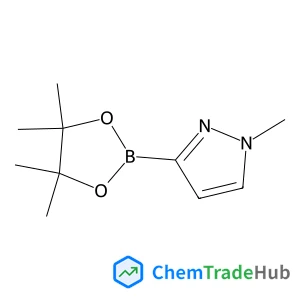
1-Methyl-3-(4,4,5,5-tetramethyl-1,3,2-dioxaborolan-2-yl)-1H-pyrazole
CAS号:
1020174-04-2
分子式:
C10H17BN2O2
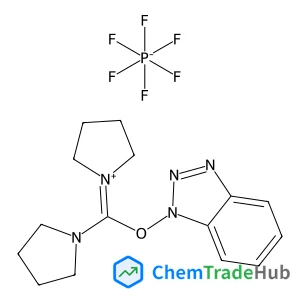
(1H-Benzotriazol-1-yloxy)(di-1-pyrrolidinyl)methylium hexafluorophosphate
CAS号:
105379-24-6
分子式:
C15H21F6N5OP
推荐供应商





免责声明
本页面提供的学术期刊信息仅供参考和研究使用。我们与任何期刊出版商均无关联,也不处理投稿事宜。如有投稿相关咨询,请直接联系相关期刊出版商。
如发现页面信息有误,请发送邮件至 support@chemtradehub.com 联系我们。我们将及时核实并处理您的问题。