




Regioisomeric wide-band-gap polymers with different fluorine topologies for non-fullerene organic solar cells
文献信息
发布日期
2018-12-04
DOI
10.1039/C8PY01458B
影响因子
5.582
作者
Yuxiang Li, Jin-Woo Lee, Minseok Kim, Changyeon Lee, Young Woong Lee, Bumjoon J. Kim, Han Young Woo
查看原文
摘要
Two regioisomeric wide-band-gap donor polymers with different fluorine topologies are designed and synthesized for use in nonfullerene organic solar cells (NFOSCs). Two fluorine atoms are substituted on the phenylene moiety in an anti (PTBDD2F-a) or a syn (PTBDD2F-s) fashion. The two isomeric polymers show nearly identical optical, thermal, and electrochemical properties, but exhibit different interchain packing and film morphologies in both pristine and blend films with an n-type acceptor (ITIC). These different morphological properties are related to differences in the molecular dipole, symmetry, and backbone curvatures of PTBDD2F-a and PTBDD2F-s, which influence the interchain packing and resulting electrical properties. From grazing incidence X-ray scattering measurements, PTBDD2F-a:ITIC shows more pronounced and two separate out-of-plane (010) peaks compared to PTBDD2F-s:ITIC, suggesting a stronger face-on cofacial packing of ITIC molecules in the PTBDD2F-a:ITIC blend. A higher domain purity (1.00 vs. 0.71) is also observed for PTBDD2F-a:ITIC compared to PTBDD2F-s:ITIC in the resonant soft X-ray scattering measurements. These different morphological features induce ∼2.5 times higher hole mobility and ∼6 times higher electron mobility with higher power conversion efficiency (6.60 vs. 5.47%) for PTBDD2F-a:ITIC than for PTBDD2F-s:ITIC. This comparative study highlights the effects of different fluorine topologies along the polymer backbone, which should be carefully considered to optimize the blend morphology and optoelectronic properties of NFOSCs.
相关文献
A practical guide to using boron doped diamond in electrochemical research
2014-12-18
Perspective
DOI: 10.1039/C4CP04022H
Topological states modulation of Bi and Sb thin films by atomic adsorption
Hongmei Liu, Xiaoli Wang, Guangliang Cui, Pinhua Zhang, Dapeng Zhao, Shuaihua Ji
2014-12-10
Paper
DOI: 10.1039/C4CP04502E
Changes in microstructure and physical properties of skutterudites after severe plastic deformation
Jiri Bursik, Jelena Horky, Ramakrishnan Anbalagan, Ramesh Chandra Mallik, Michael Zehetbauer
2014-12-18
Paper
DOI: 10.1039/C4CP05230G
The origin of the absorption spectra of porphyrin N- and dithiaporphyrin S-oxides in their neutral and protonated states
Torsten Bruhn, Christian Brückner
2014-12-11
Paper
DOI: 10.1039/C4CP04675G
Stabilities and electronic properties of monolayer MoS2 with one or two sulfur line vacancy defects
Yang Han, Ting Hu, Rui Li, Jian Zhou, Jinming Dong
2014-12-12
Paper
DOI: 10.1039/C4CP04319G
Al20+ does melt, albeit above the bulk melting temperature of aluminium
Udbhav Ojha, Krista G. Steenbergen, Nicola Gaston
2014-12-16
Paper
DOI: 10.1039/C4CP05143B
Nonidentical intracellular drug release rates in Raman and fluorescence spectroscopic determination
Erdene-Ochir Ganbold, Jinha Yoon, Doseok Kim, Sang-Woo Joo
2014-11-24
Paper
DOI: 10.1039/C4CP04235B
Voronoi dipole moments for the simulation of bulk phase vibrational spectra
Martin Thomas, Martin Brehm, Barbara Kirchner
2014-12-15
Paper
DOI: 10.1039/C4CP05272B
Aggregation induced emission enhancement of 4,4′-bis(diethylamino)benzophenone with an exceptionally large blue shift and its potential use as glucose sensor
Prativa Mazumdar, Debasish Das, Gobinda Prasad Sahoo, Guillermo Salgado-Morán, Ajay Misra
2014-11-26
Paper
DOI: 10.1039/C4CP03772C
Exploring the binding mechanisms of MIF to CXCR2 using theoretical approaches
Lei Xu, Youyong Li, Dan Li, Peng Xu, Sheng Tian, Huiyong Sun, Hui Liu, Tingjun Hou
2014-12-11
Paper
DOI: 10.1039/C4CP05095A
您可能还喜欢
化合物问答
6-氯-2H-1,4-苯并噁嗪-3(4H)-酮(CAS号:7652-29-1)应用于哪些行业?
6-氯-2H-1,4-苯并噁嗪-3(4H)-酮主要应用于医药、农药和聚合物等领域。在医药领域,该化合物可用于合成抗菌药物;在农药领域,可用作杀虫剂的中间体;在聚...
7652-29-16-Chloro-2H-1,4-benz...
化合物问答
活性氧化铝(CAS号:1302-74-5)应用于哪些行业?
活性氧化铝广泛应用于医药、聚合物、传感器、半导体和催化等领域。在医药行业,活性氧化铝用作吸附剂和干燥剂,有助于去除杂质和水分。在聚合物行业,它用作增白剂和抗结块...
1302-74-5aluminum;trihydrate
化合物问答
什么是硅胶(CAS号:112926-00-8)?
硅胶(Silica gel, pptd.,cryst.-free)是一种无定形、多孔的硅酸盐材料,主要成分为二氧化硅(SiO₂)。其结构由硅氧四面体构成,通过酸...
112926-00-8Silica gel, pptd.,cr...
化合物问答
二乙基甲基一氢硅烷(CAS号:760-32-7)的主要用途是什么?
二乙基甲基一氢硅烷主要用于有机合成、表面处理以及作为溶剂。它还被用作合成其他硅烷化合物的原料,以及在涂料、粘合剂和密封剂中的应用。
760-32-7Diethyl(methyl)silan...
化合物问答
在合成中是否有N-花生四烯酰基甘氨酸(CAS号:179113-91-8)的替代品?
在合成过程中,可以考虑使用类似结构的化合物作为替代品,例如N-亚油酰基甘氨酸或N-花生二烯酰基甘氨酸。这些替代品在结构上有类似的双键位置,但可能具有不同的物理化...
179113-91-8Glycine, N-[(5Z,8Z,1...
化合物问答
在合成中是否有1-(4-甲氧基苯基)丙烷-1,2-二酮(CAS号:10557-27-4)的替代品?
在合成过程中,可以考虑使用类似结构的化合物作为替代品,例如1-(3-甲氧基苯基)丙烷-1,2-二酮或1-(4-羟基苯基)丙烷-1,2-二酮。这些替代品具有相似的...
10557-27-41-(4-Methoxyphenyl)p...
化合物问答
N-(4-氨基-1-苄基-3-羟基-5-苯基戊基)-3-甲基-2-(2-氧代四氢嘧啶-1-基)-丁酰胺 5-氧代吡咯烷-2-甲酸(CAS号:192726-06-0)通常如何合成?
该化合物通常通过一系列复杂的有机合成步骤获得。首先,通过芳香族化合物的羟基化反应获得羟基化产物,然后通过酰化反应形成酰胺中间体,最后通过环化反应得到目标产物。常...
192726-06-05-Oxo-L-proline - (2...
化合物问答
(S)-2-氨基-3-喹啉-2-丙酸(CAS号:161513-46-8)的市场或研究趋势如何?
该化合物作为生物活性化合物,尤其是在药物化学领域表现出色。近年来,随着对新型抗炎、抗病毒和抗癌药物的研究增加,其市场和研究趋势持续增长。此外,其在神经科学领域的...
161513-46-8(S)-2-Amino-3-quinol...
化合物问答
核黄素磷酸钠(CAS号:130-40-5)安全吗?
核黄素磷酸钠在常规使用条件下安全,但高剂量可能引起刺激性反应。操作时需佩戴防护手套和护目镜,避免吸入粉尘。若接触皮肤或眼睛,应立即用大量清水冲洗。急救时需根据接...
130-40-5Sodium 1-deoxy-1-(7,...
化合物问答
盐酸丙胺卡因杂质A(EP) 标准品(CAS号:19281-31-3)通常如何合成?
盐酸丙胺卡因杂质A(EP) 标准品可通过重氮化反应和随后的酰胺化反应合成。首先,利用氯化反应将苯环上的氢原子转化为氯原子,然后通过芳香族重氮化反应引入氨基,最后...
19281-31-32-Chloro-N-(2-methyl...
来源期刊
Polymer Chemistry

CiteScore:
8.6
自引率:
7.3%
年发文量:
457
Polymer Chemistry welcomes submissions in all areas of polymer science that have a strong focus on macromolecular chemistry. Manuscripts may cover a broad range of fields, yet no direct application focus is required.
推荐化合物
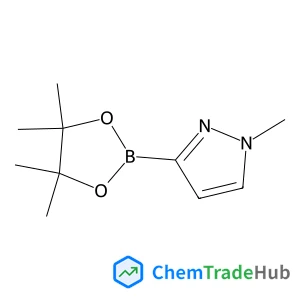
1-Methyl-3-(4,4,5,5-tetramethyl-1,3,2-dioxaborolan-2-yl)-1H-pyrazole
CAS号:
1020174-04-2
分子式:
C10H17BN2O2
推荐供应商




免责声明
本页面提供的学术期刊信息仅供参考和研究使用。我们与任何期刊出版商均无关联,也不处理投稿事宜。如有投稿相关咨询,请直接联系相关期刊出版商。
如发现页面信息有误,请发送邮件至 support@chemtradehub.com 联系我们。我们将及时核实并处理您的问题。