




Mechanistic insight into E22Q-mutation-induced antiparallel-to-parallel β-sheet transition of Aβ16−22 fibrils: an all-atom simulation study
文献信息
发布日期
2019-06-25
DOI
10.1039/C9CP02561H
影响因子
3.676
作者
Xuhua Li, Jiangtao Lei, Ruxi Qi, Luogang Xie, Guanghong Wei
查看原文
摘要
Alzheimer's disease is associated with the abnormal self-assembly of amyloid-β (Aβ) peptide into toxic oligomers and fibrils. Recent experiments reported that Aβ16−22, containing the central hydrophobic core (CHC) of Aβ, formed antiparallel β-sheet fibrils, while its E22Q mutant self-assembled into parallel β-sheet fibrils. However, the molecular mechanisms underlying E22Q-mutation-induced parallel β-sheet fibril formation are not well understood. Herein, we performed molecular dynamics (MD) simulations to study the dimerization processes of Aβ16−22 and Aβ16−22E22Q peptides. β-Sheet dimers with diverse hydrogen bond arrangements were observed and they exhibited highly dynamic and interconverting properties. An antiparallel-to-parallel β-sheet transition occurred in the assembly process of the E22Q mutant, but not in that of Aβ16−22. During this conformational transformation process, the inter-molecular Q22–Q22 hydrogen bonds were first formed and acted as a binder to facilitate the two chains forming a parallel orientation, then the hydrophobic interactions between residues in the CHC region consolidated this arrangement and drove the main-chain H-bond formation, hence resulting in parallel β-sheet formation. However, parallel β-sheets were less populated than antiparallel β-sheets of Aβ16−22E22Q dimers. In order to explore whether parallel β-sheets became dominant in larger size oligomers, we investigated the conformational ensembles of Aβ16−22 and Aβ16−22E22Q octamers by conducting replica exchange molecular dynamics (REMD) simulations. The REMD simulations revealed that the population of parallel β-strand alignment increased with an increase of the size of ordered Aβ16−22E22Q β-sheet oligomers, implying that the formation of full parallel β-sheets requires larger sized oligomers. Our findings provide a mechanistic explanation for the E22Q-mutation-induced formation of parallel β-sheet fibrils observed experimentally.
相关文献
A recombinant approach for stapled peptide discovery yields inhibitors of the RAD51 recombinase
Pedro Zuazua-Villar, Oliwia Koczy, Andrew J. Counsell, Stephen J. Walsh, Naomi S. Robertson, David R. Spring, Jessica A. Downs, Marko Hyvönen
2023-11-21
Edge Article
DOI: 10.1039/D3SC03331G
Recent advances in the utilization of covalent organic frameworks (COFs) as electrode materials for supercapacitors
Shen Xu, Jinghang Wu, Xiang Wang
2023-11-07
Review Article
DOI: 10.1039/D3SC04571D
A near-infrared light-activated nanoprobe for simultaneous detection of hydrogen polysulfide and sulfur dioxide in myocardial ischemia–reperfusion injury
Xianzhu Luo, Cuiling Zhang, Chenyang Yue, Yuelin Jiang, Fei Yang, Yuezhong Xian
2023-11-24
Edge Article
DOI: 10.1039/D3SC04937J
Hollow anatase TiO2 tetrakaidecahedral crystals with an active {001}/{110} redox interface toward high-performance photocatalytic activity
Liming Sun, Yaya Yuan, Xiaoxiao He, Wenwen Zhan, Dong Li, Yanli Zhao, Xiao-Jun Wang, Xiguang Han
2023-12-05
Edge Article
DOI: 10.1039/D3SC04328B
13Ccarbene nuclear magnetic resonance chemical shift analysis confirms CeIVC double bonding in cerium(iv)–diphosphonioalkylidene complexes
Cameron F. Baker, John A. Seed, Ralph W. Adams, Daniel Lee, Stephen T. Liddle
2023-12-06
Edge Article
DOI: 10.1039/D3SC04449A
Selective chiral dimerization and folding driven by arene–perfluoroarene force
Qiuhong Cheng, Aiyou Hao, Pengyao Xing
2023-11-29
Edge Article
DOI: 10.1039/D3SC05212E
From non-conductive MOF to proton-conducting metal-HOFs: a new class of reversible transformations induced by solvent-free mechanochemistry
Marcin Oszajca, Dariusz Matoga
2023-11-27
Edge Article
DOI: 10.1039/D3SC04401G
Photocatalytic (3 + 2) dipolar cycloadditions of aziridines driven by visible-light
Daniele Mazzarella, Tommaso Bortolato, Giorgio Pelosi, Luca Dell'Amico
2023-11-29
Edge Article
DOI: 10.1039/D3SC05997A
Towards routine organic structure determination using Raman microscopy
Jason Malenfant, Lucille Kuster, Yohann Gagné, Kouassi Signo, Maxime Denis, Sylvain Canesi, Mathieu Frenette
2023-11-14
Edge Article
DOI: 10.1039/D3SC02954A
Photoinduced cerium-catalyzed C–H acylation of unactivated alkanes
Jing Cao, Joshua L. Zhu, Karl A. Scheidt
2023-11-25
Edge Article
DOI: 10.1039/D3SC05162E
您可能还喜欢
化合物问答
5-氯咪唑并[1,2-c]嘧啶(CAS号:1208086-02-5)适用哪些法规指南?
5-氯咪唑并[1,2-c]嘧啶需遵循多项法规指南,包括但不限于GHS(全球化学品统一分类和标签制度),用于危险品的分类和标签。此外,根据其用途,还需遵循REAC...
1208086-02-55-Chloroimidazo[1,2-...
化合物问答
3-磺丙基十六烷基二甲基铵(CAS号:2281-11-0)应用于哪些行业?
3-磺丙基十六烷基二甲基铵广泛应用于医药、聚合物、传感器和半导体等领域。在医药行业,它作为乳化剂和稳定剂用于制备药物制剂;在聚合物行业中,作为增塑剂和抗静电剂;...
2281-11-03-[Hexadecyl(dimethy...
化合物问答
(R)-1-苄氧羰基-2-苄基哌嗪盐酸(CAS号:1217753-37-1)应用于哪些行业?
(R)-1-苄氧羰基-2-苄基哌嗪盐酸主要应用于医药、有机合成等行业。它作为药物合成中的中间体,具有重要的应用价值。此外,该化合物还可用于聚合物合成、传感器制造...
1217753-37-1(R)-Benzyl 3-benzylp...
化合物问答
什么是Benzo[c][1,2,5]thiadiazole-5,6-dithiol(CAS号:127498-45-7)?
Benzo[c][1,2,5]thiadiazole-5,6-二硫醇是一种含硫的有机化合物,具有独特的化学结构。该化合物的分子式为C8H5NOS4,分子量为22...
127498-45-7Benzo[c][1,2,5]thiad...
化合物问答
处理(5-氯-2-甲基吲哚-3)-乙酸(CAS号:19017-52-8)时应注意哪些实验室安全事项?
处理(5-氯-2-甲基吲哚-3)-乙酸时应佩戴防护眼镜和手套,保护皮肤和眼睛。通风橱应开启以确保良好的通风。如果不慎接触皮肤或眼睛,应立即用大量清水冲洗并寻求医...
19017-52-8(5-Chloro-2-methyl-1...
化合物问答
在合成中是否有生物素亚砜(CAS号:3376-83-8)的替代品?
在合成中,生物素亚砜的替代品包括生物素、生物素硫代半缩醛等。生物素硫代半缩醛作为生物素的衍生物,具有相似的化学性质,但在某些反应中可能表现出不同的行为。选择替代...
3376-83-8Biotin sulfoxide
化合物问答
在合成中是否有(4-氟四氢-2H-吡喃-4-基)甲醇(CAS号:883442-46-4)的替代品?
在合成过程中,可以考虑使用含有类似结构的化合物作为替代品,例如4-氟-2-羟基-1,3-二氧戊环或其他含有相应氟原子的四氢呋喃衍生物。这些化合物在化学性质上与目...
883442-46-4(4-Fluorooxan-4-YL)m...
化合物问答
2,3-二氢吡咯并[1,2-C]嘧啶-1,4-二酮(CAS号:223432-94-8)安全吗?
2,3-二氢吡咯并[1,2-C]嘧啶-1,4-二酮在处理时需要适当的安全措施。它属于一般化学品,虽然相对稳定,但在高温或强酸强碱条件下可能分解或发生化学反应。建...
223432-94-82,3-dihydropyrrolo[1...
化合物问答
如何储存反式-3-庚烯(CAS号:14686-14-7)?
反式-3-庚烯应储存在阴凉、通风良好的地方,避免阳光直射和高温。储存容器应密封,放置在温度不超过25℃的环境中,并远离火源和热源。建议使用耐腐蚀的容器,并确保良...
14686-14-73-Heptene
化合物问答
1-乙酰基-1H-吲哚-6-甲腈(CAS号:1017791-09-1)安全吗?
1-乙酰基-1H-吲哚-6-甲腈的毒性较低,但在操作时仍需谨慎。使用时应避免吸入其粉尘或烟雾,避免皮肤接触,佩戴防护眼镜和手套。
1017791-09-11-acetyl-1H-indole-6...
来源期刊
Physical Chemistry Chemical Physics

CiteScore:
5.5
自引率:
10.3%
年发文量:
3036
Physical Chemistry Chemical Physics (PCCP) is an international journal co-owned by 19 physical chemistry and physics societies from around the world. This journal publishes original, cutting-edge research in physical chemistry, chemical physics and biophysical chemistry. To be suitable for publication in PCCP, articles must include significant innovation and/or insight into physical chemistry; this is the most important criterion that reviewers and Editors will judge against when evaluating submissions. The journal has a broad scope and welcomes contributions spanning experiment, theory, computation and data science. Topical coverage includes spectroscopy, dynamics, kinetics, statistical mechanics, thermodynamics, electrochemistry, catalysis, surface science, quantum mechanics, quantum computing and machine learning. Interdisciplinary research areas such as polymers and soft matter, materials, nanoscience, energy, surfaces/interfaces, and biophysical chemistry are welcomed if they demonstrate significant innovation and/or insight into physical chemistry. Joined experimental/theoretical studies are particularly appreciated when complementary and based on up-to-date approaches.
推荐化合物
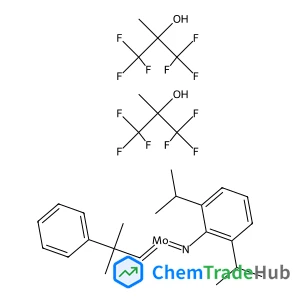
2,6-Diisopropylphenylimidoneophylidene molybdenum(VI) bis(hexafluoro-t-butoxide)
CAS号:
139220-25-0
分子式:
C30H37F12MoNO2
推荐供应商





免责声明
本页面提供的学术期刊信息仅供参考和研究使用。我们与任何期刊出版商均无关联,也不处理投稿事宜。如有投稿相关咨询,请直接联系相关期刊出版商。
如发现页面信息有误,请发送邮件至 support@chemtradehub.com 联系我们。我们将及时核实并处理您的问题。