







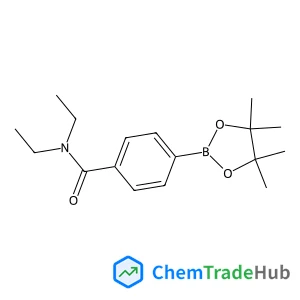
N,N-Diethyl-4-(4,4,5,5-tetramethyl-1,3,2-dioxaborolan-2-yl)benzamide
CAS号:
325142-99-2
分子式:
C17H26BNO3
Sandrine Kappler-Gratias, Léo Bucher, Nicolas Desbois, Yoann Rousselin, Claude P. Gros, Franck Gallardo
Twenty-nine fluorinated corroles were prepared, spectroscopically characterized, and studied for their antiviral activity against human cytomegalovirus infection. Six corroles were also fully characterized by X-ray crystallography giving insights on their geometrical features. The halogenated corroles reported herein exhibit significantly improved antiviral activity over their non-halogenated counterparts and over nitro-corrole analogs previously reported. Full activity of thirteen A3-corroles is achieved with four fluorine atoms present on the meso-phenyl ring reaching a selectivity index above 300. The maximum activity is achieved for A2B-corroles with selectivity indexes above 400. We thus demonstrate that the fluorocorrole is a highly potent platform to synthesize a new generation of anti hCMV molecules.
Hyeong Jun Lim, Kunsil Lee, Young Shik Cho, Yern Seung Kim, Taehoon Kim, Chong Rae Park
DOI: 10.1039/C4CP02319F
Sandra Flessau, Christopher Wolter, Elmar Pöselt, Elvira Kröger, Alf Mews, Tobias Kipp
DOI: 10.1039/C4CP00443D
H. Isobe, M. Shoji, S. Yamanaka, H. Mino, Y. Umena, K. Kawakami, N. Kamiya, J.-R. Shen
DOI: 10.1039/C4CP00282B
Sangbaek Park, Chan Woo Lee, Sanghyeon Kim, Hae Jin Kim, Ji Eon Kwon, Soo Young Park, Kug Sun Hong, Ki Tae Nam
DOI: 10.1039/C4CP01267D
S. V. Koroleva, A. I. Victorov
DOI: 10.1039/C4CP02178A
Ashok Kumar Baral, Sumaletha Narayanan, Farshid Ramezanipour, Venkataraman Thangadurai
DOI: 10.1039/C4CP00418C
Rabindranath Lo, Mrinal Kanti Si
DOI: 10.1039/C4CP01394H
Viola Mönkemöller, Mark Schüttpelz, Peter McCourt, Karen Sørensen, Bård Smedsrød
DOI: 10.1039/C4CP01574F
Régis Tadeu Santiago, Tiago Quevedo Teodoro, Roberto Luiz Andrade Haiduke
DOI: 10.1039/C4CP00706A
Stine T. Olsen, Vaida Arcisauskaite, Jacob Kongsted, Kurt V. Mikkelsen
DOI: 10.1039/C4CP02055C
3 - (二氟甲基)-1 -氟苯需遵循联合国全球化学品统一分类和标签制度(GHS),包括急性毒性、皮肤腐蚀/刺激、严重眼损伤/眼刺激等分类。同时,该化合物还需符...
3,5-二甲基苯胺通常通过乙苯的氨解反应合成。反应中使用硫酸作为催化剂,反应温度为120-130°C。乙苯在硫酸存在下与氨反应,生成3,5-二甲基苯胺和苯胺副产...
3-甲基异噻唑-5-胺在适当使用和储存条件下是相对安全的,但在操作时应注意防护措施。应避免吸入粉尘,避免与皮肤和眼睛直接接触。在操作过程中,应穿戴适当的防护装备...
3-(1,3-噻唑-2-基)-1H-吲哚通常通过多步合成方法制备。首先,由噻唑-2-基溴化物和吲哚进行偶联反应,得到中间体。然后,通过还原反应将中间体转化为所需...
4-溴-2-氟苯甲基氯主要用于有机合成中间体,特别是在医药、农药和染料等领域。作为一种具有特定结构的化合物,它在合成复杂有机分子时扮演重要角色。
处理Fmoc-β-(3-噻吩基)-D-Ala-OH时,应佩戴防护手套、护目镜和实验服。操作应在通风橱内进行。如发生泄露,应立即用大量水冲洗,并通知实验室管理人员...
氮化硅通常通过氮化硅的直接反应合成,即在高温下将四氯化硅与氨气反应。具体步骤是将四氯化硅和氨气混合并加热至1300-1700℃,在该条件下,四氯化硅与氨气反应生...
Cetirizine EP Impurity B DiHCl通常通过一锅法合成,首先将4-氯苯基-苯甲基氯甲酸酯与1-哌嗪乙酸反应,生成相应的酸,然后与盐酸反应...
1-哌啶-4-基丁-1-酮应储存在阴凉、干燥的地方,避免阳光直射。存储容器应密封,并确保通风良好。建议储存温度不超过25℃,湿度保持在相对较低的水平。
含有VORUCICLIB的废料应进行专业的收集和处理,包括使用适当的容器进行隔离,避免与其他化学品接触。处理方法通常包括化学中和、沉淀反应或吸附过程,随后进行焚...
![4-Chloro-3-(trifluoromethyl)-1H-pyrrolo[2,3-b]pyridine structure](https://cnstatic.chemtradehub.com/structs/869/869335-75-1-a9d0.webp "4-Chloro-3-(trifluoromethyl)-1H-pyrrolo[2,3-b]pyridine structure")
![tert-Butyl N-[(2-chloropyridin-4-yl)methyl]carbamate structure](https://cnstatic.chemtradehub.com/structs/916/916210-27-0-9f95.webp "tert-Butyl N-[(2-chloropyridin-4-yl)methyl]carbamate structure")




