








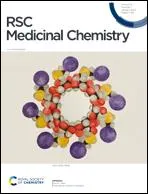
Peptide directed phthalocyanine–gold nanoparticles for selective photodynamic therapy of EGFR overexpressing cancers
文献信息
发布日期
2020-11-19
DOI
10.1039/D0MD00284D
影响因子
0
作者
Zoë Rachael Goddard, Andrew Michael Beekman, Marco M. D. Cominetti, Maria A. O'Connell, Isabelle Chambrier, Michael J. Cook, María J. Marín, David A. Russell, Mark Searcey
查看原文
摘要
Gold nanoparticles, covalently functionalised with the photosensitiser C11Pc and PEG, were actively targeted towards epidermal growth factor receptor overexpressing cancers using the peptide FITC-βAAEYLRK. Selective phototoxicity was observed at nanomolar concentrations with minimal dark toxicity.
相关文献
Generalized approximate spin projection calculations of effective exchange integrals of the CaMn4O5 cluster in the S1 and S3 states of the oxygen evolving complex of photosystem II
H. Isobe, M. Shoji, S. Yamanaka, H. Mino, Y. Umena, K. Kawakami, N. Kamiya, J.-R. Shen
2014-02-21
Paper
DOI: 10.1039/C4CP00282B
Evaluation of fundamental transport properties of Li-excess garnet-type Li5+2xLa3Ta2−xYxO12 (x = 0.25, 0.5 and 0.75) electrolytes using AC impedance and dielectric spectroscopy
Ashok Kumar Baral, Sumaletha Narayanan, Farshid Ramezanipour, Venkataraman Thangadurai
2014-05-01
Paper
DOI: 10.1039/C4CP00418C
Why is sulfuric acid a much stronger acid than ethanol? Determination of the contributions by inductive/field effects and electron-delocalization effects
Kevin Lynch, Adam Maloney, Austin Sowell, Changwei Wang, Yirong Mo, Joel M. Karty
2014-10-07
Paper
DOI: 10.1039/C4CP04110K
A σ-hole interaction with radical species as electron donors: does single-electron tetrel bonding exist?
Qingzhong Li, Xin Guo, Xin Yang, Wenzuo Li, Jianbo Cheng, Hai-Bei Li
2014-04-17
Paper
DOI: 10.1039/C4CP01209G
Fluorescence response of a dipolar organic solute in a dicationic ionic liquid (IL): is the behavior of dicationic IL different from that of usual monocationic IL?
Prabhat Kumar Sahu, Sudhir Kumar Das, Moloy Sarkar
2014-04-11
Paper
DOI: 10.1039/C4CP01053A
Analysis of hydrogen bond energies and hydrogen bonded networks in water clusters (H2O)20 and (H2O)25 using the charge-transfer and dispersion terms
2014-04-17
Paper
DOI: 10.1039/C4CP01204F
Unraveling manganese dissolution/deposition mechanisms on the negative electrode in lithium ion batteries
Xingcheng Xiao, Zhongyi Liu, Loïc Baggetto, Gabriel M. Veith, Karren L. More, Raymond R. Unocic
2014-04-03
Communication
DOI: 10.1039/C4CP00833B
Graphene oxide as an anti-shrinkage additive for resorcinol–formaldehyde composite aerogels
Kang Guo, Huaihe Song, Xiaohong Chen, Xian Du, Liang Zhong
2014-03-26
Paper
DOI: 10.1039/C4CP00592A
Electronic structure and spectra of (Cu2O)n–H2O complexes
Jerry Whitten
2014-11-07
Paper
DOI: 10.1039/C4CP04303K
Reactive molecular simulations of protonation of water clusters and depletion of acidity in H-ZSM-5 zeolite
Kaushik L. Joshi, George Psofogiannakis, Adri C. T. van Duin, Sumathy Raman
2014-07-16
Paper
DOI: 10.1039/C4CP02612H
您可能还喜欢
化合物问答
3 - (二氟甲基)-1 -氟苯(CAS号:26029-52-7)适用哪些法规指南?
3 - (二氟甲基)-1 -氟苯需遵循联合国全球化学品统一分类和标签制度(GHS),包括急性毒性、皮肤腐蚀/刺激、严重眼损伤/眼刺激等分类。同时,该化合物还需符...
26029-52-71-(Difluoromethyl)-3...
化合物问答
3,5-二甲基苯胺(CAS号:108-69-0)通常如何合成?
3,5-二甲基苯胺通常通过乙苯的氨解反应合成。反应中使用硫酸作为催化剂,反应温度为120-130°C。乙苯在硫酸存在下与氨反应,生成3,5-二甲基苯胺和苯胺副产...
108-69-03,5-Dimethylaniline
化合物问答
3-甲基异噻唑-5-胺(CAS号:24340-76-9)安全吗?
3-甲基异噻唑-5-胺在适当使用和储存条件下是相对安全的,但在操作时应注意防护措施。应避免吸入粉尘,避免与皮肤和眼睛直接接触。在操作过程中,应穿戴适当的防护装备...
24340-76-93-Methyl-1,2-thiazol...
化合物问答
3-(1,3-Thiazol-2-yl)-1H-indole(CAS号:135531-86-1)通常如何合成?
3-(1,3-噻唑-2-基)-1H-吲哚通常通过多步合成方法制备。首先,由噻唑-2-基溴化物和吲哚进行偶联反应,得到中间体。然后,通过还原反应将中间体转化为所需...
135531-86-13-(1,3-Thiazol-2-yl)...
化合物问答
4-溴-2-氟苯甲基氯(CAS号:85510-82-3)的主要用途是什么?
4-溴-2-氟苯甲基氯主要用于有机合成中间体,特别是在医药、农药和染料等领域。作为一种具有特定结构的化合物,它在合成复杂有机分子时扮演重要角色。
85510-82-34-Bromo-1-(chloromet...
化合物问答
处理Fmoc-β-(3-噻吩基)-D-Ala-OH(CAS号:220497-90-5)时应注意哪些实验室安全事项?
处理Fmoc-β-(3-噻吩基)-D-Ala-OH时,应佩戴防护手套、护目镜和实验服。操作应在通风橱内进行。如发生泄露,应立即用大量水冲洗,并通知实验室管理人员...
220497-90-5N-[(9H-Fluoren-9-ylm...
化合物问答
氮化硅(CAS号:12033-89-5)通常如何合成?
氮化硅通常通过氮化硅的直接反应合成,即在高温下将四氯化硅与氨气反应。具体步骤是将四氯化硅和氨气混合并加热至1300-1700℃,在该条件下,四氯化硅与氨气反应生...
12033-89-5Trisilicon tetranitr...
化合物问答
Cetirizine EP Impurity B DiHCl(CAS号:1000690-91-4)通常如何合成?
Cetirizine EP Impurity B DiHCl通常通过一锅法合成,首先将4-氯苯基-苯甲基氯甲酸酯与1-哌嗪乙酸反应,生成相应的酸,然后与盐酸反应...
1000690-91-4{4-[(4-Chlorophenyl)...
化合物问答
如何储存1-哌啶-4-基丁-1-酮(CAS号:3509-15-7)?
1-哌啶-4-基丁-1-酮应储存在阴凉、干燥的地方,避免阳光直射。存储容器应密封,并确保通风良好。建议储存温度不超过25℃,湿度保持在相对较低的水平。
3509-15-71-Piperidin-4-ylbuta...
化合物问答
如何处理含有VORUCICLIB(CAS号:1000023-04-0)的废料?
含有VORUCICLIB的废料应进行专业的收集和处理,包括使用适当的容器进行隔离,避免与其他化学品接触。处理方法通常包括化学中和、沉淀反应或吸附过程,随后进行焚...
1000023-04-02-[2-Chloro-4-(trifl...
来源期刊
推荐化合物
![2,6-Bis({(2R)-2-[hydroxy(diphenyl)methyl]-1-pyrrolidinyl}methyl)-4-methylphenol structure](https://cnstatic.chemtradehub.com/structs/877/877395-58-9-70bf.webp "2,6-Bis({(2R)-2-[hydroxy(diphenyl)methyl]-1-pyrrolidinyl}methyl)-4-methylphenol structure")
推荐供应商



免责声明
本页面提供的学术期刊信息仅供参考和研究使用。我们与任何期刊出版商均无关联,也不处理投稿事宜。如有投稿相关咨询,请直接联系相关期刊出版商。
如发现页面信息有误,请发送邮件至 support@chemtradehub.com 联系我们。我们将及时核实并处理您的问题。