






Identification of molecular glues of the SLP76/14-3-3 protein–protein interaction
文献信息
发布日期
2021-08-02
DOI
10.1039/D1MD00172H
影响因子
0
作者
Martin Redhead, Marta Westwood, Seppe Leysen, Jeremy Davis, Christian Ottmann
查看原文
摘要
The stabilisation of protein–protein interactions (PPIs) through molecular glues is a novel and promising approach in drug discovery. In stark contrast to research in protein–protein inhibition the field of stabilisation remains underdeveloped with comparatively few examples of small-molecule stabilisers of PPIs reported to date. At the same time identifying molecular glues has received recent sustained interest, especially in the fields of targeted protein degradation and 14-3-3 PPIs. The hub-protein 14-3-3 has a broad interactome with more than 500 known protein partners which presents a great opportunity for therapeutic intervention. In this study we have developed an HTRF assay suitable for HTS of the 14-3-3/SLP76 PPI and have completed a proof of concept screen against a chemically diverse library of 20 K molecules. The adaptor protein SLP76 has been reported to interact with 14-3-3 proteins downstream of the TCR playing an important role in mediating its own proteasomal degradation. We believe that stabilisation of this PPI could be exploited to potentiate degradation of SLP76 and therefore inhibit TCR signalling. This would represent an interesting alternative to other approaches in the field of targeted protein degradation. Here we disclose 16 novel stabilisers of the 14-3-3/SLP76 PPI across multiple different chemotypes. Based on the early results presented here we would recommend this approach to find molecular glues with broad applicability in the field of 14-3-3 PPIs.
相关文献
Why is sulfuric acid a much stronger acid than ethanol? Determination of the contributions by inductive/field effects and electron-delocalization effects
Kevin Lynch, Adam Maloney, Austin Sowell, Changwei Wang, Yirong Mo, Joel M. Karty
2014-10-07
Paper
DOI: 10.1039/C4CP04110K
Electrochemical conversion of CO2 to fuels: tuning of the reaction zone using suitable functional groups in a solid polymer electrolyte
Leela Manohar Aeshala, Ramagopal Uppaluri, Anil Verma
2014-06-09
Paper
DOI: 10.1039/C4CP02389G
Modeling the impedance response of mixed-conducting thin film electrodes
Chi Chen, Dengjie Chen, William C. Chueh
2014-04-28
Paper
DOI: 10.1039/C4CP01285B
A ferroelectric photocatalyst for enhancing hydrogen evolution: polarized particulate suspension
Sangbaek Park, Chan Woo Lee, Sanghyeon Kim, Hae Jin Kim, Ji Eon Kwon, Soo Young Park, Kug Sun Hong, Ki Tae Nam
2014-04-11
Communication
DOI: 10.1039/C4CP01267D
A QM/MM MD study of the pH-dependent ring-opening catalysis and lid motif flexibility in glucosamine 6-phosphate deaminase
Yuan Zhao, Nanhao Chen, Ruibo Wu, Zexing Cao
2014-07-15
Paper
DOI: 10.1039/C4CP01609B
Two and three dimensional network polymers for electrocatalysis
Alan Filer, Hyun-Jung Choi, Jeong-Min Seo, Jong-Beom Baek
2014-04-30
Perspective
DOI: 10.1039/C4CP01246A
The homotropenylium cation: a system with a pinched π ring current
Mark Lillington, Patrick W. Fowler, Jon Baker, Leonardus W. Jenneskens
2014-04-25
Paper
DOI: 10.1039/C4CP01075B
Evidence of short-range electron transfer of a redox enzyme on graphene oxide electrodes
Marccus V. A. Martins, Andressa R. Pereira, Roberto A. S. Luz, Rodrigo M. Iost, Frank N. Crespilho
2014-03-13
Paper
DOI: 10.1039/C4CP00452C
Graphene mechanics: I. Efficient first principles based Morse potential
Bogdan I. Costescu, Ilona B. Baldus
2014-04-15
Paper
DOI: 10.1039/C3CP55340J
Concerted charge and energy transfer processes in a highly flexible fullerene–dye system: a mixed quantum–classical study
Thomas Plehn, Jörg Megow, Volkhard May
2014-05-22
Paper
DOI: 10.1039/C4CP01081G
您可能还喜欢
化合物问答
3 - (二氟甲基)-1 -氟苯(CAS号:26029-52-7)适用哪些法规指南?
3 - (二氟甲基)-1 -氟苯需遵循联合国全球化学品统一分类和标签制度(GHS),包括急性毒性、皮肤腐蚀/刺激、严重眼损伤/眼刺激等分类。同时,该化合物还需符...
26029-52-71-(Difluoromethyl)-3...
化合物问答
3,5-二甲基苯胺(CAS号:108-69-0)通常如何合成?
3,5-二甲基苯胺通常通过乙苯的氨解反应合成。反应中使用硫酸作为催化剂,反应温度为120-130°C。乙苯在硫酸存在下与氨反应,生成3,5-二甲基苯胺和苯胺副产...
108-69-03,5-Dimethylaniline
化合物问答
3-甲基异噻唑-5-胺(CAS号:24340-76-9)安全吗?
3-甲基异噻唑-5-胺在适当使用和储存条件下是相对安全的,但在操作时应注意防护措施。应避免吸入粉尘,避免与皮肤和眼睛直接接触。在操作过程中,应穿戴适当的防护装备...
24340-76-93-Methyl-1,2-thiazol...
化合物问答
3-(1,3-Thiazol-2-yl)-1H-indole(CAS号:135531-86-1)通常如何合成?
3-(1,3-噻唑-2-基)-1H-吲哚通常通过多步合成方法制备。首先,由噻唑-2-基溴化物和吲哚进行偶联反应,得到中间体。然后,通过还原反应将中间体转化为所需...
135531-86-13-(1,3-Thiazol-2-yl)...
化合物问答
4-溴-2-氟苯甲基氯(CAS号:85510-82-3)的主要用途是什么?
4-溴-2-氟苯甲基氯主要用于有机合成中间体,特别是在医药、农药和染料等领域。作为一种具有特定结构的化合物,它在合成复杂有机分子时扮演重要角色。
85510-82-34-Bromo-1-(chloromet...
化合物问答
处理Fmoc-β-(3-噻吩基)-D-Ala-OH(CAS号:220497-90-5)时应注意哪些实验室安全事项?
处理Fmoc-β-(3-噻吩基)-D-Ala-OH时,应佩戴防护手套、护目镜和实验服。操作应在通风橱内进行。如发生泄露,应立即用大量水冲洗,并通知实验室管理人员...
220497-90-5N-[(9H-Fluoren-9-ylm...
化合物问答
氮化硅(CAS号:12033-89-5)通常如何合成?
氮化硅通常通过氮化硅的直接反应合成,即在高温下将四氯化硅与氨气反应。具体步骤是将四氯化硅和氨气混合并加热至1300-1700℃,在该条件下,四氯化硅与氨气反应生...
12033-89-5Trisilicon tetranitr...
化合物问答
Cetirizine EP Impurity B DiHCl(CAS号:1000690-91-4)通常如何合成?
Cetirizine EP Impurity B DiHCl通常通过一锅法合成,首先将4-氯苯基-苯甲基氯甲酸酯与1-哌嗪乙酸反应,生成相应的酸,然后与盐酸反应...
1000690-91-4{4-[(4-Chlorophenyl)...
化合物问答
如何储存1-哌啶-4-基丁-1-酮(CAS号:3509-15-7)?
1-哌啶-4-基丁-1-酮应储存在阴凉、干燥的地方,避免阳光直射。存储容器应密封,并确保通风良好。建议储存温度不超过25℃,湿度保持在相对较低的水平。
3509-15-71-Piperidin-4-ylbuta...
化合物问答
如何处理含有VORUCICLIB(CAS号:1000023-04-0)的废料?
含有VORUCICLIB的废料应进行专业的收集和处理,包括使用适当的容器进行隔离,避免与其他化学品接触。处理方法通常包括化学中和、沉淀反应或吸附过程,随后进行焚...
1000023-04-02-[2-Chloro-4-(trifl...
来源期刊
推荐化合物
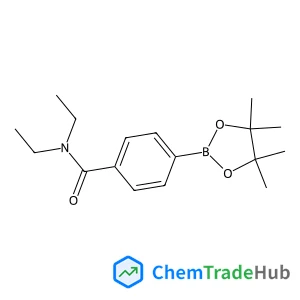
N,N-Diethyl-4-(4,4,5,5-tetramethyl-1,3,2-dioxaborolan-2-yl)benzamide
CAS号:
325142-99-2
分子式:
C17H26BNO3
推荐供应商



免责声明
本页面提供的学术期刊信息仅供参考和研究使用。我们与任何期刊出版商均无关联,也不处理投稿事宜。如有投稿相关咨询,请直接联系相关期刊出版商。
如发现页面信息有误,请发送邮件至 support@chemtradehub.com 联系我们。我们将及时核实并处理您的问题。