










![6-Benzyl-4,5,6,7-tetrahydro-1H-pyrazolo[3,4-c]pyridin-3(2H)-one structure](https://cnstatic.chemtradehub.com/structs/909/909187-64-0-f54f.webp "6-Benzyl-4,5,6,7-tetrahydro-1H-pyrazolo[3,4-c]pyridin-3(2H)-one structure")
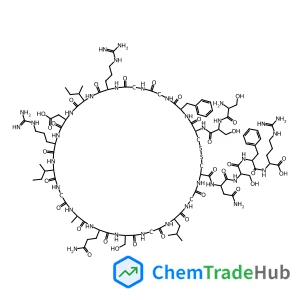
Posttranslational modifications of α-conotoxins: sulfotyrosine and C-terminal amidation stabilise structures and increase acetylcholine receptor binding
文献信息
发布日期
2021-07-26
DOI
10.1039/D1MD00182E
影响因子
0
作者
Thao N. T. Ho, Han Siean Lee, Shilpa Swaminathan, Lewis Goodwin, Nishant Rai, Brianna Ushay, Richard J. Lewis, K. Johan Rosengren, Anne C. Conibear
查看原文
摘要
Conotoxins are peptides found in the venoms of marine cone snails. They are typically highly structured and stable and have potent activities at nicotinic acetylcholine receptors, which make them valuable research tools and promising lead molecules for drug development. Many conotoxins are also highly modified with posttranslational modifications such as proline hydroxylation, glutamic acid gamma-carboxylation, tyrosine sulfation and C-terminal amidation, amongst others. The role of these posttranslational modifications is poorly understood, and it is unclear whether the modifications interact directly with the binding site, alter conotoxin structure, or both. Here we synthesised a set of twelve conotoxin variants bearing posttranslational modifications in the form of native sulfotyrosine and C-terminal amidation and show that these two modifications in combination increase their activity at nicotinic acetylcholine receptors and binding to soluble acetylcholine binding proteins, respectively. We then rationalise how these functional differences between variants might arise from stabilization of the three-dimensional structures and interactions with the binding sites, using high-resolution nuclear magnetic resonance data. This study demonstrates that posttranslational modifications can modulate interactions between a ligand and receptor by a combination of structural and binding alterations. A deeper mechanistic understanding of the role of posttranslational modifications in structure–activity relationships is essential for understanding receptor biology and could help to guide structure-based drug design.
相关文献
Unraveling manganese dissolution/deposition mechanisms on the negative electrode in lithium ion batteries
Xingcheng Xiao, Zhongyi Liu, Loïc Baggetto, Gabriel M. Veith, Karren L. More, Raymond R. Unocic
2014-04-03
Communication
DOI: 10.1039/C4CP00833B
Proton dynamics in oxides: insight into the mechanics of proton conduction from quasielastic neutron scattering
2014-10-29
Perspective
DOI: 10.1039/C4CP04112G
Fully printable transparent monolithic solid-state dye-sensitized solar cell with mesoscopic indium tin oxide counter electrode
Ying Yang, Kwangho Ri, Yaoguang Rong, Linfeng Liu, Tongfa Liu, Min Hu, Xiong Li, Hongwei Han
2014-07-03
Paper
DOI: 10.1039/C4CP02354D
The strong specific effect of coions on micellar growth from molecular-thermodynamic theory
S. V. Koroleva, A. I. Victorov
2014-07-15
Communication
DOI: 10.1039/C4CP02178A
The theoretical account of the ligand field bonding regime and magnetic anisotropy in the DySc2N@C80 single ion magnet endohedral fullerene
Fanica Cimpoesu, Nita Dragoe, Harry Ramanantoanina, Werner Urland, Claude Daul
2014-04-07
Paper
DOI: 10.1039/C4CP00953C
Photoluminescence of cerium fluoride and cerium-doped lanthanum fluoride nanoparticles and investigation of energy transfer to photosensitizer molecules
Daniel R. Cooper, Konstantin Kudinov, Pooja Tyagi, Colin K. Hill, Stephen E. Bradforth, Jay L. Nadeau
2014-05-08
Paper
DOI: 10.1039/C4CP01044B
Electrochemistry of orthosilicate-based lithium battery cathodes: a perspective
Stefania Ferrari, Doretta Capsoni, Simone Casino, Matteo Destro, Claudio Gerbaldi, Marcella Bini
2014-04-15
Perspective
DOI: 10.1039/C4CP00511B
Optical and electrochemical properties of ethynylaniline derivatives of phenothiazine, phenothiazine-5-oxide and phenothiazine-5,5-dioxide
Kim D. Thériault, Todd C. Sutherland
2014-05-13
Paper
DOI: 10.1039/C4CP00678J
Interstellar H adsorption and H2 formation on the crystalline (010) forsterite surface: a B3LYP-D2* periodic study
Javier Navarro-Ruiz, Mariona Sodupe, Piero Ugliengo, Albert Rimola
2014-04-15
Paper
DOI: 10.1039/C4CP00819G
您可能还喜欢
化合物问答
3 - (二氟甲基)-1 -氟苯(CAS号:26029-52-7)适用哪些法规指南?
3 - (二氟甲基)-1 -氟苯需遵循联合国全球化学品统一分类和标签制度(GHS),包括急性毒性、皮肤腐蚀/刺激、严重眼损伤/眼刺激等分类。同时,该化合物还需符...
26029-52-71-(Difluoromethyl)-3...
化合物问答
3,5-二甲基苯胺(CAS号:108-69-0)通常如何合成?
3,5-二甲基苯胺通常通过乙苯的氨解反应合成。反应中使用硫酸作为催化剂,反应温度为120-130°C。乙苯在硫酸存在下与氨反应,生成3,5-二甲基苯胺和苯胺副产...
108-69-03,5-Dimethylaniline
化合物问答
3-甲基异噻唑-5-胺(CAS号:24340-76-9)安全吗?
3-甲基异噻唑-5-胺在适当使用和储存条件下是相对安全的,但在操作时应注意防护措施。应避免吸入粉尘,避免与皮肤和眼睛直接接触。在操作过程中,应穿戴适当的防护装备...
24340-76-93-Methyl-1,2-thiazol...
化合物问答
3-(1,3-Thiazol-2-yl)-1H-indole(CAS号:135531-86-1)通常如何合成?
3-(1,3-噻唑-2-基)-1H-吲哚通常通过多步合成方法制备。首先,由噻唑-2-基溴化物和吲哚进行偶联反应,得到中间体。然后,通过还原反应将中间体转化为所需...
135531-86-13-(1,3-Thiazol-2-yl)...
化合物问答
4-溴-2-氟苯甲基氯(CAS号:85510-82-3)的主要用途是什么?
4-溴-2-氟苯甲基氯主要用于有机合成中间体,特别是在医药、农药和染料等领域。作为一种具有特定结构的化合物,它在合成复杂有机分子时扮演重要角色。
85510-82-34-Bromo-1-(chloromet...
化合物问答
处理Fmoc-β-(3-噻吩基)-D-Ala-OH(CAS号:220497-90-5)时应注意哪些实验室安全事项?
处理Fmoc-β-(3-噻吩基)-D-Ala-OH时,应佩戴防护手套、护目镜和实验服。操作应在通风橱内进行。如发生泄露,应立即用大量水冲洗,并通知实验室管理人员...
220497-90-5N-[(9H-Fluoren-9-ylm...
化合物问答
氮化硅(CAS号:12033-89-5)通常如何合成?
氮化硅通常通过氮化硅的直接反应合成,即在高温下将四氯化硅与氨气反应。具体步骤是将四氯化硅和氨气混合并加热至1300-1700℃,在该条件下,四氯化硅与氨气反应生...
12033-89-5Trisilicon tetranitr...
化合物问答
Cetirizine EP Impurity B DiHCl(CAS号:1000690-91-4)通常如何合成?
Cetirizine EP Impurity B DiHCl通常通过一锅法合成,首先将4-氯苯基-苯甲基氯甲酸酯与1-哌嗪乙酸反应,生成相应的酸,然后与盐酸反应...
1000690-91-4{4-[(4-Chlorophenyl)...
化合物问答
如何储存1-哌啶-4-基丁-1-酮(CAS号:3509-15-7)?
1-哌啶-4-基丁-1-酮应储存在阴凉、干燥的地方,避免阳光直射。存储容器应密封,并确保通风良好。建议储存温度不超过25℃,湿度保持在相对较低的水平。
3509-15-71-Piperidin-4-ylbuta...
化合物问答
如何处理含有VORUCICLIB(CAS号:1000023-04-0)的废料?
含有VORUCICLIB的废料应进行专业的收集和处理,包括使用适当的容器进行隔离,避免与其他化学品接触。处理方法通常包括化学中和、沉淀反应或吸附过程,随后进行焚...
1000023-04-02-[2-Chloro-4-(trifl...
来源期刊
推荐化合物
推荐供应商





免责声明
本页面提供的学术期刊信息仅供参考和研究使用。我们与任何期刊出版商均无关联,也不处理投稿事宜。如有投稿相关咨询,请直接联系相关期刊出版商。
如发现页面信息有误,请发送邮件至 support@chemtradehub.com 联系我们。我们将及时核实并处理您的问题。