





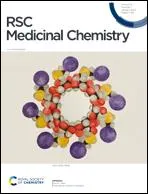
Potency and metabolic stability: a molecular hybrid case in the design of novel PF74-like small molecules targeting HIV-1 capsid protein
文献信息
发布日期
2021-09-28
DOI
10.1039/D1MD00292A
影响因子
0
作者
Rajkumar Lalji Sahani, Thamina Akther, Maria E. Cilento, Andres Emanuelli Castaner, Huanchun Zhang, Jiashu Xie, Zhengqiang Wang
查看原文
摘要
PF74 (1) is a potent and well-characterized prototypical small molecule targeting human immunodeficiency virus type 1 (HIV-1) capsid protein (CA), but not a viable antiviral lead due to the lack of metabolic stability. We report herein our molecular hybridization-based medicinal chemistry efforts toward potent and metabolically stable PF74-like small molecules. The design of the new sub-chemotype 4 rationally combines binding features of two recently reported PF74-like compounds 2 and 3. The subsequent confirmation and structure–activity relationship (SAR) of hit 4a entailed the chemical synthesis of 37 novel analogs, most of which showed modest but meaningful thermal shift, and low μM antiviral activity. The most potent analogs (4a, 4d, 4o, and 4r) all exhibited noticeably improved metabolic stability over PF74. Molecular modeling suggests that these new analogs bind to the PF74 binding site. Overall, our work demonstrated that the molecular hybridization approach is suitable for designing compounds with balanced potency and metabolic stability.
相关文献
Binary aromatic self-assembled monolayers: electrostatic properties and charge tunneling rates across the molecular framework
Andika Asyuda, Xianglong Wan, Michael Zharnikov
2020-04-27
Paper
DOI: 10.1039/D0CP01740J
Can glycine betaine denature proteins?
Arusha Acharyya, Dayoung Shin, Thomas Troxler, Feng Gai
2020-03-30
Paper
DOI: 10.1039/D0CP00397B
Electron injection effect in In2O3 and SnO2 nanocrystals modified by ruthenium heteroleptic complexes
Marina Rumyantseva, Abulkosim Nasriddinov, Alexander Gaskov, Anna Moiseeva, Yuri Fedorov, Gediminas Jonusauskas
2020-03-16
Paper
DOI: 10.1039/C9CP07016H
The role of an unintentional carbon dopant in resolving the controversial conductivity aspects in BiFeO3
Shaan Ameer, Kajal Jindal, Monika Tomar, Pradip K. Jha, Vinay Gupta
2020-04-27
Paper
DOI: 10.1039/C9CP06614D
Ab initio investigation of the formation mechanism of nano-interfaces between 3d-late transition-metals and ZrO2 nanoclusters
Larissa Zibordi-Besse, Lucas G. Verga, Vivianne K. Ocampo-Restrepo, Juarez L. F. Da Silva
2020-03-25
Paper
DOI: 10.1039/D0CP00584C
Versatile surface-active ionic liquid: construction of microemulsions and their applications in light harvesting
Pratap Bahadur, Debes Ray, V. K. Aswal
2020-03-24
Paper
DOI: 10.1039/C9CP06842B
Active stereo-control of the Cl + CH4(ν3 = 1) reaction: a three-dimensional perspective
2020-04-23
Paper
DOI: 10.1039/D0CP01502D
Tunable electronic properties of the novel g-ZnO/1T-TiS2 vdW heterostructure by electric field and strain: crossovers in bandgap and band alignment types
2020-03-20
Paper
DOI: 10.1039/D0CP00524J
Structural and thermodynamic study of Ca A- or Co B-site substituted SrFeO3−δ perovskites for low temperature chemical looping applications
Giancarlo Luongo, Felix Donat, Christoph R. Müller
2020-04-08
Paper
DOI: 10.1039/D0CP01049A
Orientation independent vibrational dynamics of lipid-bound interfacial water
Malte Deiseroth, Mischa Bonn
2020-04-02
Paper
DOI: 10.1039/D0CP01099E
您可能还喜欢
化合物问答
3 - (二氟甲基)-1 -氟苯(CAS号:26029-52-7)适用哪些法规指南?
3 - (二氟甲基)-1 -氟苯需遵循联合国全球化学品统一分类和标签制度(GHS),包括急性毒性、皮肤腐蚀/刺激、严重眼损伤/眼刺激等分类。同时,该化合物还需符...
26029-52-71-(Difluoromethyl)-3...
化合物问答
3,5-二甲基苯胺(CAS号:108-69-0)通常如何合成?
3,5-二甲基苯胺通常通过乙苯的氨解反应合成。反应中使用硫酸作为催化剂,反应温度为120-130°C。乙苯在硫酸存在下与氨反应,生成3,5-二甲基苯胺和苯胺副产...
108-69-03,5-Dimethylaniline
化合物问答
3-甲基异噻唑-5-胺(CAS号:24340-76-9)安全吗?
3-甲基异噻唑-5-胺在适当使用和储存条件下是相对安全的,但在操作时应注意防护措施。应避免吸入粉尘,避免与皮肤和眼睛直接接触。在操作过程中,应穿戴适当的防护装备...
24340-76-93-Methyl-1,2-thiazol...
化合物问答
3-(1,3-Thiazol-2-yl)-1H-indole(CAS号:135531-86-1)通常如何合成?
3-(1,3-噻唑-2-基)-1H-吲哚通常通过多步合成方法制备。首先,由噻唑-2-基溴化物和吲哚进行偶联反应,得到中间体。然后,通过还原反应将中间体转化为所需...
135531-86-13-(1,3-Thiazol-2-yl)...
化合物问答
4-溴-2-氟苯甲基氯(CAS号:85510-82-3)的主要用途是什么?
4-溴-2-氟苯甲基氯主要用于有机合成中间体,特别是在医药、农药和染料等领域。作为一种具有特定结构的化合物,它在合成复杂有机分子时扮演重要角色。
85510-82-34-Bromo-1-(chloromet...
化合物问答
处理Fmoc-β-(3-噻吩基)-D-Ala-OH(CAS号:220497-90-5)时应注意哪些实验室安全事项?
处理Fmoc-β-(3-噻吩基)-D-Ala-OH时,应佩戴防护手套、护目镜和实验服。操作应在通风橱内进行。如发生泄露,应立即用大量水冲洗,并通知实验室管理人员...
220497-90-5N-[(9H-Fluoren-9-ylm...
化合物问答
氮化硅(CAS号:12033-89-5)通常如何合成?
氮化硅通常通过氮化硅的直接反应合成,即在高温下将四氯化硅与氨气反应。具体步骤是将四氯化硅和氨气混合并加热至1300-1700℃,在该条件下,四氯化硅与氨气反应生...
12033-89-5Trisilicon tetranitr...
化合物问答
Cetirizine EP Impurity B DiHCl(CAS号:1000690-91-4)通常如何合成?
Cetirizine EP Impurity B DiHCl通常通过一锅法合成,首先将4-氯苯基-苯甲基氯甲酸酯与1-哌嗪乙酸反应,生成相应的酸,然后与盐酸反应...
1000690-91-4{4-[(4-Chlorophenyl)...
化合物问答
如何储存1-哌啶-4-基丁-1-酮(CAS号:3509-15-7)?
1-哌啶-4-基丁-1-酮应储存在阴凉、干燥的地方,避免阳光直射。存储容器应密封,并确保通风良好。建议储存温度不超过25℃,湿度保持在相对较低的水平。
3509-15-71-Piperidin-4-ylbuta...
化合物问答
如何处理含有VORUCICLIB(CAS号:1000023-04-0)的废料?
含有VORUCICLIB的废料应进行专业的收集和处理,包括使用适当的容器进行隔离,避免与其他化学品接触。处理方法通常包括化学中和、沉淀反应或吸附过程,随后进行焚...
1000023-04-02-[2-Chloro-4-(trifl...
来源期刊
推荐化合物
![Methyl 4-({[(2-methyl-2-propanyl)oxy]carbonyl}amino)bicyclo[2.2.2]octane-1-carboxylate structure](https://cnstatic.chemtradehub.com/structs/943/943845-74-7-b7e5.webp "Methyl 4-({[(2-methyl-2-propanyl)oxy]carbonyl}amino)bicyclo[2.2.2]octane-1-carboxylate structure")
推荐供应商





免责声明
本页面提供的学术期刊信息仅供参考和研究使用。我们与任何期刊出版商均无关联,也不处理投稿事宜。如有投稿相关咨询,请直接联系相关期刊出版商。
如发现页面信息有误,请发送邮件至 support@chemtradehub.com 联系我们。我们将及时核实并处理您的问题。