



First comparison of catalytic CO2 reduction to CO over molybdenum carbide, nitride and phosphide catalysts
文献信息
发布日期
2023-10-17
DOI
10.1039/D3CY00979C
影响因子
6.119
作者
Wei Ding, Guogang Liu, Zhiqiang Zhang
查看原文
摘要
Carbonization, nitridation and phosphorization of Mo/CNT precursors can lead to the formation of β-Mo2C, a γ-Mo2N/β-Mo2C mixture and MoP, respectively, on the CNT support. It was proposed that the γ-Mo2N phase showed better reverse water gas shift (RWGS) performance than the β-Mo2C and MoP phases, which can be due to its higher oxophilicity and weaker affinity with CO. Noticeably, this nitrided Mo/CNT catalyst showed comparable RWGS performance to bimetallic Cu/β-Mo2C (recently known to be the most excellent non-noble metal catalyst for the RWGS).
相关文献
A direct meta-lithiation route to 1,3-disubstituted ferrocenes
Christophe Pichon, Barbara Odell, John M. Brown
2004-02-10
Communication
DOI: 10.1039/B314641C
Adduct formation by photo-induced electron transfer between photo-oxidising Ru(ii) complexes and tryptophan
Etienne Gicquel, Arnaud Boisdenghien, Eric Defrancq, Cécile Moucheron, Andrée Kirsch-De Mesmaeker
2004-10-21
Communication
DOI: 10.1039/B411686K
Discovery of two high-energy N2O2 isomers
Giulia de Petris, Fulvio Cacace, Anna Troiani
2004-01-08
Communication
DOI: 10.1039/B312628E
The substituent-dependent base-treatment chemistry of (η5-C5H5)Fe(CO)2SiR2SiR2Cl: formation of 1,2-disila-3-metallacyclobutanes, their ring-opened polymers, migrations and substitutions
Hemant K. Sharma, Keith H. Pannell
2004-10-06
Communication
DOI: 10.1039/B410822A
From group 13–group 13 donor–acceptor bonds to triple-decker cations
2004-10-13
Feature Article
DOI: 10.1039/B409497M
Polymorphism in butylated hydroxy anisole (BHA)
Jennifer A. McMahon, Michael J. Zaworotko, Julius F. Remenar
2004-01-06
Communication
DOI: 10.1039/B311606A
Reactivation of aged model Pd/Ce0.68Zr0.32O2 three-way catalyst by high temperature oxidising treatment
N. Hickey, P. Fornasiero, R. Di Monte, J. Kašpar, J. R. González-Velasco, M. A. Gutiérrez-Ortiz, M. P. González-Marcos, J. M. Gatica, S. Bernal
2003-11-25
Communication
DOI: 10.1039/B308321G
Low temperature 1,1,1-trichloroethane dehydrochlorination over Pt catalysts: from model surfaces to the real world
Adam F. Lee, Paul A. Carr, Karen Wilson
2004-10-22
Communication
DOI: 10.1039/B408745C
Stereoconservative Negishi arylation and alkynylation as an efficient approach to enantiopure 2,2′-diarylated 1,1′-binaphthyls
Katarína Krascsenicsová, Peter Walla, Peter Kasák, Georg Uray, C. Oliver Kappe, Martin Putala
2004-10-01
Communication
DOI: 10.1039/B410185E
NRIS study on the [FeN6] core in photo-induced high-spin state of [Fe(2-pic)3]Cl2·EtOH
Gergely Juhász, Makoto Seto, Yoshitaka Yoda, Shinya Hayami, Yonezo Maeda
2004-09-29
Communication
DOI: 10.1039/B409025J
您可能还喜欢
化合物问答
十二烷基磺酸钠(CAS号:2386-53-0)的主要用途是什么?
十二烷基磺酸钠主要用作表面活性剂,广泛应用于洗涤剂、肥皂、化妆品和工业清洁产品中。它能有效去除油脂和污垢,常用于制造洗发水、沐浴露、洗衣粉和金属清洗剂。此外,它...
2386-53-01-Dodecanesulfonic a...
化合物问答
5-羟基异喹啉(CAS号:2439-04-5)适用哪些法规指南?
5-羟基异喹啉作为化学品,主要适用的法规包括GHS全球化学品统一分类和标签制度,REACH法规等。GHS将5-羟基异喹啉分类为皮肤腐蚀/刺激类别2,严重眼损伤/...
2439-04-55-Isoquinolinol
化合物问答
在合成中是否有FIDAS-5 | Wnt(CAS号:1391934-98-7)的替代品?
合成中可以考虑使用类似结构的化合物,如4-[(E)-2-(2-氯-6-氟苯基)乙烯基]-N-甲基苯胺的类似物或衍生物作为替代品。这类化合物可能具有相似的生物活性...
1391934-98-74-[(E)-2-(2-Chloro-6...
化合物问答
(R)-tert-Butyl 2-(5-bromo-1H-imidazol-2-yl)pyrrolidine-1-carboxylate(CAS号:1370600-56-8)通常如何合成?
该化合物通常通过如下步骤合成:首先,将4-溴-1H-咪唑与对甲苯磺酸在乙酸乙酯中反应,得到中间体5-溴-1H-咪唑-2-甲酸乙酯。然后,该中间体与2-甲基-2-...
1370600-56-82-Methyl-2-propanyl ...
化合物问答
处理4-(吡咯烷-1-基)环己酮(CAS号:10421-18-8)时应注意哪些实验室安全事项?
处理4-(吡咯烷-1-基)环己酮时,应佩戴手套、护目镜和实验室外套,以防止直接接触或吸入。在通风橱中操作,确保良好的通风条件。一旦发生泄漏,应立即清理并使用适当...
10421-18-84-(Pyrrolidin-1-yl)c...
化合物问答
如何处理含有异麦芽糖醇(CAS号:534-73-6)的废料?
含有异麦芽糖醇的废液应首先进行分类收集,避免与其他化学品混合。对于小规模的废液,可以通过焚烧或加入特定的化学试剂进行无害化处理。对于大规模的废液,建议联系专业的...
534-73-66-O-alpha-D-Glucopyr...
化合物问答
7-甲基壬酸(CAS号:41653-89-8)的主要用途是什么?
7-甲基壬酸主要用于有机合成领域,作为合成其他化合物的原料。此外,它还可能作为一种中间体用于药品制造和香料合成,但具体用途需要根据其具体的化学结构和反应特性来确...
41653-89-87-Methylnonanoic aci...
化合物问答
N-甲氧基-N-甲基甲基吡啶羧酰胺(CAS号:148493-07-6)应用于哪些行业?
N-甲氧基-N-甲基甲基吡啶羧酰胺在医药领域有一定的应用,作为一种潜在的药物前体或中间体。此外,该化合物也可能应用于聚合物改性剂、传感器材料等。由于其独特的化学...
148493-07-6N-Methoxy-N-methylpi...
化合物问答
什么是惕各酸香叶酯(CAS号:7785-33-3)?
惕各酸香叶酯是一种化合物,化学名称为(2E)-3,7-二甲基-2,6-辛二烯-1-基(2E)-2-甲基-2-丁烯酸酯。它是一种具有香叶香气的化合物,分子式为C1...
7785-33-3(2E)-3,7-Dimethyl-2,...
化合物问答
1-环丁基哌嗪(CAS号:132800-13-6)安全吗?
1-环丁基哌嗪在适当的操作条件下是相对安全的,但如遇明火或高热会释放有毒气体。操作时应佩戴防护眼镜和手套,避免吸入或接触皮肤、眼睛。
132800-13-61-Cyclobutylpiperazi...
来源期刊
Catalysis Science & Technology

CiteScore:
5.91
自引率:
4.5%
年发文量:
600
Catalysis Science & Technology is committed to publishing research reporting high-quality, cutting-edge developments across the catalysis community at large. The journal places equal focus on publications from the heterogeneous, homogeneous, thermo-, electro-, photo-, organo- and biocatalysis communities. Works published in the journal feature a balanced mix of fundamental, technology-oriented, experimental, computational, digital and data-driven original research, thus appealing to catalysis practitioners in both academic and industrial environments. Original research articles published in the journal must demonstrate new catalytic discoveries and/or methodological advances that represent a significant advance on previously published work, from the molecular to the process scales. We welcome rigorous research in a wide range of timely or emerging applications related to the environment, health, energy and materials. Catalysis Science & Technology publishes Communications, Articles, Reviews and Perspectives. More details regarding manuscript types may be found in the Information for Authors section.
推荐化合物
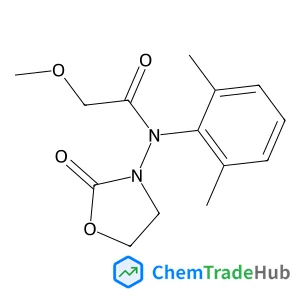
N-(2,6-Dimethylphenyl)-2-methoxy-N-(2-oxo-1,3-oxazolidin-3-yl)acetamide
CAS号:
77732-09-3
分子式:
C14H18N2O4
推荐供应商



免责声明
本页面提供的学术期刊信息仅供参考和研究使用。我们与任何期刊出版商均无关联,也不处理投稿事宜。如有投稿相关咨询,请直接联系相关期刊出版商。
如发现页面信息有误,请发送邮件至 support@chemtradehub.com 联系我们。我们将及时核实并处理您的问题。