










A versatile method for quantification of DNA and PCR products based on time-resolved Euiii luminescence
文献信息
发布日期
2008-09-05
DOI
10.1039/B807959E
影响因子
4.616
作者
Bo Song, Caroline D. B. Vandevyver, Emmanuel Deiters, Anne-Sophie Chauvin, Ilkka Hemmilä, Jean-Claude G. Bünzli
查看原文
摘要
A versatile and robust method for the determination of DNA and PCR products (<500 bp) is presented, based on a mix of an EuIII chelate and acridine orange (AO). The nucleic acid selective stains acridine orange (AO) and ethidium bromide (EB) quench the luminescence of the bimetallic [Eu2(LC2)3] and of other monometallic chelates such as the macrocyclic complex [Eu(Lkel)], even at very low molar ratios. Stern–Volmer plots of the metal-centered emission intensities (F0/F) and Eu(5D0) lifetimes (τ0/τ) show the AO quenching being purely dynamic with KD = 6.7 × 10⁵ M−1 for [Eu2(LC2)3] and 1.6 × 10⁶ M−1 for [Eu(Lkel)], and bimolecular rate constants kq = 2.7 × 10⁸ M−1 s−1 and 3.4 × 10⁹ M−1 s−1, respectively. On the other hand, EB quenching is due to both dynamic and static mechanisms. In the presence of various types of DNA > 0.1 ng μL−1 (dsDNA, ssDNA or circular DNA), the quenched luminescence is reinstated, AO and EB intercalating into DNA, which removes the interaction with the EuIII complexes. The best results are obtained with [Eu2(LC2)3]/AO with detections limits in the range 0.18–0.66 ng μL−1; detection limits for the [Eu(Lkel)]/AO system are slightly larger; simpler monometallic EuIII complexes with dipicolinate derivatives do not follow suit in that they decompose in the presence of DNA. The EuIII/AO method is shown to be pH insensitive in the range 3–10; furthermore it is essentially insensitive to 1000-fold excesses of potential interfering substances, e.g. BSA, glucose, chelating agents and anions, alkaline earth and transition metal cations, variations in luminescence intensity being < 5%, (10 analytes) or 5–10% (4 analytes); only CoII and CuII interfere substantially.
相关文献
Ammonolysis of ketene as a potential source of acetamide in the troposphere: a quantum chemical investigation
Saptarshi Sarkar, Subhasish Mallick, Pradeep Kumar, Biman Bandyopadhyay
2018-04-25
Paper
DOI: 10.1039/C8CP01650J
Phonon transport in Janus monolayer MoSSe: a first-principles study
2018-02-15
Paper
DOI: 10.1039/C8CP00350E
Adsorption of alcohols and hydrocarbons on nonstoichiometric cementite{010} surfaces
David Muñoz Ramo, Stephen J. Jenkins
2018-05-03
Paper
DOI: 10.1039/C8CP01028E
A theoretical study of the confinement effects on the energetics and vibrational properties of 4,4′-bipyridine adsorption on H-ZSM-5 zeolite
A. Moissette
2018-01-30
Paper
DOI: 10.1039/C7CP07968K
Asymmetric triphenylamine–phenothiazine based small molecules with varying terminal acceptors for solution processed bulk-heterojunction organic solar cells
Srikanth Revoju, Subhayan Biswas, Bertil Eliasson, Ganesh D. Sharma
2018-02-01
Paper
DOI: 10.1039/C7CP08653A
Fermi resonance in solvated H3O+: a counter-intuitive trend confirmed via a joint experimental and theoretical investigation
Qian-Rui Huang, Tomoki Nishigori, Marusu Katada, Asuka Fujii, Jer-Lai Kuo
2018-04-30
Paper
DOI: 10.1039/C8CP02151A
Solvation-controlled lithium-ion complexes in a nonflammable solvent containing ethylene carbonate: structural and electrochemical aspects
Michiru Sogawa, Hikaru Kawanoue, Yanko Marinov Todorov, Daisuke Hirayama, Hideyuki Mimura, Nobuko Yoshimoto, Masayuki Morita, Kenta Fujii
2018-02-09
Paper
DOI: 10.1039/C7CP08511G
Tunable reactivity of supported single metal atoms by impurity engineering of the MgO(001) support
2018-01-31
Paper
DOI: 10.1039/C7CP08370J
Effects of 1-hexanol on C12E10 micelles: a molecular simulations and light scattering study
Sampsa Vierros, Maria Sammalkorpi
2018-01-31
Paper
DOI: 10.1039/C7CP07511A
您可能还喜欢
化合物问答
十二烷基磺酸钠(CAS号:2386-53-0)的主要用途是什么?
十二烷基磺酸钠主要用作表面活性剂,广泛应用于洗涤剂、肥皂、化妆品和工业清洁产品中。它能有效去除油脂和污垢,常用于制造洗发水、沐浴露、洗衣粉和金属清洗剂。此外,它...
2386-53-01-Dodecanesulfonic a...
化合物问答
5-羟基异喹啉(CAS号:2439-04-5)适用哪些法规指南?
5-羟基异喹啉作为化学品,主要适用的法规包括GHS全球化学品统一分类和标签制度,REACH法规等。GHS将5-羟基异喹啉分类为皮肤腐蚀/刺激类别2,严重眼损伤/...
2439-04-55-Isoquinolinol
化合物问答
在合成中是否有FIDAS-5 | Wnt(CAS号:1391934-98-7)的替代品?
合成中可以考虑使用类似结构的化合物,如4-[(E)-2-(2-氯-6-氟苯基)乙烯基]-N-甲基苯胺的类似物或衍生物作为替代品。这类化合物可能具有相似的生物活性...
1391934-98-74-[(E)-2-(2-Chloro-6...
化合物问答
(R)-tert-Butyl 2-(5-bromo-1H-imidazol-2-yl)pyrrolidine-1-carboxylate(CAS号:1370600-56-8)通常如何合成?
该化合物通常通过如下步骤合成:首先,将4-溴-1H-咪唑与对甲苯磺酸在乙酸乙酯中反应,得到中间体5-溴-1H-咪唑-2-甲酸乙酯。然后,该中间体与2-甲基-2-...
1370600-56-82-Methyl-2-propanyl ...
化合物问答
处理4-(吡咯烷-1-基)环己酮(CAS号:10421-18-8)时应注意哪些实验室安全事项?
处理4-(吡咯烷-1-基)环己酮时,应佩戴手套、护目镜和实验室外套,以防止直接接触或吸入。在通风橱中操作,确保良好的通风条件。一旦发生泄漏,应立即清理并使用适当...
10421-18-84-(Pyrrolidin-1-yl)c...
化合物问答
如何处理含有异麦芽糖醇(CAS号:534-73-6)的废料?
含有异麦芽糖醇的废液应首先进行分类收集,避免与其他化学品混合。对于小规模的废液,可以通过焚烧或加入特定的化学试剂进行无害化处理。对于大规模的废液,建议联系专业的...
534-73-66-O-alpha-D-Glucopyr...
化合物问答
7-甲基壬酸(CAS号:41653-89-8)的主要用途是什么?
7-甲基壬酸主要用于有机合成领域,作为合成其他化合物的原料。此外,它还可能作为一种中间体用于药品制造和香料合成,但具体用途需要根据其具体的化学结构和反应特性来确...
41653-89-87-Methylnonanoic aci...
化合物问答
N-甲氧基-N-甲基甲基吡啶羧酰胺(CAS号:148493-07-6)应用于哪些行业?
N-甲氧基-N-甲基甲基吡啶羧酰胺在医药领域有一定的应用,作为一种潜在的药物前体或中间体。此外,该化合物也可能应用于聚合物改性剂、传感器材料等。由于其独特的化学...
148493-07-6N-Methoxy-N-methylpi...
化合物问答
什么是惕各酸香叶酯(CAS号:7785-33-3)?
惕各酸香叶酯是一种化合物,化学名称为(2E)-3,7-二甲基-2,6-辛二烯-1-基(2E)-2-甲基-2-丁烯酸酯。它是一种具有香叶香气的化合物,分子式为C1...
7785-33-3(2E)-3,7-Dimethyl-2,...
化合物问答
1-环丁基哌嗪(CAS号:132800-13-6)安全吗?
1-环丁基哌嗪在适当的操作条件下是相对安全的,但如遇明火或高热会释放有毒气体。操作时应佩戴防护眼镜和手套,避免吸入或接触皮肤、眼睛。
132800-13-61-Cyclobutylpiperazi...
来源期刊
Analyst

CiteScore:
7.8
自引率:
5.6%
年发文量:
653
Analyst publishes analytical and bioanalytical research that reports premier fundamental discoveries and inventions, and the applications of those discoveries, unconfined by traditional discipline barriers.
推荐化合物
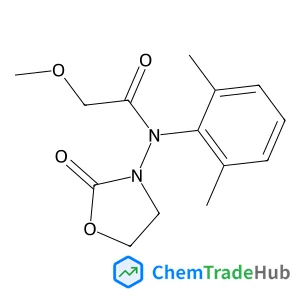
N-(2,6-Dimethylphenyl)-2-methoxy-N-(2-oxo-1,3-oxazolidin-3-yl)acetamide
CAS号:
77732-09-3
分子式:
C14H18N2O4
![4-[2-(Trichlorosilyl)ethyl]benzenesulfonyl chloride structure](https://cnstatic.chemtradehub.com/structs/797/79793-00-3-de16.webp "4-[2-(Trichlorosilyl)ethyl]benzenesulfonyl chloride structure")
推荐供应商




免责声明
本页面提供的学术期刊信息仅供参考和研究使用。我们与任何期刊出版商均无关联,也不处理投稿事宜。如有投稿相关咨询,请直接联系相关期刊出版商。
如发现页面信息有误,请发送邮件至 support@chemtradehub.com 联系我们。我们将及时核实并处理您的问题。