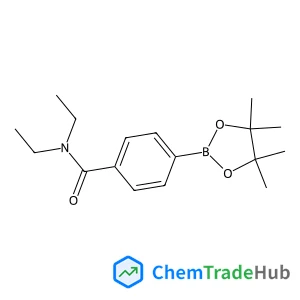
N,N-Diethyl-4-(4,4,5,5-tetramethyl-1,3,2-dioxaborolan-2-yl)benzamide
CAS号:
325142-99-2
分子式:
C17H26BNO3
Kang-ming Tian, Dan-dan Niu, Govender Algasan, Suren Singh, Zheng-xiang Wang
Biodiesel has attracted considerable attention as one of the best choices among alternative and renewable fuels. Large quantities of crude glycerol are produced as a main co-product with increasing biodiesel production. Currently, the problem of waste glycerol utilization needs to be crucially addressed, not only for environmental protection but also for the economy of the biodiesel industry. In this paper, the use of crude glycerol for the production of D-lactate by engineered Escherichia coli was investigated. Engineered E. coli B0013-070 with a homolactic pathway for D-lactate synthesis by elimination of byproduct pathways (ethanol, succinate, formate and acetate) could convert 20 g L−1 of crude glycerol to 13.6 g L−1 of D-lactate with a yield of 0.67 g g−1 glycerol. Overexpression of D-lactate dehydrogenase by a low-copy vector in E. coli B0013-070 resulted in the increased production and yield of D-lactate, in which 14.5 g L−1 of D-lactate was produced with a yield of 0.72 g g−1 glycerol from crude glycerol. The effect of temperature on D-lactate fermentation by the engineered strain E. coli B0013-070-pTHldhA was also investigated, and 34 °C and 40 °C were found to be the optimal temperatures for cell growth and lactate production, respectively. The engineered strain B0013-070-pTHldhA produced 100.3 g L−1 of D-lactate with 99.97% optical purity from 531.5 g of crude glycerol with an overall productivity of 2.78 g L−1 h−1 and a yield of 75.4 g per 100 g glycerol (0.77 mol mol−1) using two phase fermentation combined with a temperature shifting strategy in a 7 L bioreactor. In summary, this paper shows that crude glycerol could be directly converted to D-lactate without any prior purification.

Journal of the Indian Institute of Science

NDT & E International

Bioorganic & Medicinal Chemistry Letters
Atomization and Sprays

Chinese Journal of Chemistry

Critical Reviews in Solid State and Materials Sciences
Acta Metallurgica Sinica-English Letters

Heteroatom Chemistry

Journal of Chemical Sciences
Main Group Chemistry
Dawit N. Wordofa, Pankaj Ramnani, Thien-Toan Tran
DOI: 10.1039/C6AN00018E
Nan Sheng, Bingjie Zou, Huan Tong, Yan Lu, Sixi Xing
DOI: 10.1039/C9AN00970A
Danyang Ma, Lini Dong, Ming Zhou, Liande Zhu
DOI: 10.1039/C5AN02506K
Kamila Kołacińska
DOI: 10.1039/C5AN02522B
Magdalena Matczuk, Joanna Legat, Andrei R. Timerbaev, Maciej Jarosz
DOI: 10.1039/C6AN00276E
Shuang Liu, Chen Xin, Xiaoxiao Yu, Zhenbo Ding, Shufeng Liu
DOI: 10.1039/C9AN01568J
Yoon-Tae Kang, Emma Purcell, Thomas Hadlock, Ting-Wen Lo, Anusha Mutukuri, Shruti Jolly, Sunitha Nagrath
DOI: 10.1039/C9AN01235D
J. Sarkar, A. Kumar
DOI: 10.1039/C6AN00356G
3 - (二氟甲基)-1 -氟苯需遵循联合国全球化学品统一分类和标签制度(GHS),包括急性毒性、皮肤腐蚀/刺激、严重眼损伤/眼刺激等分类。同时,该化合物还需符...
3,5-二甲基苯胺通常通过乙苯的氨解反应合成。反应中使用硫酸作为催化剂,反应温度为120-130°C。乙苯在硫酸存在下与氨反应,生成3,5-二甲基苯胺和苯胺副产...
3-甲基异噻唑-5-胺在适当使用和储存条件下是相对安全的,但在操作时应注意防护措施。应避免吸入粉尘,避免与皮肤和眼睛直接接触。在操作过程中,应穿戴适当的防护装备...
3-(1,3-噻唑-2-基)-1H-吲哚通常通过多步合成方法制备。首先,由噻唑-2-基溴化物和吲哚进行偶联反应,得到中间体。然后,通过还原反应将中间体转化为所需...
4-溴-2-氟苯甲基氯主要用于有机合成中间体,特别是在医药、农药和染料等领域。作为一种具有特定结构的化合物,它在合成复杂有机分子时扮演重要角色。
处理Fmoc-β-(3-噻吩基)-D-Ala-OH时,应佩戴防护手套、护目镜和实验服。操作应在通风橱内进行。如发生泄露,应立即用大量水冲洗,并通知实验室管理人员...
氮化硅通常通过氮化硅的直接反应合成,即在高温下将四氯化硅与氨气反应。具体步骤是将四氯化硅和氨气混合并加热至1300-1700℃,在该条件下,四氯化硅与氨气反应生...
Cetirizine EP Impurity B DiHCl通常通过一锅法合成,首先将4-氯苯基-苯甲基氯甲酸酯与1-哌嗪乙酸反应,生成相应的酸,然后与盐酸反应...
1-哌啶-4-基丁-1-酮应储存在阴凉、干燥的地方,避免阳光直射。存储容器应密封,并确保通风良好。建议储存温度不超过25℃,湿度保持在相对较低的水平。
含有VORUCICLIB的废料应进行专业的收集和处理,包括使用适当的容器进行隔离,避免与其他化学品接触。处理方法通常包括化学中和、沉淀反应或吸附过程,随后进行焚...

Green Chemistry provides a unique forum for the publication of innovative research on the development of alternative green and sustainable technologies. The scope of Green Chemistry is based on, but not limited to, the definition proposed by Anastas and Warner (Green Chemistry: Theory and Practice, P T Anastas and J C Warner, Oxford University Press, Oxford, 1998). Green chemistry is the utilisation of a set of principles that reduces or eliminates the use or generation of hazardous substances in the design, manufacture and application of chemical products. Green Chemistry is at the frontiers of this continuously-evolving interdisciplinary science and publishes research that attempts to reduce the environmental impact of the chemical enterprise by developing a technology base that is inherently non-toxic to living things and the environment. Submissions on all aspects of research relating to the endeavour are welcome. The journal publishes original and significant cutting-edge research that is likely to be of wide general appeal. To be published, work must present a significant advance in green chemistry. Papers must contain a comparison with existing methods and demonstrate advantages over those methods before publication can be considered. For more information please see this Editorial. Coverage includes the following, but is not limited to: Design (e.g. biomimicry, design for degradation/recycling/reduced toxicity…) Reagents & Feedstocks (e.g. renewables, CO2, solvents, auxiliary agents, waste utilization…) Synthesis (e.g. organic, inorganic, synthetic biology…) Catalysis (e.g. homogeneous, heterogeneous, enzyme, whole cell…) Process (e.g. process design, intensification, separations, recycling, efficiency…) Energy (e.g. renewable energy, fuels, photovoltaics, fuel cells, energy storage, energy carriers…) Applications (e.g. electronics, dyes, consumer products, coatings, pharmaceuticals, preservatives, building materials, chemicals for industry/agriculture/mining…) Impact (e.g. safety, metrics, LCA, sustainability, (eco)toxicology…) Green chemistry is, by definition, a continuously-evolving frontier. Therefore, the inclusion of a particular material or technology does not, of itself, guarantee that a paper is suitable for the journal. To be suitable, the novel advance should have the potential for reduced environmental impact relative to the state of the art. Green Chemistry does not normally deal with research associated with 'end-of-pipe' or remediation issues.