


Fabrication of multifunctional fluorescent organic nanoparticles with AIE feature through photo-initiated RAFT polymerization
文献信息
发布日期
2017-11-13
DOI
10.1039/C7PY01563A
影响因子
5.582
作者
Ruming Jiang, Meiying Liu, Qiang Huang, Hongye Huang, Qing Wan, Yuanqing Wen, Jianwen Tian, Qian-yong Cao, Xiaoyong Zhang
查看原文
摘要
Fluorescent organic nanoparticles (FONs) based on an aggregation-induced emission (AIE) dye have recently received increasing interest owing to their unique optical properties, water dispersibility and biocompatibility. However, fabrication of multifunctional AIE-active FONs through a facile controlled free radical polymerization method has not been reported thus far. In this work, a novel photo-initiated reversible addition–fragmentation chain-transfer (RAFT) polymerization has been developed for the fabrication of AIE-active FONs for the first time. During this procedure, a new tetraphenylethene based dye (named TPE-DETC) was conjugated to a chain transfer agent, which could serve as the fluorescence signal and catalyst for RAFT polymerization. Styrene (SE) and itaconic acid (IA) were selected as the monomers to construct the final fluorescent copolymers (TPE-SE-IA). Due to the amphiphilicity and AIE properties of TPE-DETC, the TPE-SE-IA copolymers tend to self-assemble and form FONs. The physicochemical properties, drug loading and release behavior of TPE-SE-IA FONs towards cisplatin (CDDP), their biocompatibility as well as cell uptake behavior have been investigated in detail. The results verified that TPE-SE-IA FONs possess strong fluorescence, high water dispersibility, distinguished biocompatibility and highly efficient drug loading capability, making them promising candidates for biomedical applications. More importantly, the in situ photo-initiated RAFT polymerization strategy is an ideal method to be used for the preparation of functional polymeric materials owing to its fascinating features, such as environmental friendliness, mild reaction conditions, being catalyst-free and cost effectiveness.
期刊推荐
Pharmacological Reviews
Fibre Chemistry
Molecular Pharmacology
Helvetica Chimica Acta
Science Progress
Journal of Medicinal Chemistry

Israel Journal of Chemistry

Russian Chemical Reviews

Journal of Physics and Chemistry of Solids

Proceedings of the National Academy of Sciences of the United States of America
相关文献
Atomic force microscopic investigations of the gel phase of phosphatidylcholines containing ω-cyclohexyl fatty acids
2000-08-11
Paper
DOI: 10.1039/B004216L
Infrared spectroscopic studies of the low temperature interconversion of sulfuric acid hydrates
Karen L. Nash, K. Jessica Sully, Andrew B. Horn
2000-10-10
Paper
DOI: 10.1039/B005531J
Photophysical and photochemical properties of bis-silylated C60 derivatives
Paper
DOI: 10.1039/A902939G
Laser induced ionisation/dissociation of cyclopentanone in the 320–370 nm region
Paper
DOI: 10.1039/A902027F
Ultrafast IR laser control of photodissociation: single- vs. multi-pulse schemes
Paper
DOI: 10.1039/A902136A
Determination of the nature and reactivity of copper sites in Cu–TiO2catalysts
Fernando Coloma, Francisco Marquez, Colin H. Rochester, James A. Anderson
2000-10-16
Paper
DOI: 10.1039/B005331G
您可能还喜欢
化合物问答
6-氯-2H-1,4-苯并噁嗪-3(4H)-酮(CAS号:7652-29-1)应用于哪些行业?
6-氯-2H-1,4-苯并噁嗪-3(4H)-酮主要应用于医药、农药和聚合物等领域。在医药领域,该化合物可用于合成抗菌药物;在农药领域,可用作杀虫剂的中间体;在聚...
7652-29-16-Chloro-2H-1,4-benz...
化合物问答
活性氧化铝(CAS号:1302-74-5)应用于哪些行业?
活性氧化铝广泛应用于医药、聚合物、传感器、半导体和催化等领域。在医药行业,活性氧化铝用作吸附剂和干燥剂,有助于去除杂质和水分。在聚合物行业,它用作增白剂和抗结块...
1302-74-5aluminum;trihydrate
化合物问答
什么是硅胶(CAS号:112926-00-8)?
硅胶(Silica gel, pptd.,cryst.-free)是一种无定形、多孔的硅酸盐材料,主要成分为二氧化硅(SiO₂)。其结构由硅氧四面体构成,通过酸...
112926-00-8Silica gel, pptd.,cr...
化合物问答
二乙基甲基一氢硅烷(CAS号:760-32-7)的主要用途是什么?
二乙基甲基一氢硅烷主要用于有机合成、表面处理以及作为溶剂。它还被用作合成其他硅烷化合物的原料,以及在涂料、粘合剂和密封剂中的应用。
760-32-7Diethyl(methyl)silan...
化合物问答
在合成中是否有N-花生四烯酰基甘氨酸(CAS号:179113-91-8)的替代品?
在合成过程中,可以考虑使用类似结构的化合物作为替代品,例如N-亚油酰基甘氨酸或N-花生二烯酰基甘氨酸。这些替代品在结构上有类似的双键位置,但可能具有不同的物理化...
179113-91-8Glycine, N-[(5Z,8Z,1...
化合物问答
在合成中是否有1-(4-甲氧基苯基)丙烷-1,2-二酮(CAS号:10557-27-4)的替代品?
在合成过程中,可以考虑使用类似结构的化合物作为替代品,例如1-(3-甲氧基苯基)丙烷-1,2-二酮或1-(4-羟基苯基)丙烷-1,2-二酮。这些替代品具有相似的...
10557-27-41-(4-Methoxyphenyl)p...
化合物问答
N-(4-氨基-1-苄基-3-羟基-5-苯基戊基)-3-甲基-2-(2-氧代四氢嘧啶-1-基)-丁酰胺 5-氧代吡咯烷-2-甲酸(CAS号:192726-06-0)通常如何合成?
该化合物通常通过一系列复杂的有机合成步骤获得。首先,通过芳香族化合物的羟基化反应获得羟基化产物,然后通过酰化反应形成酰胺中间体,最后通过环化反应得到目标产物。常...
192726-06-05-Oxo-L-proline - (2...
化合物问答
(S)-2-氨基-3-喹啉-2-丙酸(CAS号:161513-46-8)的市场或研究趋势如何?
该化合物作为生物活性化合物,尤其是在药物化学领域表现出色。近年来,随着对新型抗炎、抗病毒和抗癌药物的研究增加,其市场和研究趋势持续增长。此外,其在神经科学领域的...
161513-46-8(S)-2-Amino-3-quinol...
化合物问答
核黄素磷酸钠(CAS号:130-40-5)安全吗?
核黄素磷酸钠在常规使用条件下安全,但高剂量可能引起刺激性反应。操作时需佩戴防护手套和护目镜,避免吸入粉尘。若接触皮肤或眼睛,应立即用大量清水冲洗。急救时需根据接...
130-40-5Sodium 1-deoxy-1-(7,...
化合物问答
盐酸丙胺卡因杂质A(EP) 标准品(CAS号:19281-31-3)通常如何合成?
盐酸丙胺卡因杂质A(EP) 标准品可通过重氮化反应和随后的酰胺化反应合成。首先,利用氯化反应将苯环上的氢原子转化为氯原子,然后通过芳香族重氮化反应引入氨基,最后...
19281-31-32-Chloro-N-(2-methyl...
来源期刊
Polymer Chemistry

CiteScore:
8.6
自引率:
7.3%
年发文量:
457
Polymer Chemistry welcomes submissions in all areas of polymer science that have a strong focus on macromolecular chemistry. Manuscripts may cover a broad range of fields, yet no direct application focus is required.
推荐化合物
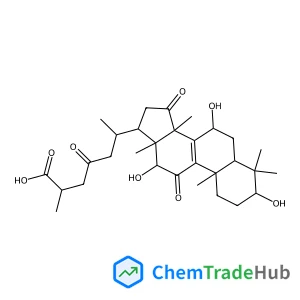
![N-[(Benzyloxy)carbonyl]serine structure](https://cnstatic.chemtradehub.com/structs/276/2768-56-1-77f7.webp "N-[(Benzyloxy)carbonyl]serine structure")
![1,2-Diphenyl-4-[2-(phenylsulfinyl)ethyl]-3,5-pyrazolidinedione structure](https://cnstatic.chemtradehub.com/structs/57-/57-96-5-efcc.webp "1,2-Diphenyl-4-[2-(phenylsulfinyl)ethyl]-3,5-pyrazolidinedione structure")
推荐供应商



免责声明
本页面提供的学术期刊信息仅供参考和研究使用。我们与任何期刊出版商均无关联,也不处理投稿事宜。如有投稿相关咨询,请直接联系相关期刊出版商。
如发现页面信息有误,请发送邮件至 support@chemtradehub.com 联系我们。我们将及时核实并处理您的问题。