





Strain induced spin-splitting and half-metallicity in antiferromagnetic bilayer silicene under bending
文献信息
发布日期
2020-04-24
DOI
10.1039/D0CP01350A
影响因子
3.676
作者
Jin-Lei Shi, Xing-Ju Zhao, Yu-Zhong Zhang, Su-Huai Wei
查看原文
摘要
Searching for half-metals in low dimensional materials is not only of scientific importance, but also has important implications for the realization of spintronic devices on a small scale. In this work, we show theoretically that simple bending can induce spin-splitting in bilayer silicene. For bilayer silicene with Bernal stacking, the monolayer has a long range ferromagnetic spin order and between the two monolayers, the spin orders are opposite, giving rise to an antiferromagnetic configuration for the ground state of the bilayer silicene. Under bending, the antiferromagnetic spin order is retained but the energetic degeneracy of opposite spin states is lifted. Due to the unusual deformation potentials of the conduction band minimum (CBM) and valence band maximum (VBM) as revealed by density-functional theory calculations and density-functional tight-binding calculations, this spin-splitting is nearly proportional to the degree of bending deformation. Consequently, the spin-splitting can be significant and the desired half-metallic state may emerge when the bending increases, which has been verified by direct simulation of the bent bilayer silicene using the generalized Bloch theorem. Our results hint that bilayer silicene may be an excellent candidate for half-metallicity.
相关文献
Thermo-responsive gold/poly(vinyl alcohol)-b-poly(N-vinylcaprolactam) core–corona nanoparticles as a drug delivery system
Christophe Detrembleur, Marie Hurtgen, Antoine Debuigne, Marie-Claire De Pauw-Gillet, Stéphane Mornet, Etienne Duguet, Christine Jérôme
2014-05-09
Paper
DOI: 10.1039/C4PY00352G
Free-standing thermo-responsive nanoporous membranes from high molecular weight PS-PNIPAM block copolymers synthesized via RAFT polymerization
Merve Mocan, Joris de Grooth, Anton H. Hofman, Hanne M. van der Kooij, Katja Loos, Wiebe M. de Vos, Marleen Kamperman
2017-03-17
Paper
DOI: 10.1039/C7PY00023E
The para-fluoro-thiol ligation in water
Parvesh Wadhwani, Rouven Müller
2017-01-16
Communication
DOI: 10.1039/C6PY02108E
Dynamic supramolecular self-assembly: hydrogen bonding-induced contraction and extension of functional polymers
Chih-Chia Cheng, Jui-Hsu Wang, Wei-Tsung Chuang, Zhi-Sheng Liao, Jyun-Jie Huang, Shan-You Huang, Wen-Lu Fan
2017-04-26
Paper
DOI: 10.1039/C7PY00684E
The living anionic polymerization of activated aziridines: a systematic study of reaction conditions and kinetics
Elisabeth Rieger, Tassilo Gleede, Katja Weber, Angelika Manhart, Manfred Wagner, Frederik R. Wurm
2017-04-06
Paper
DOI: 10.1039/C7PY00436B
The impact of the molecular weight on the electrochemical properties of poly(TEMPO methacrylate)
Kai Zhang, Jiyu Fan, Michael J. Monteiro, Zhongfan Jia
2017-02-22
Paper
DOI: 10.1039/C7PY00151G
Nanocomposite latexes containing layered double hydroxides via RAFT-assisted encapsulating emulsion polymerization
Ana Cenacchi Perreira, Samuel Pearson, Franck D'Agosto, Muriel Lansalot, Elodie Bourgeat-Lami
2017-01-05
Paper
DOI: 10.1039/C6PY01742H
Synthetic strategies for the generation of ABCA' type asymmetric tetrablock terpolymers
Siddharth Chanpuriya, Marc A. Hillmyer, Frank S. Bates
2014-06-13
Paper
DOI: 10.1039/C4PY00614C
Tailoring the properties of polypropylene in the polymerization reactor using polymeric nucleating agents as prepolymers on the Ziegler–Natta catalyst granule
Claudio De Rosa, Finizia Auriemma, Oreste Tarallo, Rocco Di Girolamo, Enrico M. Troisi, Simona Esposito, Dario Liguori, Fabrizio Piemontesi, Gianni Vitale, Giampiero Morini
2016-12-23
Communication
DOI: 10.1039/C6PY01950A
您可能还喜欢
化合物问答
如何储存1,2-环己二酮环乙缩醛(CAS号:4746-96-7)?
1,2-环己二酮环乙缩醛应储存在阴凉、干燥、通风良好的地方,避免阳光直射。建议使用密封容器保存,并保持环境温度在室温范围内,远离火源和热源。
4746-96-71,4-Dioxaspiro[4.5]d...
化合物问答
Ecopladib(CAS号:381683-92-7)的市场或研究趋势如何?
Ecopladib作为一种新型的药物,主要应用于治疗高胆固醇等疾病。目前,市场和研究趋势显示,Ecopladib因其独特的药理作用而受到关注。随着对心血管疾病治...
381683-92-7Ecopladib
化合物问答
2,3-Dimethyl-3H-imidazo[4,5-c]pyridine(CAS号:52538-09-7)通常如何合成?
2,3-二甲基-3H-咪唑[4,5-c]吡啶通常通过咪唑和2,3-二甲基吡啶的缩合反应合成。具体来说,将咪唑和2,3-二甲基吡啶在适当的溶剂中进行加热或加压反应...
52538-09-72,3-Dimethyl-3H-imid...
化合物问答
2,3,4,5-tetrahydro-1H-3-苯并氮杂环;盐酸盐(CAS号:17379-01-0)的市场或研究趋势如何?
该化合物在药物化学和有机合成中有一定的应用。近年来,随着对新型药物化合物的需求增加,该化合物的研究趋势主要集中在探索其生物活性,尤其是其在神经系统疾病治疗中的潜...
17379-01-02,3,4,5-Tetrahydro-1...
68-90-6(2-Ethyl-1-benzofura...
化合物问答
如何储存盐酸甘氨酸丁酯(CAS号:13048-99-2)?
盐酸甘氨酸丁酯应储存在阴凉、干燥、通风良好的地方,避免阳光直射和高温环境,温度应控制在25℃以下。储存容器应密封,避免与空气中的水分和酸性物质接触,以防发生水解...
13048-99-2Butyl glycinate hydr...
化合物问答
什么是2-Iodo-N,N-dimethylbenzamide(CAS号:54616-46-5)?
2-碘-N,N-二甲基苯胺是一种有机化合物,化学名为2-Iodo-N,N-dimethylbenzamide。其分子式为C<sub>9</sub>H<sub>1...
54616-46-52-Iodo-N,N-dimethylb...
16817-90-6N-Cyclohexylglycinam...
化合物问答
5-溴-2-(4H-1,2,4-三唑-4-基)吡啶(CAS号:959240-99-4)的市场或研究趋势如何?
随着医药、农药和新材料领域的发展,该化合物作为关键中间体的应用日益增多。特别是在药物合成中,由于其独特的化学性质,可以用于合成多种药物分子。未来的研究趋势可能集...
959240-99-45-Bromo-2-(4H-1,2,4-...
化合物问答
2,4-二溴-6-三氟甲基嘧啶(CAS号:785778-00-9)通常如何合成?
2,4-二溴-6-三氟甲基嘧啶通常通过溴化反应合成。首先,将6-三氟甲基嘧啶与溴化剂(如液溴)在适当的溶剂(如二氯甲烷、四氢呋喃)中反应,加入适当的催化剂(如四...
785778-00-92,4-Dibromo-6-(trifl...
来源期刊
Physical Chemistry Chemical Physics

CiteScore:
5.5
自引率:
10.3%
年发文量:
3036
Physical Chemistry Chemical Physics (PCCP) is an international journal co-owned by 19 physical chemistry and physics societies from around the world. This journal publishes original, cutting-edge research in physical chemistry, chemical physics and biophysical chemistry. To be suitable for publication in PCCP, articles must include significant innovation and/or insight into physical chemistry; this is the most important criterion that reviewers and Editors will judge against when evaluating submissions. The journal has a broad scope and welcomes contributions spanning experiment, theory, computation and data science. Topical coverage includes spectroscopy, dynamics, kinetics, statistical mechanics, thermodynamics, electrochemistry, catalysis, surface science, quantum mechanics, quantum computing and machine learning. Interdisciplinary research areas such as polymers and soft matter, materials, nanoscience, energy, surfaces/interfaces, and biophysical chemistry are welcomed if they demonstrate significant innovation and/or insight into physical chemistry. Joined experimental/theoretical studies are particularly appreciated when complementary and based on up-to-date approaches.
推荐化合物
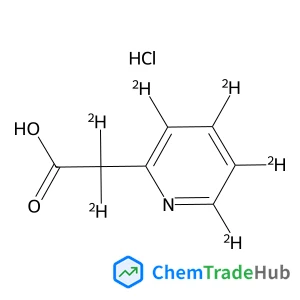
2,2-dideuterio-2-(3,4,5,6-tetradeuterio-2-pyridyl)acetic acid;hydrochloride
CAS号:
1329799-67-8
分子式:
C7H2ClD6NO2
![[(1S,2S,3R,4S,7R,9S,10S,12R,15S)-4,12-Diacetyloxy-15-[(2R,3S)-3-benzamido-3-phenyl-2-(2,2,2-trichloroethoxycarbonyloxy)propanoyl]oxy-1,9-dihydroxy-10,14,17,17-tetramethyl-11-oxo-6-oxatetracyclo[11.3.1.03,10.04,7]heptadec-13-en-2-yl] benzoate structure](https://cnstatic.chemtradehub.com/structs/100/100431-55-8-7104.webp "[(1S,2S,3R,4S,7R,9S,10S,12R,15S)-4,12-Diacetyloxy-15-[(2R,3S)-3-benzamido-3-phenyl-2-(2,2,2-trichloroethoxycarbonyloxy)propanoyl]oxy-1,9-dihydroxy-10,14,17,17-tetramethyl-11-oxo-6-oxatetracyclo[11.3.1.03,10.04,7]heptadec-13-en-2-yl] benzoate structure")
![N-[2-(4-Hydroxyphenoxy)-4-nitrophenyl]methanesulfonamide structure](https://cnstatic.chemtradehub.com/structs/109/109032-22-6-7c88.webp "N-[2-(4-Hydroxyphenoxy)-4-nitrophenyl]methanesulfonamide structure")
![1-[(4-Methylphenyl)sulfonyl]-3-(4,4,5,5-tetramethyl-1,3,2-dioxaborolan-2-yl)-1H-pyrrolo[2,3-b]pyridine-5-carbonitrile structure](https://cnstatic.chemtradehub.com/structs/143/1434747-57-5-fc0d.webp "1-[(4-Methylphenyl)sulfonyl]-3-(4,4,5,5-tetramethyl-1,3,2-dioxaborolan-2-yl)-1H-pyrrolo[2,3-b]pyridine-5-carbonitrile structure")
推荐供应商





免责声明
本页面提供的学术期刊信息仅供参考和研究使用。我们与任何期刊出版商均无关联,也不处理投稿事宜。如有投稿相关咨询,请直接联系相关期刊出版商。
如发现页面信息有误,请发送邮件至 support@chemtradehub.com 联系我们。我们将及时核实并处理您的问题。