








Near-field diffraction in a two-dimensional V-groove and its role in SERS
文献信息
发布日期
2011-10-14
DOI
10.1039/C1CP21750J
影响因子
3.676
作者
Matyas Mechler, Sergei V. Kukhlevsky, Adam Mechler, Don McNaughton
查看原文
摘要
Optical field distribution in micro–nano geometries of miniaturized optical devices is often significantly different from that in identical but macroscopic geometries. Plasmon effects and near-field diffraction can enhance the local field intensity, leading to enhanced cross section for light absorption and scattering, which can be utilized in substrate-enhanced spectroscopies for the detection of trace amounts of adsorbed chemicals. A specific problem is an ingenious but only empirically described way to enhance signal intensity in Raman spectroscopy by the use of a substrate patterned with gold coated micron size pyramidal pits. While Raman enhancement on nanostructured substrates is generally attributed to surface plasmons, here the micron size, and thus the sub-wavelength to near-wavelength dimensions suggest that resonant enhancement emanating from optical near-field diffraction might also play a role. To answer this question, light diffraction in a projection of the pyramidal pit: a V-groove, was modelled with a modified Neerhoff–Mur formalism suitable to calculate electromagnetic field distribution in sub-wavelength structures. Under the boundary conditions a perfect conductor screen was assumed, which excludes plasmon effects. The calculations show that interference in the cavity causes a modest resonant increase in local intensity and that near-field diffraction strongly influences the field distribution, which is explained with the electrodynamic edge effect. The magnitude of the resonant electric field on its own cannot account for the experimentally observed Raman enhancement. However, a resonant enhancement of a similar magnitude is expected for the emitted Stokes frequencies. In this case the geometry implements the conditions for the classical electromagnetic Raman enhancement, ∼E4, in a good agreement with experimental results.
相关文献
Palladium-catalysed stereoselective [3 + 2] annulation of vinylethylene carbonates and tryptanthrin-based ketones
Qing-Zhu Li, Jun-Long Li, Bin Zhang, Zhen Dai, Ke Xie, Rong Zeng, Liang Zou, Xiang Zhang
2021-11-22
Research Article
DOI: 10.1039/D1QO01543E
A photoredox/nickel dual-catalytic strategy for benzylic C–H alkoxylation
Min Dong, Yuqi Jia, Wei Zhou, Jinlai Gao, Xiaoqing Lv, Fan Luo, Yongqiang Zhang, Shihui Liu
2021-10-26
Research Article
DOI: 10.1039/D1QO01421H
Multifunctional P-ligand-controlled “silicon-centered” selectivity in Rh/Cu-catalyzed Si–C bond cleavage of silacyclobutanes
Xu Wang, Shuai-Shuai Huang, Feng-Jiao Zhang, Jia-Le Xie, Zhao Li, Zheng Xu, Fei Ye
2021-10-05
Research Article
DOI: 10.1039/D1QO01386F
A mechanistic study on the regioselective Ni-catalyzed methylation–alkenylation of alkyne with AlMe3 and allylic alcohol
Jiao Liu, Deguang Liu, Wan Nie, Haizhu Yu, Jing Shi
2021-11-17
Research Article
DOI: 10.1039/D1QO01580J
Asymmetric cycloisomerization/[3 + 2] cycloaddition for the synthesis of chiral spiroisobenzofuran-1,3′-pyrrolidine derivatives
Pei Dong, Long Chen, Zhendong Yang, Shunxi Dong, Xiaoming Feng
2021-10-08
Research Article
DOI: 10.1039/D1QO01194D
A multifaceted approach towards understanding the peculiar behavior of (α)-hydroxyiminophosphonates
Thomas Toupy, Christopher Kune, Kristof Van Hecke, Loïc Quinton, Jean-Christophe M. Monbaliu
2021-11-22
Research Article
DOI: 10.1039/D1QO01564H
Acetylation of alcohols and amines under visible light irradiation: diacetyl as an acylation reagent and photosensitizer
Pengcheng Lian, Ruyi Li, Xiao Wan, Zixin Xiang, Hang Liu, Zhiyu Cao, Xiaobing Wan
2021-11-19
Research Article
DOI: 10.1039/D1QO01613J
Mechanistic insights into the rhodium-catalyzed aryl C–H carboxylation
DeGuang Liu, ZheYuan Xu, MingQiang Liu, Yao Fu
2021-12-07
Research Article
DOI: 10.1039/D1QO01560E
Palladium mediated deallylation in fully aqueous conditions for native chemical ligation at aspartic and glutamic acid sites
Muhammad Jbara, Emad Eid, Ashraf Brik
2018-05-07
Communication
DOI: 10.1039/C8OB00890F
Regioselective nitration of anilines with Fe(NO3)3·9H2O as a promoter and a nitro source
Yang Gao, Yuanyou Mao, Biwei Zhang, Yingying Zhan, Yanping Huo
2018-05-03
Communication
DOI: 10.1039/C8OB00841H
您可能还喜欢
化合物问答
如何处理含有8-氯咪唑并[1,2-A]吡嗪(CAS号:69214-33-1)的废料?
处理含有8-氯咪唑并[1,2-A]吡嗪的废料时,应首先将其收集并进行化学回收或降解。如果无法回收,需采用安全的化学处理方法,如中和、氧化还原或沉淀。处理过程中需...
69214-33-18-chloroimidazo[1,2-...
化合物问答
Calhex 231 hydrochloride(CAS号:2387505-78-2)适用哪些法规指南?
Calhex 231 hydrochloride 需要遵循《全球化学品统一分类和标签制度》(GHS)的分类和标签要求,以及欧盟的《化学品注册、评估、授权和限制条...
2387505-78-24-Chloro-N-[(1S,2S)-...
化合物问答
11-Beta,17-alpha,21-三羟基-5-beta-孕烯-3,20-二酮(CAS号:1482-50-4)的物理化学性质是什么?
11-Beta,17-alpha,21-三羟基-5-beta-孕烯-3,20-二酮是一种无色结晶性粉末,分子量为372.45 g/mol。该化合物在水中的溶解度...
1482-50-45β-Dihydrocortisol
化合物问答
处理5-异丙基-1,3,4-恶二唑-2-羧酸(CAS号:944907-13-5)时应注意哪些实验室安全事项?
处理5-异丙基-1,3,4-恶二唑-2-羧酸时应注意以下安全事项:穿戴适当的个人防护装备,包括实验室外套、手套和护目镜;操作应在通风橱中进行,以减少吸入或接触有...
944907-13-55-Isopropyl-1,3,4-ox...
化合物问答
benzyl 3-bromopropanoate(CAS号:90841-55-7)安全吗?
Benzyl 3-bromopropanoate属于有毒物质,吸入、摄入或皮肤接触均可能对人体造成伤害。操作时应佩戴防护眼镜、口罩和手套,避免吸入蒸汽和直接接触...
90841-55-7Benzyl 3-bromopropan...
化合物问答
什么是(R)-N-苄氧羰基-3,4-二氢-1H-异喹啉羧酸(CAS号:151004-88-5)?
(R)-N-苄氧羰基-3,4-二氢-1H-异喹啉羧酸是一种含有苄氧羰基和异喹啉环结构的化合物,分子式为C17H15NO3。它是一种有机化合物,具有一定的生物活性...
151004-88-5(1R)-2-[(Benzyloxy)c...
化合物问答
在合成中是否有1-苄基吡啶嗡-3-羧酸盐(CAS号:15990-43-9)的替代品?
可以考虑使用1-苄基吡啶-3-羧酸盐作为1-苄基吡啶嗡-3-羧酸盐的替代品。此外,还可以探索其他类似物,如1-苄基吡啶-3-氨基甲酸酯等。具体的替代品选择需根据...
15990-43-91-Benzyl-3-pyridiniu...
化合物问答
(2,6-二甲基吡啶-3-基)甲醇(CAS号:582303-10-4)安全吗?
(2,6-二甲基吡啶-3-基)甲醇在使用时需注意安全,应避免吸入其蒸汽,接触皮肤和眼睛。操作应在通风良好的环境中进行,佩戴适当的个人防护装备。
582303-10-4(2,6-Dimethyl-3-pyri...
化合物问答
5-溴-2-乙烯基吡啶(CAS号:226883-52-9)的物理化学性质是什么?
5-溴-2-乙烯基吡啶是一种有机化合物,外观为白色固体,具有良好的结晶性。分子量约为190.03 g/mol。它的溶解性在水中较差,但在有机溶剂如二氯甲烷、甲醇...
226883-52-95-Bromo-2-vinylpyrid...
化合物问答
2-羟基-3-硝基-5-甲基吡啶(CAS号:7464-14-4)应用于哪些行业?
2-羟基-3-硝基-5-甲基吡啶主要应用于医药、聚合物和半导体行业。在医药领域,它可以用作合成其他药物的中间体。在聚合物领域,它可以作为功能性单体参与聚合反应,...
7464-14-45-Methyl-3-nitro-2(1...
来源期刊
Physical Chemistry Chemical Physics

CiteScore:
5.5
自引率:
10.3%
年发文量:
3036
Physical Chemistry Chemical Physics (PCCP) is an international journal co-owned by 19 physical chemistry and physics societies from around the world. This journal publishes original, cutting-edge research in physical chemistry, chemical physics and biophysical chemistry. To be suitable for publication in PCCP, articles must include significant innovation and/or insight into physical chemistry; this is the most important criterion that reviewers and Editors will judge against when evaluating submissions. The journal has a broad scope and welcomes contributions spanning experiment, theory, computation and data science. Topical coverage includes spectroscopy, dynamics, kinetics, statistical mechanics, thermodynamics, electrochemistry, catalysis, surface science, quantum mechanics, quantum computing and machine learning. Interdisciplinary research areas such as polymers and soft matter, materials, nanoscience, energy, surfaces/interfaces, and biophysical chemistry are welcomed if they demonstrate significant innovation and/or insight into physical chemistry. Joined experimental/theoretical studies are particularly appreciated when complementary and based on up-to-date approaches.
推荐化合物
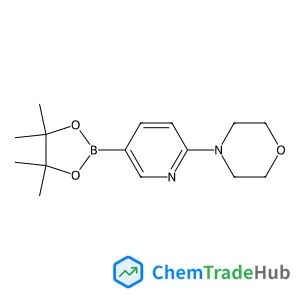
4-(5-(4,4,5,5-tetramethyl-1,3,2-dioxaborolan-2-yl)pyridin-2-yl)morpholine
CAS号:
485799-04-0
分子式:
C15H23BN2O3
推荐供应商




免责声明
本页面提供的学术期刊信息仅供参考和研究使用。我们与任何期刊出版商均无关联,也不处理投稿事宜。如有投稿相关咨询,请直接联系相关期刊出版商。
如发现页面信息有误,请发送邮件至 support@chemtradehub.com 联系我们。我们将及时核实并处理您的问题。