


![[4-Chloro-3-(diethylcarbamoyl)phenyl]boronic acid structure](https://cnstatic.chemtradehub.com/structs/871/871332-68-2-0e3b.webp "[4-Chloro-3-(diethylcarbamoyl)phenyl]boronic acid structure")
Single site metallorganic polymerization catalysis as a method to probe the properties of polyolefins
文献信息
发布日期
2011-06-09
DOI
10.1039/C1PY00129A
影响因子
5.582
作者
Claudio De Rosa, Finizia Auriemma
查看原文
摘要
Single-site metallorganic catalysts for the polymerization of olefins has allowed the synthesis of new polymeric materials having molecular structures that cannot be obtained with conventional Ziegler–Natta catalysts, with exceptional control over the chain architecture, including control of the concentration of stereo- and regio-defects and efficient uniform placement of comonomeric units along the chains. The cases of isotactic and syndiotactic polypropylenes are illustrated as examples of a fine tuning of the physical and mechanical properties of polymeric materials achieved through the controlled incorporation of stereo- and regio-defects, and the rational choice of the catalytic system. Novel isotactic polypropylenes with controlled properties, intermediate between those of stiff-plastic and elastomeric materials have been produced through the design of the catalysts. For syndiotactic polypropylene, a new class of thermoplastic elastomers with finely controlled mechanical properties have been produced by using metallorganic catalysts of different stereoselectivity. Depending on the concentration of stereodefects, elastomers showing entropic or unconventional enthalpic elasticity, can be produced.
期刊推荐
Journal of Saudi Chemical Society
Saudi Pharmaceutical Journal
Russian Chemical Bulletin

New Journal of Chemistry

Chemical Communications

Current Opinion in Solid State & Materials Science
Organic Process Research & Development
Russian Journal of Applied Chemistry
Crystallography Reports
Journal of Peptide Science
相关文献
Ring-opening polymerization of an O-carboxyanhydride monomer derived from l-malic acid
Ryan J. Pounder, David J. Fox, Ian A. Barker, Michael J. Bennison, Andrew P. Dove
2011-07-19
Paper
DOI: 10.1039/C1PY00254F
Tuning the lower critical solution temperature of thermoresponsive polymers by biospecific recognition
Jens Buller, André Laschewsky, Jean-François Lutz, Erik Wischerhoff
2011-02-15
Communication
DOI: 10.1039/C1PY00001B
Influence of macromolecular characteristics of RAFT/MADIX poly(vinyl acetate)-based (co)polymers on their solubility in supercritical carbon dioxide
Thierry Tassaing, Jean-Daniel Marty, Mathias Destarac
2011-07-20
Paper
DOI: 10.1039/C1PY00209K
Catalytic chain transfer and its derived macromonomers
Johan P. A. Heuts, Niels M. B. Smeets
2011-07-26
Review Article
DOI: 10.1039/C1PY00224D
A novel poly(thienylenevinylene) derivative for application in polymer solar cells
Feiyao Qing, Xiaochen Wang, Na Li, Yongfang Li, Xiaoyu Li, Haiqiao Wang
2011-06-25
Paper
DOI: 10.1039/C1PY00192B
Single site metallorganic polymerization catalysis as a method to probe the properties of polyolefins
Claudio De Rosa, Finizia Auriemma
2011-06-09
Review Article
DOI: 10.1039/C1PY00129A
pH-triggered micellar membrane for controlled release microchips
Xiaoqiang Yang, Basem A. Moosa, Lin Deng, Lan Zhao, Niveen M. Khashab
2011-09-16
Paper
DOI: 10.1039/C1PY00300C
Peptide-based lipid mimetics with tunable core properties viathiol–alkyne chemistry
Jacob G. Ray, Jack T. Ly, Daniel A. Savin
2011-03-08
Paper
DOI: 10.1039/C1PY00003A
您可能还喜欢
化合物问答
2-(甲基磺酰基)嘧啶-5-胺(CAS号:56621-92-2)适用哪些法规指南?
该化合物适用的法规指南包括GHS(全球化学品统一分类和标签制度)分类为特定目标器官毒性-单次接触类别3;根据欧盟REACH法规,该化合物需要进行注册和评估;在美...
56621-92-22-(Methylsulfonyl)py...
化合物问答
在合成中是否有4-(4-氯苯基)-1H-咪唑(CAS号:35512-29-9)的替代品?
在合成中,可以考虑使用一些类似的化合物作为4-(4-氯苯基)-1H-咪唑的替代品,如4-(4-溴苯基)-1H-咪唑或4-(4-甲氧基苯基)-1H-咪唑。这些化合...
35512-29-94-(4-Chlorophenyl)-1...
化合物问答
什么是N~2~-甲基丙氨酸酰胺(CAS号:32012-16-1)?
N~2~-甲基丙氨酸酰胺是一种有机化合物,其化学名为2-(Methylamino)propanamide。它是一种酰胺类化合物,分子式为C4H10N2O,相对分...
32012-16-12-(Methylamino)propa...
化合物问答
如何处理含有N-苄基-3-氨基氧杂环丁烷草酸盐(CAS号:1956341-96-0)的废料?
处理含有N-苄基-3-氨基氧杂环丁烷草酸盐(CAS号:1956341-96-0)的废料时,应首先确保遵循相关法规要求,如GHS和REACH等。通常,废液应先进行...
1956341-96-0N-Benzyloxetan-3-ami...
化合物问答
4-bromo-2-chloro-6-methylbenzoic acid(CAS号:877149-07-0)的物理化学性质是什么?
4-溴-2-氯-6-甲基苯甲酸是一种固体化合物,具有较高的熔点和较低的沸点。它的分子量为261.03 g/mol。该化合物在水中几乎不溶,在有机溶剂中溶解度适中...
877149-07-04-Bromo-2-chloro-6-m...
化合物问答
2-[(2,5-二氯-4-嘧啶)氨基]-N-甲基苯甲酰胺(CAS号:761440-08-8)通常如何合成?
该化合物通常通过缩合反应合成,典型的方法是将2,5-二氯嘧啶与N-甲基苯甲酰胺在碱性条件下进行偶联反应。常用的碱包括NaH、LDA等强碱。该合成路线具有较高的选...
761440-08-82-[(2,5-dichloropyri...
4752-10-71,4-Dichlorophthalaz...
化合物问答
在合成中是否有3,5-二溴-4-甲基苯胺(CAS号:13194-73-5)的替代品?
3,5-二溴-4-甲基苯胺在某些合成路线中可能没有直接替代品。然而,在某些应用场景下,可以考虑使用其他类似结构的化合物如3,5-二溴-4-硝基苯胺或3,5-二碘...
13194-73-53,5-Dibromo-4-methyl...
化合物问答
2-氯喹啉-4-羧酸甲酯(CAS号:62482-26-2)的主要用途是什么?
2-氯喹啉-4-羧酸甲酯主要用于有机合成和药物合成领域,作为中间体或原料。它在合成某些药物和染料时具有重要作用。此外,该化合物还可能用于某些特定的化学研究中。
62482-26-2Methyl 2-chloro-4-qu...
化合物问答
i>]吡啶(CAS号:474708-88-8)安全吗?
6-溴-8-氯咪唑[1,2-a]吡啶在操作过程中需要谨慎以确保安全。该化合物具有一定的毒性,吸入其蒸气或粉尘可能导致呼吸道刺激。处理时应佩戴适当的防护装备,如手...
474708-88-86-Bromo-8-chloroimid...
来源期刊
Polymer Chemistry

CiteScore:
8.6
自引率:
7.3%
年发文量:
457
Polymer Chemistry welcomes submissions in all areas of polymer science that have a strong focus on macromolecular chemistry. Manuscripts may cover a broad range of fields, yet no direct application focus is required.
推荐化合物
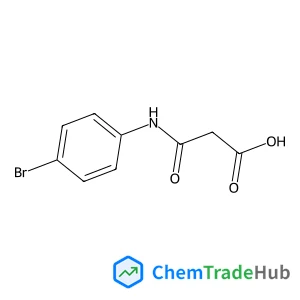
![2-[({[(2-Methyl-2-propanyl)oxy]carbonyl}amino)methyl]isonicotinic acid structure](https://cnstatic.chemtradehub.com/structs/473/473924-63-9-973b.webp "2-[({[(2-Methyl-2-propanyl)oxy]carbonyl}amino)methyl]isonicotinic acid structure")
2-[({[(2-Methyl-2-propanyl)oxy]carbonyl}amino)methyl]isonicotinic acid
CAS号:
473924-63-9
分子式:
C12H16N2O4
推荐供应商


免责声明
本页面提供的学术期刊信息仅供参考和研究使用。我们与任何期刊出版商均无关联,也不处理投稿事宜。如有投稿相关咨询,请直接联系相关期刊出版商。
如发现页面信息有误,请发送邮件至 support@chemtradehub.com 联系我们。我们将及时核实并处理您的问题。