







![[4-(Heptyloxy)phenyl]boronic acid structure](https://cnstatic.chemtradehub.com/structs/136/136370-19-9-ad33.webp "[4-(Heptyloxy)phenyl]boronic acid structure")
Systematic exploration of the mechanism of chemical reactions: the global reaction route mapping (GRRM) strategy using the ADDF and AFIR methods
文献信息
发布日期
2013-01-14
DOI
10.1039/C3CP44063J
影响因子
3.676
作者
Satoshi Maeda, Koichi Ohno
查看原文
摘要
Global reaction route mapping (GRRM), a fully-automated search for all important reaction pathways relevant to a given purpose, on the basis of quantum chemical calculations enables systematic elucidation of complex chemical reaction mechanisms. However, GRRM had previously been limited to very simple systems. This is mainly because such calculations are highly demanding even in small systems when a brute-force sampling is considered. Hence, we have developed two independent but complementary methods: anharmonic downward distortion following (ADDF) and artificial force induced reaction (AFIR) methods. ADDF can follow reaction pathways starting from local minima on the potential energy surface (PES) toward transition structures (TSs) and dissociation channels. AFIR can find pathways starting from two or more reactants toward TSs for their associative reactions. In other words, ADDF searches for A → X type isomerization and A → X + Y type dissociation pathways, whereas AFIR finds A + B → X (+ Y) type associative pathways. Both follow special paths called the ADDF path and the AFIR path, and these tend to pass through near TSs of corresponding reaction pathways, giving approximate TSs. Such approximate TSs can easily be re-optimized to corresponding true TSs by standard geometry optimizations. On the basis of these two methods, we have proposed practical strategies of GRRM. The GRRM strategies have been applied to a variety of chemical systems ranging from thermal- and photochemical-reactions in small systems to organometallic- and enzyme-catalysis, on the basis of quantum chemical calculations. In this perspective, we present an overview of the GRRM strategies and some results of applications. Their practical usage for systematic prediction is also discussed.
相关文献
Lithium storage in disordered graphitic materials: a semi-quantitative study of the relationship between structure disordering and capacity
Tan Xing, Thrinathreddy Ramireddy, Lu Hua Li, Daniel Gunzelmann, Hong Zeng, Wen Qi, Shaoxiong Zhou, Ying Chen
2015-01-08
Paper
DOI: 10.1039/C4CP05589F
Dimer domain swapping versus monomer folding in apo-myoglobin studied by molecular simulations
Koji Ono, Mashiho Ito, Shun Hirota, Shoji Takada
2015-01-09
Paper
DOI: 10.1039/C4CP05203J
Contact angles of surfactant solutions on heterogeneous surfaces
J. A. W. Elliott, A. Amirfazli
2014-10-24
Paper
DOI: 10.1039/C4CP03760J
Improved photocatalytic activity in RuO2–ZnO nanoparticulate heterostructures due to inhomogeneous space charge effects
Md. Tamez Uddin, Yohann Nicolas, Céline Olivier, Laurent Servant, Thierry Toupance, Shunyi Li, Andreas Klein, Wolfram Jaegermann
2015-01-12
Paper
DOI: 10.1039/C4CP04780J
Properties and photochemistry of valence-induced-Ti3+ enriched (Nb,N)-codoped anatase TiO2 semiconductors
Jonathan Z. Bloh, Anaïs Lecaplain, Rebecca Walker, Donald E. Macphee
2015-01-06
Communication
DOI: 10.1039/C4CP05521G
Influence of zeolite pore structure on product selectivities for protolysis and hydride transfer reactions in the cracking of n-pentane
Akimitsu Miyaji, Yasuyoshi Iwase, Toshiki Nishitoba, Nguyen Quang Long, Ken Motokura, Toshihide Baba
2014-12-22
Paper
DOI: 10.1039/C4CP04438J
Insights into hydrogen bond donor promoted fixation of carbon dioxide with epoxides catalyzed by ionic liquids
Mengshuai Liu, Kunqi Gao, Lin Liang, Fangxiao Wang, Lei Shi, Li Sheng
2015-01-15
Paper
DOI: 10.1039/C4CP05464D
Artificially maturated [FeFe] hydrogenase from Chlamydomonas reinhardtii: a HYSCORE and ENDOR study of a non-natural H-cluster
Agnieszka Adamska-Venkatesh, Trevor R. Simmons, Judith F. Siebel, Vincent Artero, Edward Reijerse, Wolfgang Lubitz
2015-01-15
Paper
DOI: 10.1039/C4CP05426A
Stacked functionalized silicene: a powerful system to adjust the electronic structure of silicene
2015-01-12
Paper
DOI: 10.1039/C4CP05331A
Native like helices in a specially designed β peptide in the gas phase
Franziska Schubert, Stephan Warnke, Mario Salwiczek, Beate Koksch, Gert von Helden, Carsten Baldauf, Matthias Scheffler
2015-01-09
Paper
DOI: 10.1039/C4CP05216A
您可能还喜欢
化合物问答
6-氯-2H-1,4-苯并噁嗪-3(4H)-酮(CAS号:7652-29-1)应用于哪些行业?
6-氯-2H-1,4-苯并噁嗪-3(4H)-酮主要应用于医药、农药和聚合物等领域。在医药领域,该化合物可用于合成抗菌药物;在农药领域,可用作杀虫剂的中间体;在聚...
7652-29-16-Chloro-2H-1,4-benz...
化合物问答
活性氧化铝(CAS号:1302-74-5)应用于哪些行业?
活性氧化铝广泛应用于医药、聚合物、传感器、半导体和催化等领域。在医药行业,活性氧化铝用作吸附剂和干燥剂,有助于去除杂质和水分。在聚合物行业,它用作增白剂和抗结块...
1302-74-5aluminum;trihydrate
化合物问答
什么是硅胶(CAS号:112926-00-8)?
硅胶(Silica gel, pptd.,cryst.-free)是一种无定形、多孔的硅酸盐材料,主要成分为二氧化硅(SiO₂)。其结构由硅氧四面体构成,通过酸...
112926-00-8Silica gel, pptd.,cr...
化合物问答
二乙基甲基一氢硅烷(CAS号:760-32-7)的主要用途是什么?
二乙基甲基一氢硅烷主要用于有机合成、表面处理以及作为溶剂。它还被用作合成其他硅烷化合物的原料,以及在涂料、粘合剂和密封剂中的应用。
760-32-7Diethyl(methyl)silan...
化合物问答
在合成中是否有N-花生四烯酰基甘氨酸(CAS号:179113-91-8)的替代品?
在合成过程中,可以考虑使用类似结构的化合物作为替代品,例如N-亚油酰基甘氨酸或N-花生二烯酰基甘氨酸。这些替代品在结构上有类似的双键位置,但可能具有不同的物理化...
179113-91-8Glycine, N-[(5Z,8Z,1...
化合物问答
在合成中是否有1-(4-甲氧基苯基)丙烷-1,2-二酮(CAS号:10557-27-4)的替代品?
在合成过程中,可以考虑使用类似结构的化合物作为替代品,例如1-(3-甲氧基苯基)丙烷-1,2-二酮或1-(4-羟基苯基)丙烷-1,2-二酮。这些替代品具有相似的...
10557-27-41-(4-Methoxyphenyl)p...
化合物问答
N-(4-氨基-1-苄基-3-羟基-5-苯基戊基)-3-甲基-2-(2-氧代四氢嘧啶-1-基)-丁酰胺 5-氧代吡咯烷-2-甲酸(CAS号:192726-06-0)通常如何合成?
该化合物通常通过一系列复杂的有机合成步骤获得。首先,通过芳香族化合物的羟基化反应获得羟基化产物,然后通过酰化反应形成酰胺中间体,最后通过环化反应得到目标产物。常...
192726-06-05-Oxo-L-proline - (2...
化合物问答
(S)-2-氨基-3-喹啉-2-丙酸(CAS号:161513-46-8)的市场或研究趋势如何?
该化合物作为生物活性化合物,尤其是在药物化学领域表现出色。近年来,随着对新型抗炎、抗病毒和抗癌药物的研究增加,其市场和研究趋势持续增长。此外,其在神经科学领域的...
161513-46-8(S)-2-Amino-3-quinol...
化合物问答
核黄素磷酸钠(CAS号:130-40-5)安全吗?
核黄素磷酸钠在常规使用条件下安全,但高剂量可能引起刺激性反应。操作时需佩戴防护手套和护目镜,避免吸入粉尘。若接触皮肤或眼睛,应立即用大量清水冲洗。急救时需根据接...
130-40-5Sodium 1-deoxy-1-(7,...
化合物问答
盐酸丙胺卡因杂质A(EP) 标准品(CAS号:19281-31-3)通常如何合成?
盐酸丙胺卡因杂质A(EP) 标准品可通过重氮化反应和随后的酰胺化反应合成。首先,利用氯化反应将苯环上的氢原子转化为氯原子,然后通过芳香族重氮化反应引入氨基,最后...
19281-31-32-Chloro-N-(2-methyl...
来源期刊
Physical Chemistry Chemical Physics

CiteScore:
5.5
自引率:
10.3%
年发文量:
3036
Physical Chemistry Chemical Physics (PCCP) is an international journal co-owned by 19 physical chemistry and physics societies from around the world. This journal publishes original, cutting-edge research in physical chemistry, chemical physics and biophysical chemistry. To be suitable for publication in PCCP, articles must include significant innovation and/or insight into physical chemistry; this is the most important criterion that reviewers and Editors will judge against when evaluating submissions. The journal has a broad scope and welcomes contributions spanning experiment, theory, computation and data science. Topical coverage includes spectroscopy, dynamics, kinetics, statistical mechanics, thermodynamics, electrochemistry, catalysis, surface science, quantum mechanics, quantum computing and machine learning. Interdisciplinary research areas such as polymers and soft matter, materials, nanoscience, energy, surfaces/interfaces, and biophysical chemistry are welcomed if they demonstrate significant innovation and/or insight into physical chemistry. Joined experimental/theoretical studies are particularly appreciated when complementary and based on up-to-date approaches.
推荐化合物
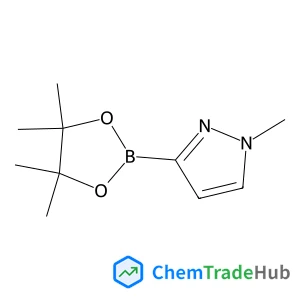
1-Methyl-3-(4,4,5,5-tetramethyl-1,3,2-dioxaborolan-2-yl)-1H-pyrazole
CAS号:
1020174-04-2
分子式:
C10H17BN2O2
推荐供应商





免责声明
本页面提供的学术期刊信息仅供参考和研究使用。我们与任何期刊出版商均无关联,也不处理投稿事宜。如有投稿相关咨询,请直接联系相关期刊出版商。
如发现页面信息有误,请发送邮件至 support@chemtradehub.com 联系我们。我们将及时核实并处理您的问题。