




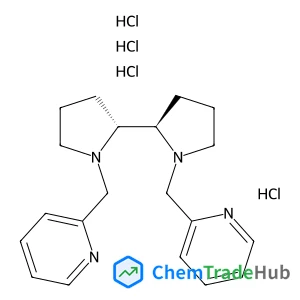
(2R,2'R)-1,1'-Bis(2-pyridinylmethyl)-2,2'-bipyrrolidine tetrahydrochloride
CAS号:
1228077-88-0
分子式:
C20H30Cl4N4
E. V. Albano
The phase behavior and structure of a symmetric binary polymer blend confined between two hard impenetrable walls is studied, assuming also short range forces between the monomers and the walls. Phenomenological considerations are elaborated with the self-consistent field theory of Gaussian chains, and also some Monte Carlo simulations of the bond-fluctuation model. In the case of “antisymmetric” walls (right wall attracts component A with the same strength as does left wall component B) the phase diagram is symmetric around volume fraction ϕ = 1/2. For very thin films (or very weak surface fields) one finds a single critical point at ϕc = 1/2, as in the bulk. For thicker films, or stronger surface fields, the phase diagram exhibits two critical points and two concomitant coexistence regions, down to a triple point Tt, while below the triple point there is a single coexistence region. When the film thickness D → ∞, the two coexistence regions for T>Tt shrink into the prewetting lines, while Tt approaches the wetting transition temperature. Asymmetric surface forces are also considered, studying the smooth crossover from “ antisymmetric walls” to “ symmetric walls” (that both attract the A component with the same strength). The resulting crossover between capillary-type behavior (i.e., a single critical point of the thin film) and the above behavior with two critical points is analyzed. Particular attention is paid to the behavior of interfaces between coexisting phases.
DOI: 10.1039/C7OB02628E
Stefan Matysiak, Klaus Hellmuth, Arun Shivalingam, Yavuz Ariyurek, Marco de Jong, Martine J. Hollestelle, Ruud Out, Tom Brown
DOI: 10.1039/C7OB02119D
Máté Kicsák, Attila Mándi, Szabolcs Varga, Mihály Herczeg, Gyula Batta, Attila Bényei, Anikó Borbás, Pál Herczegh
DOI: 10.1039/C7OB02296D
Dnyaneshwar B. Gophane, Burkhard Endeward, Thomas F. Prisner, Snorri Th. Sigurdsson
DOI: 10.1039/C7OB02870A
Lei Wang, Pascale Coric, Kexin Zhu, Wang-Qing Liu, Serge Bouaziz, Sylvain Broussy
DOI: 10.1039/C7OB02852K
Gemma Aragay, Guillem Peñuelas-Haro
DOI: 10.1039/D1QO00517K
Bhavani Shankar Chinta, Beeraiah Baire
DOI: 10.1039/C7OB02609A
Cheng Zhang, Shanliang Dong, Yang Zheng, Ciwang He, Jiaolong Chen, Jingsen Zhen, Lihua Qiu, Xinfang Xu
DOI: 10.1039/C7OB02802D
Amandine Xolin, Romain Losa, Aicha Kaid, Cédric Tresse, Stéphanie Norsikian
DOI: 10.1039/C7OB02792C
Ying Chou, Elena N. Kitova, Maju Joe, Richard Brunton, Todd L. Lowary, John S. Klassen, Ratmir Derda
DOI: 10.1039/C7OB02783D
随着环保要求的提高和安全意识的增强,该化合物的研究和应用趋势正逐渐转向更安全、更环境友好的替代品。市场关注点主要集中在开发新型合成方法和绿色化学路径,以减少有害...
处理含有2,9 - 二苯基 - 1,10 - 菲罗啉的废料时,应先将其收集在适当的容器中,避免与其他化学品混合。随后,可以通过水解或氧化等方法进行处理,直至达到...
处理(6-氯-吡嗪-3-基)-(4-乙基-哌嗪-1-基)-甲酮时,应穿戴适当的个人防护装备(PPE),包括手套、护目镜和实验室外套。在通风橱中操作以确保良好的通...
在处理(R)-2-氯-1-(2,4-二氯苯基)乙醇时,应佩戴防护眼镜、实验室外套和手套,确保通风橱开启以减少接触和吸入的风险。避免直接接触皮肤和眼睛。处理过程中...
可考虑使用类似结构的化合物作为替代品,如3-氯-6-(哌啶-1-基)吡嗪或3-氯-6-(2-氯哌啶-1-基)吡嗪,这些化合物在结构上与目标化合物相似,可能具有相...
该化合物可以通过乙酸乙酯与5-溴-1H-苯并三氮唑的反应合成,通常在无水条件下进行。合成过程中,需要使用适当的溶剂如乙酸乙酯,并在适当的温度下反应。该反应具有较...
一水硫酸镁是一种无机化合物,化学式为MgSO₄·H₂O,CAS号为14168-73-1。它由镁离子、硫酸根离子和一个结晶水分子组成,通常呈现为白色粉末或颗粒状固...
氘代-1,3-二氯-2-丙醇主要应用于医药和有机合成领域,作为研究化合物的氘代替代品,用于标记和追踪反应过程。此外,在聚合物和半导体生产中也有一定的应用潜力。
氰乙酸环己酯应储存在阴凉、干燥、通风良好的环境中,远离火源和热源,防止阳光直射。储存容器应密封良好,避免与空气接触,防止发生不必要的反应。
目前,2-碘-4-硝基苯胺在医药和农药领域有一定的研究和应用,尤其是在开发新型药物和农药产品方面。然而,由于其潜在的环境和健康风险,行业正趋向于寻找更为安全和环...

Physical Chemistry Chemical Physics (PCCP) is an international journal co-owned by 19 physical chemistry and physics societies from around the world. This journal publishes original, cutting-edge research in physical chemistry, chemical physics and biophysical chemistry. To be suitable for publication in PCCP, articles must include significant innovation and/or insight into physical chemistry; this is the most important criterion that reviewers and Editors will judge against when evaluating submissions. The journal has a broad scope and welcomes contributions spanning experiment, theory, computation and data science. Topical coverage includes spectroscopy, dynamics, kinetics, statistical mechanics, thermodynamics, electrochemistry, catalysis, surface science, quantum mechanics, quantum computing and machine learning. Interdisciplinary research areas such as polymers and soft matter, materials, nanoscience, energy, surfaces/interfaces, and biophysical chemistry are welcomed if they demonstrate significant innovation and/or insight into physical chemistry. Joined experimental/theoretical studies are particularly appreciated when complementary and based on up-to-date approaches.